Entity: 01KCJ4C11C7JQ1PVGDP1VNFTHB
PI
Version: 3 (current) | Updated: 12/15/2025, 11:09:17 PM | Created: 12/15/2025, 11:08:47 PM
OCR: Updated 1 refs
Files (1)
OCR Text
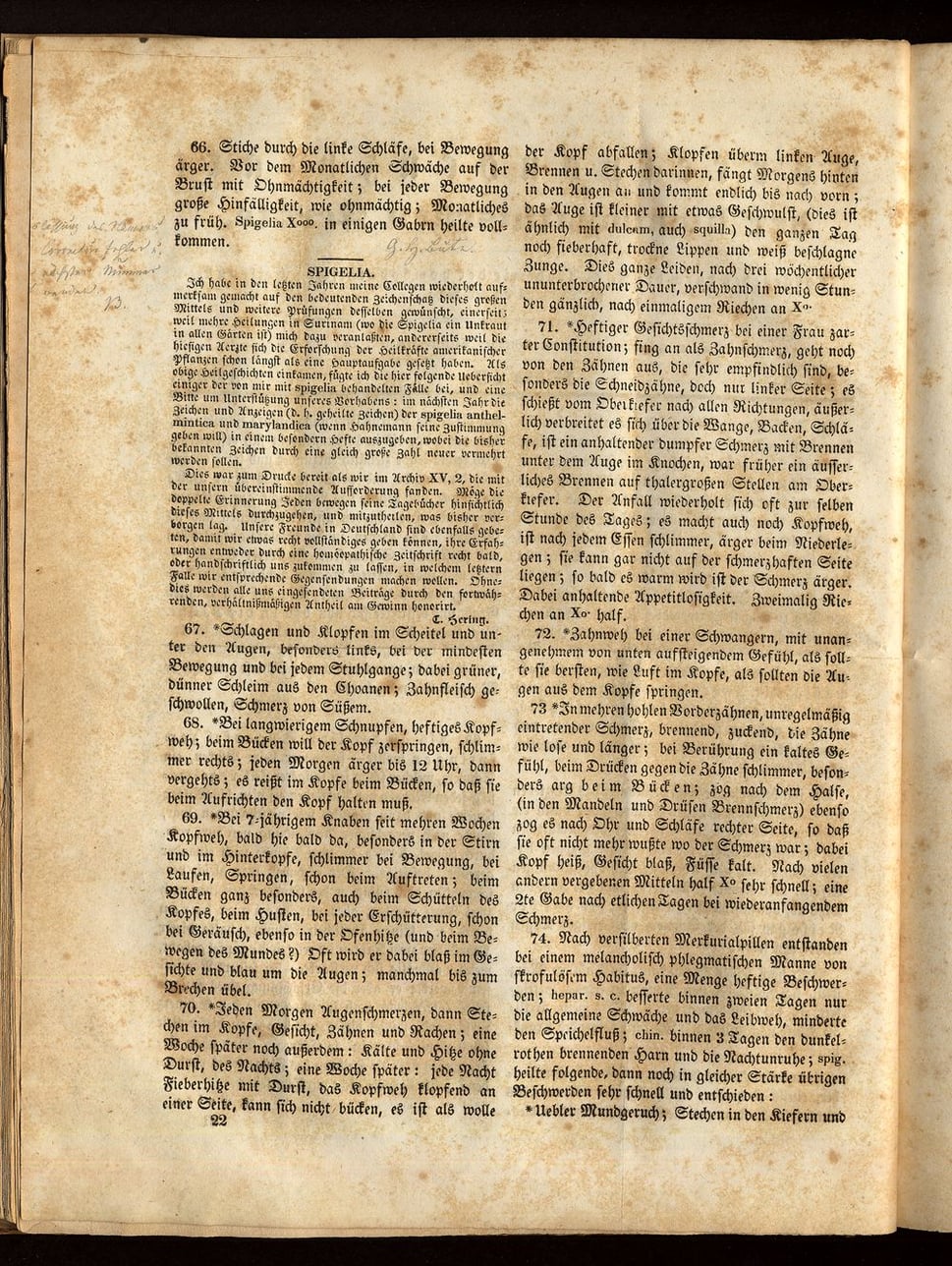
66. Stiche durch die linke Schlafse, bei Bewegung ärger. Vor dem Monatlichen Schwäche auf der Brust mit Ohnmachtigkeit; bei jeder Bewegung große Hinsfälligkeit, wie ohnmächtig; Monatliches zu früh. Spigelia Xoo. in einigen Gaben heilte vollkommen. SPIGELIA. Ich habe in den letzten Jahren meine Collegen wiederholt aufmerksam gemacht auf den bedeutenden Heilnachgang dieses großen Mittels und weitere Prüfungen desselben gewünscht, einerseits weil mehrere Heilungen in Surinam (wo die Spigelia ein Unkraut in allen Gärten ist) mich dazu veranlassten, andererseits weil die hiesigen Ärzte sich die Erforschung der Heilkraft amerikanischer Pflanzen schon längst als eine Hauptaufgabe gesetzt haben. Als obige Beistücksblätter entnomme fügte ich die hier folgende Uebersicht an, die von mir mit spiegelhaften behandelt hat bei, und eine Mittel zur Heilung unseres Weibesbens: im nächsten Jahr die Zeichen und Angaben (s. s. gehalte Zeiten) der spigelia anthelmintica und marylandica (wenn Zahlmengen seine Zustimmung geben will) in einem besonderen Hefte auszugeben, worin die bisher bekannten Zeichen durch eine gleich große Zahl neuer erneuert werden sollen. Dies war zum Dritte bereit als wir im Archiv XV. 2. die mit der unsern übereinstimmende Ausforderung fanden. Wege die doppelte Erinnerung jeden bewogen seine Tagebücher hinsichtlich dieses Mittels durchzugehen, und mitzuheissen, was bisher verborgen lag. Unsere Freunde in Deutschland sind ebenfalls gebeten, damit wir etwas recht vollständiges geben können, ihrer Erfahrung nach anderer durch eine heimwehreiche Zeitschrift recht bald, oder handschriftlich uns zukommen zu lassen, in welchem letzten Falle wir entsprechende Gegenbemerkungen machen wollen. Ohne dies werden alle uns eingefundenen Beiträge durch den fortwährenden, verschlankenden Anteil am Gewinn hineingehen. 67. *Schlagen und Klopfen im Scheitel und unter den Augen, besonders links, bei der mindesten Bewegung und bei jedem Stuhlgange; dabei grüner, dünner Schleim aus den Choanen; Zahnschleim geschwollen, Schmerz von Süssem. 68. *Bei langwierigem Schnupfen, heftiges Kopfschweh; beim Bücken will der Kopf zerspringen, schlummer rechts; jeden Morgen ärger bis 12 Uhr, dann vergeht's; es reißt im Kopfe beim Bücken, so daß sie beim Aufrichten den Kopf halten muß. 69. *Bei 7-jährigem Knaben seit mehreren Wochen Kopfschweh, bald hier bald da, besonders in der Stirn und im Hinterkopf, schlimmer bei Bewegung, bei Laufen, Springen, schon beim Auftreten; beim Bücken ganz besonders, auch beim Schütteln des Kopfes, beim Husten, bei jeder Erschütterung, schon bei Geräusch, ebenso in der Öffnisse (und beim Bewegen des Mundes?) Oft wird er dabei bläf im Gesichte und blau um die Augen; manchmal bis zum Brechen äbel. 70. *Jeden Morgen Augenschmerzen, dann Stechen im Kopfe, Gesicht, Zähnen und Nachen; eine Woche später noch ausserdem: Kälte und Hisse ohne Durst, des Nachts; eine Woche später: jede Nacht Fieberhöhe mit Durst, das Kopfschweh klopfend an einer Seite, kann sich nicht bücken, es ist als wolle der Kopf abfallen; Klopfen überm linken Auge, Bremmen u. Stechen darinnen, fängt Morgens hinten in den Augen an und kommt endlich bis nach vorn; das Auge ist kleiner mit etwas Geschwulst, (dies ist ähnlich mit dalem, auch squilla) den ganzen Tag noch sieberhaft, trockne Lippen und weiss beschlagene Zunge. Dies ganze Leiden, nach drei wöchentlicher ununterbrochener Dauer, verschwand in wenig Stunden ganzlich, nach einmaligem Riechen an Xo. 71. *Heftiger Gesichtsschmerz bei einer Frau zar- ter Constitution; fing an als Zahnschmerz, geht noch von den Zähnen aus, die sehr empfindlich sind, besonders die Schneidezähne, doch nur linker Seite; es schließt vom Oberkiefer nach allen Richtungen, äußerlich verbreitet es sich über die Wangen, Backen, Schlafse, ist ein anhaltender dumpfer Schmerz mit Brennen unter dem Auge im Knochen, war früher ein äußerliches Brennen auf thalergrössen Stellen am Oberkiefer. Der Anfall wiederholt sich oft zur selben Stunde des Tages; es macht auch noch Kopfschweh, ist nach jedem Essen schlummer, ärger beim Niederlegen; sie kann gar nicht auf der schmerzhaften Seite liegen; so bald es warm wird ist der Schmerz ärger. Dabei anhaltende Appetitlosigkeit. Zweimalig Riechen an Xo half. 72. *Zahnweh bei einer Schwangeren, mit unangenehm von unten aufsteigendem Gefühl, als sollte sie bersten, wie Luft im Kopfe, als sollten die Augen aus dem Kopfe springen. 73. *In mehreren hohlen Borderzähnen, unregelmäßig eintretender Schmerz, brennend, zuckend, die Zähne wie lose und länger; bei Berührung ein kaltes Gefühl, beim Drühen gegen die Zähne schlummer, besonders arg beim Bücken; zog nach dem Halse, (in den Mandeln und Drüsen Brennschmerz) ebenso zog es nach Ohr und Schlafse rechter Seite, so daß sie oft nicht mehr wusste wo der Schmerz war; dabei Kopf heiß, Gesicht blau, Füße kalt. Nach vielen andern vergebener Mitteln half Xo sehr schnell; eine Rte Gabe nach etlichen Tagen bei wiederansangendem Schmerz. 74. Nach versilberten Merkurialpillsen entstanden bei einem melancholisch phlegmatischen Manne von krofulössem Habitus, eine Menge heftige Beschwerden; hepär. s. c. besterte binnen zweien Tagen nur die allgemeine Schwäche und das Leibweh, minderte den Speichelfluß; chin. binnen 3 Tagen den dunkelrothen brennenden Harn und die Nachtunruhe; spig. heilte folgende, dann noch in gleicher Stärke übrigen Beschwerden sehr schnell und entschieden: *Uebler Mundgeruch; Stechen in den Kiefern und
Version History (3 versions)
- ✓ v3 (current) · 12/15/2025, 11:09:17 PM
"OCR: Updated 1 refs" - v2 · 12/15/2025, 11:08:47 PM · View this version
"Added to parent 01KCJ4C16JT3VAN1R7BMT832W5" - v1 · 12/15/2025, 11:08:47 PM · View this version
"Initial discovery snapshot"
Additional Components
book_05.txt
BOOK V


CALYPSO—ULYSSES REACHES SCHERIA ON A RAFT.


And now, as Dawn rose from her couch beside Tithonus—harbinger of light
alike to mortals and immortals—the gods met in council and with them,
Jove the lord of thunder, who is their king. Thereon Minerva began to
tell them of the many sufferings of Ulysses, for she pitied him away
there in the house of the nymph Calypso.

“Father Jove,” said she, “and all you other gods that live in
everlasting bliss, I hope there may never be such a thing as a kind and
well-disposed ruler any more, nor one who will govern equitably. I hope
they will be all henceforth cruel and unjust, for there is not one of
his subjects but has forgotten Ulysses, who ruled them as though he
were their father. There he is, lying in great pain in an island where
dwells the nymph Calypso, who will not let him go; and he cannot get
back to his own country, for he can find neither ships nor sailors to
take him over the sea. Furthermore, wicked people are now trying to
murder his only son Telemachus, who is coming home from Pylos and
Lacedaemon, where he has been to see if he can get news of his father.”

“What, my dear, are you talking about?” replied her father, “did you
not send him there yourself, because you thought it would help Ulysses
to get home and punish the suitors? Besides, you are perfectly able to
protect Telemachus, and to see him safely home again, while the suitors
have to come hurry-skurrying back without having killed him.”

When he had thus spoken, he said to his son Mercury, “Mercury, you are
our messenger, go therefore and tell Calypso we have decreed that poor
Ulysses is to return home. He is to be convoyed neither by gods nor
men, but after a perilous voyage of twenty days upon a raft he is to
reach fertile Scheria,50 the land of the Phaeacians, who are near of
kin to the gods, and will honour him as though he were one of
ourselves. They will send him in a ship to his own country, and will
give him more bronze and gold and raiment than he would have brought
back from Troy, if he had had all his prize money and had got home
without disaster. This is how we have settled that he shall return to
his country and his friends.”

Thus he spoke, and Mercury, guide and guardian, slayer of Argus, did as
he was told. Forthwith he bound on his glittering golden sandals with
which he could fly like the wind over land and sea. He took the wand
with which he seals men’s eyes in sleep or wakes them just as he
pleases, and flew holding it in his hand over Pieria; then he swooped
down through the firmament till he reached the level of the sea, whose
waves he skimmed like a cormorant that flies fishing every hole and
corner of the ocean, and drenching its thick plumage in the spray. He
flew and flew over many a weary wave, but when at last he got to the
island which was his journey’s end, he left the sea and went on by land
till he came to the cave where the nymph Calypso lived.

He found her at home. There was a large fire burning on the hearth, and
one could smell from far the fragrant reek of burning cedar and sandal
wood. As for herself, she was busy at her loom, shooting her golden
shuttle through the warp and singing beautifully. Round her cave there
was a thick wood of alder, poplar, and sweet smelling cypress trees,
wherein all kinds of great birds had built their nests—owls, hawks, and
chattering sea-crows that occupy their business in the waters. A vine
loaded with grapes was trained and grew luxuriantly about the mouth of
the cave; there were also four running rills of water in channels cut
pretty close together, and turned hither and thither so as to irrigate
the beds of violets and luscious herbage over which they flowed. 51
Even a god could not help being charmed with such a lovely spot, so
Mercury stood still and looked at it; but when he had admired it
sufficiently he went inside the cave.

Calypso knew him at once—for the gods all know each other, no matter
how far they live from one another—but Ulysses was not within; he was
on the sea-shore as usual, looking out upon the barren ocean with tears
in his eyes, groaning and breaking his heart for sorrow. Calypso gave
Mercury a seat and said: “Why have you come to see me,
Mercury—honoured, and ever welcome—for you do not visit me often? Say
what you want; I will do it for you at once if I can, and if it can be
done at all; but come inside, and let me set refreshment before you.”

As she spoke she drew a table loaded with ambrosia beside him and mixed
him some red nectar, so Mercury ate and drank till he had had enough,
and then said:

“We are speaking god and goddess to one another, and you ask me why I
have come here, and I will tell you truly as you would have me do. Jove
sent me; it was no doing of mine; who could possibly want to come all
this way over the sea where there are no cities full of people to offer
me sacrifices or choice hecatombs? Nevertheless I had to come, for none
of us other gods can cross Jove, nor transgress his orders. He says
that you have here the most ill-starred of all those who fought nine
years before the city of King Priam and sailed home in the tenth year
after having sacked it. On their way home they sinned against
Minerva,52 who raised both wind and waves against them, so that all his
brave companions perished, and he alone was carried hither by wind and
tide. Jove says that you are to let this man go at once, for it is
decreed that he shall not perish here, far from his own people, but
shall return to his house and country and see his friends again.”

Calypso trembled with rage when she heard this, “You gods,” she
exclaimed, “ought to be ashamed of yourselves. You are always jealous
and hate seeing a goddess take a fancy to a mortal man, and live with
him in open matrimony. So when rosy-fingered Dawn made love to Orion,
you precious gods were all of you furious till Diana went and killed
him in Ortygia. So again when Ceres fell in love with Iasion, and
yielded to him in a thrice-ploughed fallow field, Jove came to hear of
it before so very long and killed Iasion with his thunderbolts. And now
you are angry with me too because I have a man here. I found the poor
creature sitting all alone astride of a keel, for Jove had struck his
ship with lightning and sunk it in mid ocean, so that all his crew were
drowned, while he himself was driven by wind and waves on to my island.
I got fond of him and cherished him, and had set my heart on making him
immortal, so that he should never grow old all his days; still I cannot
cross Jove, nor bring his counsels to nothing; therefore, if he insists
upon it, let the man go beyond the seas again; but I cannot send him
anywhere myself for I have neither ships nor men who can take him.
Nevertheless I will readily give him such advice, in all good faith, as
will be likely to bring him safely to his own country.”

“Then send him away,” said Mercury, “or Jove will be angry with you and
punish you”.

On this he took his leave, and Calypso went out to look for Ulysses,
for she had heard Jove’s message. She found him sitting upon the beach
with his eyes ever filled with tears, and dying of sheer home sickness;
for he had got tired of Calypso, and though he was forced to sleep with
her in the cave by night, it was she, not he, that would have it so. As
for the day time, he spent it on the rocks and on the sea shore,
weeping, crying aloud for his despair, and always looking out upon the
sea. Calypso then went close up to him said:

“My poor fellow, you shall not stay here grieving and fretting your
life out any longer. I am going to send you away of my own free will;
so go, cut some beams of wood, and make yourself a large raft with an
upper deck that it may carry you safely over the sea. I will put bread,
wine, and water on board to save you from starving. I will also give
you clothes, and will send you a fair wind to take you home, if the
gods in heaven so will it—for they know more about these things, and
can settle them better than I can.”

Ulysses shuddered as he heard her. “Now goddess,” he answered, “there
is something behind all this; you cannot be really meaning to help me
home when you bid me do such a dreadful thing as put to sea on a raft.
Not even a well found ship with a fair wind could venture on such a
distant voyage: nothing that you can say or do shall make me go on
board a raft unless you first solemnly swear that you mean me no
mischief.”

Calypso smiled at this and caressed him with her hand: “You know a
great deal,” said she, “but you are quite wrong here. May heaven above
and earth below be my witnesses, with the waters of the river Styx—and
this is the most solemn oath which a blessed god can take—that I mean
you no sort of harm, and am only advising you to do exactly what I
should do myself in your place. I am dealing with you quite
straightforwardly; my heart is not made of iron, and I am very sorry
for you.”

When she had thus spoken she led the way rapidly before him, and
Ulysses followed in her steps; so the pair, goddess and man, went on
and on till they came to Calypso’s cave, where Ulysses took the seat
that Mercury had just left. Calypso set meat and drink before him of
the food that mortals eat; but her maids brought ambrosia and nectar
for herself, and they laid their hands on the good things that were
before them. When they had satisfied themselves with meat and drink,
Calypso spoke, saying:

“Ulysses, noble son of Laertes, so you would start home to your own
land at once? Good luck go with you, but if you could only know how
much suffering is in store for you before you get back to your own
country, you would stay where you are, keep house along with me, and
let me make you immortal, no matter how anxious you may be to see this
wife of yours, of whom you are thinking all the time day after day; yet
I flatter myself that I am no whit less tall or well-looking than she
is, for it is not to be expected that a mortal woman should compare in
beauty with an immortal.”

“Goddess,” replied Ulysses, “do not be angry with me about this. I am
quite aware that my wife Penelope is nothing like so tall or so
beautiful as yourself. She is only a woman, whereas you are an
immortal. Nevertheless, I want to get home, and can think of nothing
else. If some god wrecks me when I am on the sea, I will bear it and
make the best of it. I have had infinite trouble both by land and sea
already, so let this go with the rest.”

Presently the sun set and it became dark, whereon the pair retired into
the inner part of the cave and went to bed.

When the child of morning rosy-fingered Dawn appeared, Ulysses put on
his shirt and cloak, while the goddess wore a dress of a light gossamer
fabric, very fine and graceful, with a beautiful golden girdle about
her waist and a veil to cover her head. She at once set herself to
think how she could speed Ulysses on his way. So she gave him a great
bronze axe that suited his hands; it was sharpened on both sides, and
had a beautiful olive-wood handle fitted firmly on to it. She also gave
him a sharp adze, and then led the way to the far end of the island
where the largest trees grew—alder, poplar and pine, that reached the
sky—very dry and well seasoned, so as to sail light for him in the
water.53 Then, when she had shown him where the best trees grew,
Calypso went home, leaving him to cut them, which he soon finished
doing. He cut down twenty trees in all and adzed them smooth, squaring
them by rule in good workmanlike fashion. Meanwhile Calypso came back
with some augers, so he bored holes with them and fitted the timbers
together with bolts and rivets. He made the raft as broad as a skilled
shipwright makes the beam of a large vessel, and he fixed a deck on top
of the ribs, and ran a gunwale all round it. He also made a mast with a
yard arm, and a rudder to steer with. He fenced the raft all round with
wicker hurdles as a protection against the waves, and then he threw on
a quantity of wood. By and by Calypso brought him some linen to make
the sails, and he made these too, excellently, making them fast with
braces and sheets. Last of all, with the help of levers, he drew the
raft down into the water.

In four days he had completed the whole work, and on the fifth Calypso
sent him from the island after washing him and giving him some clean
clothes. She gave him a goat skin full of black wine, and another
larger one of water; she also gave him a wallet full of provisions, and
found him in much good meat. Moreover, she made the wind fair and warm
for him, and gladly did Ulysses spread his sail before it, while he sat
and guided the raft skilfully by means of the rudder. He never closed
his eyes, but kept them fixed on the Pleiads, on late-setting Bootes,
and on the Bear—which men also call the wain, and which turns round and
round where it is, facing Orion, and alone never dipping into the
stream of Oceanus—for Calypso had told him to keep this to his left.
Days seven and ten did he sail over the sea, and on the eighteenth the
dim outlines of the mountains on the nearest part of the Phaeacian
coast appeared, rising like a shield on the horizon.

But King Neptune, who was returning from the Ethiopians, caught sight
of Ulysses a long way off, from the mountains of the Solymi. He could
see him sailing upon the sea, and it made him very angry, so he wagged
his head and muttered to himself, saying, “Good heavens, so the gods
have been changing their minds about Ulysses while I was away in
Ethiopia, and now he is close to the land of the Phaeacians, where it
is decreed that he shall escape from the calamities that have befallen
him. Still, he shall have plenty of hardship yet before he has done
with it.”

Thereon he gathered his clouds together, grasped his trident, stirred
it round in the sea, and roused the rage of every wind that blows till
earth, sea, and sky were hidden in cloud, and night sprang forth out of
the heavens. Winds from East, South, North, and West fell upon him all
at the same time, and a tremendous sea got up, so that Ulysses’ heart
began to fail him. “Alas,” he said to himself in his dismay, “what ever
will become of me? I am afraid Calypso was right when she said I should
have trouble by sea before I got back home. It is all coming true. How
black is Jove making heaven with his clouds, and what a sea the winds
are raising from every quarter at once. I am now safe to perish. Blest
and thrice blest were those Danaans who fell before Troy in the cause
of the sons of Atreus. Would that I had been killed on the day when the
Trojans were pressing me so sorely about the dead body of Achilles, for
then I should have had due burial and the Achaeans would have honoured
my name; but now it seems that I shall come to a most pitiable end.”

As he spoke a sea broke over him with such terrific fury that the raft
reeled again, and he was carried overboard a long way off. He let go
the helm, and the force of the hurricane was so great that it broke the
mast half way up, and both sail and yard went over into the sea. For a
long time Ulysses was under water, and it was all he could do to rise
to the surface again, for the clothes Calypso had given him weighed him
down; but at last he got his head above water and spat out the bitter
brine that was running down his face in streams. In spite of all this,
however, he did not lose sight of his raft, but swam as fast as he
could towards it, got hold of it, and climbed on board again so as to
escape drowning. The sea took the raft and tossed it about as Autumn
winds whirl thistledown round and round upon a road. It was as though
the South, North, East, and West winds were all playing battledore and
shuttlecock with it at once.

When he was in this plight, Ino daughter of Cadmus, also called
Leucothea, saw him. She had formerly been a mere mortal, but had been
since raised to the rank of a marine goddess. Seeing in what great
distress Ulysses now was, she had compassion upon him, and, rising like
a sea-gull from the waves, took her seat upon the raft.

“My poor good man,” said she, “why is Neptune so furiously angry with
you? He is giving you a great deal of trouble, but for all his bluster
he will not kill you. You seem to be a sensible person, do then as I
bid you; strip, leave your raft to drive before the wind, and swim to
the Phaeacian coast where better luck awaits you. And here, take my
veil and put it round your chest; it is enchanted, and you can come to
no harm so long as you wear it. As soon as you touch land take it off,
throw it back as far as you can into the sea, and then go away again.”
With these words she took off her veil and gave it him. Then she dived
down again like a sea-gull and vanished beneath the dark blue waters.

But Ulysses did not know what to think. “Alas,” he said to himself in
his dismay, “this is only some one or other of the gods who is luring
me to ruin by advising me to quit my raft. At any rate I will not do so
at present, for the land where she said I should be quit of all
troubles seemed to be still a good way off. I know what I will do—I am
sure it will be best—no matter what happens I will stick to the raft as
long as her timbers hold together, but when the sea breaks her up I
will swim for it; I do not see how I can do any better than this.”

While he was thus in two minds, Neptune sent a terrible great wave that
seemed to rear itself above his head till it broke right over the raft,
which then went to pieces as though it were a heap of dry chaff tossed
about by a whirlwind. Ulysses got astride of one plank and rode upon it
as if he were on horseback; he then took off the clothes Calypso had
given him, bound Ino’s veil under his arms, and plunged into the
sea—meaning to swim on shore. King Neptune watched him as he did so,
and wagged his head, muttering to himself and saying, “There now, swim
up and down as you best can till you fall in with well-to-do people. I
do not think you will be able to say that I have let you off too
lightly.” On this he lashed his horses and drove to Aegae where his
palace is.

But Minerva resolved to help Ulysses, so she bound the ways of all the
winds except one, and made them lie quite still; but she roused a good
stiff breeze from the North that should lay the waters till Ulysses
reached the land of the Phaeacians where he would be safe.

Thereon he floated about for two nights and two days in the water, with
a heavy swell on the sea and death staring him in the face; but when
the third day broke, the wind fell and there was a dead calm without so
much as a breath of air stirring. As he rose on the swell he looked
eagerly ahead, and could see land quite near. Then, as children rejoice
when their dear father begins to get better after having for a long
time borne sore affliction sent him by some angry spirit, but the gods
deliver him from evil, so was Ulysses thankful when he again saw land
and trees, and swam on with all his strength that he might once more
set foot upon dry ground. When, however, he got within earshot, he
began to hear the surf thundering up against the rocks, for the swell
still broke against them with a terrific roar. Everything was enveloped
in spray; there were no harbours where a ship might ride, nor shelter
of any kind, but only headlands, low-lying rocks, and mountain tops.

Ulysses’ heart now began to fail him, and he said despairingly to
himself, “Alas, Jove has let me see land after swimming so far that I
had given up all hope, but I can find no landing place, for the coast
is rocky and surf-beaten, the rocks are smooth and rise sheer from the
sea, with deep water close under them so that I cannot climb out for
want of foot hold. I am afraid some great wave will lift me off my legs
and dash me against the rocks as I leave the water—which would give me
a sorry landing. If, on the other hand, I swim further in search of
some shelving beach or harbour, a hurricane may carry me out to sea
again sorely against my will, or heaven may send some great monster of
the deep to attack me; for Amphitrite breeds many such, and I know that
Neptune is very angry with me.”

While he was thus in two minds a wave caught him and took him with such
force against the rocks that he would have been smashed and torn to
pieces if Minerva had not shown him what to do. He caught hold of the
rock with both hands and clung to it groaning with pain till the wave
retired, so he was saved that time; but presently the wave came on
again and carried him back with it far into the sea—tearing his hands
as the suckers of a polypus are torn when some one plucks it from its
bed, and the stones come up along with it—even so did the rocks tear
the skin from his strong hands, and then the wave drew him deep down
under the water.

Here poor Ulysses would have certainly perished even in spite of his
own destiny, if Minerva had not helped him to keep his wits about him.
He swam seaward again, beyond reach of the surf that was beating
against the land, and at the same time he kept looking towards the
shore to see if he could find some haven, or a spit that should take
the waves aslant. By and by, as he swam on, he came to the mouth of a
river, and here he thought would be the best place, for there were no
rocks, and it afforded shelter from the wind. He felt that there was a
current, so he prayed inwardly and said:

“Hear me, O King, whoever you may be, and save me from the anger of the
sea-god Neptune, for I approach you prayerfully. Any one who has lost
his way has at all times a claim even upon the gods, wherefore in my
distress I draw near to your stream, and cling to the knees of your
riverhood. Have mercy upon me, O king, for I declare myself your
suppliant.”

Then the god staid his stream and stilled the waves, making all calm
before him, and bringing him safely into the mouth of the river. Here
at last Ulysses’ knees and strong hands failed him, for the sea had
completely broken him. His body was all swollen, and his mouth and
nostrils ran down like a river with sea-water, so that he could neither
breathe nor speak, and lay swooning from sheer exhaustion; presently,
when he had got his breath and came to himself again, he took off the
scarf that Ino had given him and threw it back into the salt54 stream
of the river, whereon Ino received it into her hands from the wave that
bore it towards her. Then he left the river, laid himself down among
the rushes, and kissed the bounteous earth.

“Alas,” he cried to himself in his dismay, “what ever will become of
me, and how is it all to end? If I stay here upon the river bed through
the long watches of the night, I am so exhausted that the bitter cold
and damp may make an end of me—for towards sunrise there will be a keen
wind blowing from off the river. If, on the other hand, I climb the
hill side, find shelter in the woods, and sleep in some thicket, I may
escape the cold and have a good night’s rest, but some savage beast may
take advantage of me and devour me.”

In the end he deemed it best to take to the woods, and he found one
upon some high ground not far from the water. There he crept beneath
two shoots of olive that grew from a single stock—the one an ungrafted
sucker, while the other had been grafted. No wind, however squally,
could break through the cover they afforded, nor could the sun’s rays
pierce them, nor the rain get through them, so closely did they grow
into one another. Ulysses crept under these and began to make himself a
bed to lie on, for there was a great litter of dead leaves lying
about—enough to make a covering for two or three men even in hard
winter weather. He was glad enough to see this, so he laid himself down
and heaped the leaves all round him. Then, as one who lives alone in
the country, far from any neighbor, hides a brand as fire-seed in the
ashes to save himself from having to get a light elsewhere, even so did
Ulysses cover himself up with leaves; and Minerva shed a sweet sleep
upon his eyes, closed his eyelids, and made him lose all memories of
his sorrows.
book_06.txt
BOOK VI


THE MEETING BETWEEN NAUSICAA AND ULYSSES.


So here Ulysses slept, overcome by sleep and toil; but Minerva went off
to the country and city of the Phaeacians—a people who used to live in
the fair town of Hypereia, near the lawless Cyclopes. Now the Cyclopes
were stronger than they and plundered them, so their king Nausithous
moved them thence and settled them in Scheria, far from all other
people. He surrounded the city with a wall, built houses and temples,
and divided the lands among his people; but he was dead and gone to the
house of Hades, and King Alcinous, whose counsels were inspired of
heaven, was now reigning. To his house, then, did Minerva hie in
furtherance of the return of Ulysses.

She went straight to the beautifully decorated bedroom in which there
slept a girl who was as lovely as a goddess, Nausicaa, daughter to King
Alcinous. Two maid servants were sleeping near her, both very pretty,
one on either side of the doorway, which was closed with well made
folding doors. Minerva took the form of the famous sea captain Dymas’s
daughter, who was a bosom friend of Nausicaa and just her own age;
then, coming up to the girl’s bedside like a breath of wind, she
hovered over her head and said:

“Nausicaa, what can your mother have been about, to have such a lazy
daughter? Here are your clothes all lying in disorder, yet you are
going to be married almost immediately, and should not only be well
dressed yourself, but should find good clothes for those who attend
you. This is the way to get yourself a good name, and to make your
father and mother proud of you. Suppose, then, that we make tomorrow a
washing day, and start at daybreak. I will come and help you so that
you may have everything ready as soon as possible, for all the best
young men among your own people are courting you, and you are not going
to remain a maid much longer. Ask your father, therefore, to have a
waggon and mules ready for us at daybreak, to take the rugs, robes, and
girdles, and you can ride, too, which will be much pleasanter for you
than walking, for the washing-cisterns are some way from the town.”

When she had said this Minerva went away to Olympus, which they say is
the everlasting home of the gods. Here no wind beats roughly, and
neither rain nor snow can fall; but it abides in everlasting sunshine
and in a great peacefulness of light, wherein the blessed gods are
illumined for ever and ever. This was the place to which the goddess
went when she had given instructions to the girl.

By and by morning came and woke Nausicaa, who began wondering about her
dream; she therefore went to the other end of the house to tell her
father and mother all about it, and found them in their own room. Her
mother was sitting by the fireside spinning her purple yarn with her
maids around her, and she happened to catch her father just as he was
going out to attend a meeting of the town council, which the Phaeacian
aldermen had convened. She stopped him and said:

“Papa dear, could you manage to let me have a good big waggon? I want
to take all our dirty clothes to the river and wash them. You are the
chief man here, so it is only right that you should have a clean shirt
when you attend meetings of the council. Moreover, you have five sons
at home, two of them married, while the other three are good looking
bachelors; you know they always like to have clean linen when they go
to a dance, and I have been thinking about all this.”

She did not say a word about her own wedding, for she did not like to,
but her father knew and said, “You shall have the mules, my love, and
whatever else you have a mind for. Be off with you, and the men shall
get you a good strong waggon with a body to it that will hold all your
clothes.”

On this he gave his orders to the servants, who got the waggon out,
harnessed the mules, and put them to, while the girl brought the
clothes down from the linen room and placed them on the waggon. Her
mother prepared her a basket of provisions with all sorts of good
things, and a goat skin full of wine; the girl now got into the waggon,
and her mother gave her also a golden cruse of oil, that she and her
women might anoint themselves. Then she took the whip and reins and
lashed the mules on, whereon they set off, and their hoofs clattered on
the road. They pulled without flagging, and carried not only Nausicaa
and her wash of clothes, but the maids also who were with her.

When they reached the water side they went to the washing cisterns,
through which there ran at all times enough pure water to wash any
quantity of linen, no matter how dirty. Here they unharnessed the mules
and turned them out to feed on the sweet juicy herbage that grew by the
water side. They took the clothes out of the waggon, put them in the
water, and vied with one another in treading them in the pits to get
the dirt out. After they had washed them and got them quite clean, they
laid them out by the sea side, where the waves had raised a high beach
of shingle, and set about washing themselves and anointing themselves
with olive oil. Then they got their dinner by the side of the stream,
and waited for the sun to finish drying the clothes. When they had done
dinner they threw off the veils that covered their heads and began to
play at ball, while Nausicaa sang for them. As the huntress Diana goes
forth upon the mountains of Taygetus or Erymanthus to hunt wild boars
or deer, and the wood nymphs, daughters of Aegis-bearing Jove, take
their sport along with her (then is Leto proud at seeing her daughter
stand a full head taller than the others, and eclipse the loveliest
amid a whole bevy of beauties), even so did the girl outshine her
handmaids.

When it was time for them to start home, and they were folding the
clothes and putting them into the waggon, Minerva began to consider how
Ulysses should wake up and see the handsome girl who was to conduct him
to the city of the Phaeacians. The girl, therefore, threw a ball at one
of the maids, which missed her and fell into deep water. On this they
all shouted, and the noise they made woke Ulysses, who sat up in his
bed of leaves and began to wonder what it might all be.

“Alas,” said he to himself, “what kind of people have I come amongst?
Are they cruel, savage, and uncivilised, or hospitable and humane? I
seem to hear the voices of young women, and they sound like those of
the nymphs that haunt mountain tops, or springs of rivers and meadows
of green grass. At any rate I am among a race of men and women. Let me
try if I cannot manage to get a look at them.”

As he said this he crept from under his bush, and broke off a bough
covered with thick leaves to hide his nakedness. He looked like some
lion of the wilderness that stalks about exulting in his strength and
defying both wind and rain; his eyes glare as he prowls in quest of
oxen, sheep, or deer, for he is famished, and will dare break even into
a well fenced homestead, trying to get at the sheep—even such did
Ulysses seem to the young women, as he drew near to them all naked as
he was, for he was in great want. On seeing one so unkempt and so
begrimed with salt water, the others scampered off along the spits that
jutted out into the sea, but the daughter of Alcinous stood firm, for
Minerva put courage into her heart and took away all fear from her. She
stood right in front of Ulysses, and he doubted whether he should go up
to her, throw himself at her feet, and embrace her knees as a
suppliant, or stay where he was and entreat her to give him some
clothes and show him the way to the town. In the end he deemed it best
to entreat her from a distance in case the girl should take offence at
his coming near enough to clasp her knees, so he addressed her in
honeyed and persuasive language.

“O queen,” he said, “I implore your aid—but tell me, are you a goddess
or are you a mortal woman? If you are a goddess and dwell in heaven, I
can only conjecture that you are Jove’s daughter Diana, for your face
and figure resemble none but hers; if on the other hand you are a
mortal and live on earth, thrice happy are your father and
mother—thrice happy, too, are your brothers and sisters; how proud and
delighted they must feel when they see so fair a scion as yourself
going out to a dance; most happy, however, of all will he be whose
wedding gifts have been the richest, and who takes you to his own home.
I never yet saw any one so beautiful, neither man nor woman, and am
lost in admiration as I behold you. I can only compare you to a young
palm tree which I saw when I was at Delos growing near the altar of
Apollo—for I was there, too, with much people after me, when I was on
that journey which has been the source of all my troubles. Never yet
did such a young plant shoot out of the ground as that was, and I
admired and wondered at it exactly as I now admire and wonder at
yourself. I dare not clasp your knees, but I am in great distress;
yesterday made the twentieth day that I had been tossing about upon the
sea. The winds and waves have taken me all the way from the Ogygian
island,55 and now fate has flung me upon this coast that I may endure
still further suffering; for I do not think that I have yet come to the
end of it, but rather that heaven has still much evil in store for me.

“And now, O queen, have pity upon me, for you are the first person I
have met, and I know no one else in this country. Show me the way to
your town, and let me have anything that you may have brought hither to
wrap your clothes in. May heaven grant you in all things your heart’s
desire—husband, house, and a happy, peaceful home; for there is nothing
better in this world than that man and wife should be of one mind in a
house. It discomfits their enemies, makes the hearts of their friends
glad, and they themselves know more about it than any one.”

To this Nausicaa answered, “Stranger, you appear to be a sensible,
well-disposed person. There is no accounting for luck; Jove gives
prosperity to rich and poor just as he chooses, so you must take what
he has seen fit to send you, and make the best of it. Now, however,
that you have come to this our country, you shall not want for clothes
nor for anything else that a foreigner in distress may reasonably look
for. I will show you the way to the town, and will tell you the name of
our people; we are called Phaeacians, and I am daughter to Alcinous, in
whom the whole power of the state is vested.”

Then she called her maids and said, “Stay where you are, you girls. Can
you not see a man without running away from him? Do you take him for a
robber or a murderer? Neither he nor any one else can come here to do
us Phaeacians any harm, for we are dear to the gods, and live apart on
a land’s end that juts into the sounding sea, and have nothing to do
with any other people. This is only some poor man who has lost his way,
and we must be kind to him, for strangers and foreigners in distress
are under Jove’s protection, and will take what they can get and be
thankful; so, girls, give the poor fellow something to eat and drink,
and wash him in the stream at some place that is sheltered from the
wind.”

On this the maids left off running away and began calling one another
back. They made Ulysses sit down in the shelter as Nausicaa had told
them, and brought him a shirt and cloak. They also brought him the
little golden cruse of oil, and told him to go and wash in the stream.
But Ulysses said, “Young women, please to stand a little on one side
that I may wash the brine from my shoulders and anoint myself with oil,
for it is long enough since my skin has had a drop of oil upon it. I
cannot wash as long as you all keep standing there. I am ashamed to
strip56 before a number of good looking young women.”

Then they stood on one side and went to tell the girl, while Ulysses
washed himself in the stream and scrubbed the brine from his back and
from his broad shoulders. When he had thoroughly washed himself, and
had got the brine out of his hair, he anointed himself with oil, and
put on the clothes which the girl had given him; Minerva then made him
look taller and stronger than before, she also made the hair grow thick
on the top of his head, and flow down in curls like hyacinth blossoms;
she glorified him about the head and shoulders as a skilful workman who
has studied art of all kinds under Vulcan and Minerva enriches a piece
of silver plate by gilding it—and his work is full of beauty. Then he
went and sat down a little way off upon the beach, looking quite young
and handsome, and the girl gazed on him with admiration; then she said
to her maids:

“Hush, my dears, for I want to say something. I believe the gods who
live in heaven have sent this man to the Phaeacians. When I first saw
him I thought him plain, but now his appearance is like that of the
gods who dwell in heaven. I should like my future husband to be just
such another as he is, if he would only stay here and not want to go
away. However, give him something to eat and drink.”

They did as they were told, and set food before Ulysses, who ate and
drank ravenously, for it was long since he had had food of any kind.
Meanwhile, Nausicaa bethought her of another matter. She got the linen
folded and placed in the waggon, she then yoked the mules, and, as she
took her seat, she called Ulysses:

“Stranger,” said she, “rise and let us be going back to the town; I
will introduce you at the house of my excellent father, where I can
tell you that you will meet all the best people among the Phaeacians.
But be sure and do as I bid you, for you seem to be a sensible person.
As long as we are going past the fields and farm lands, follow briskly
behind the waggon along with the maids and I will lead the way myself.
Presently, however, we shall come to the town, where you will find a
high wall running all round it, and a good harbour on either side with
a narrow entrance into the city, and the ships will be drawn up by the
road side, for every one has a place where his own ship can lie. You
will see the market place with a temple of Neptune in the middle of it,
and paved with large stones bedded in the earth. Here people deal in
ship’s gear of all kinds, such as cables and sails, and here, too, are
the places where oars are made, for the Phaeacians are not a nation of
archers; they know nothing about bows and arrows, but are a sea-faring
folk, and pride themselves on their masts, oars, and ships, with which
they travel far over the sea.

“I am afraid of the gossip and scandal that may be set on foot against
me later on; for the people here are very ill-natured, and some low
fellow, if he met us, might say, ‘Who is this fine-looking stranger
that is going about with Nausicaa? Where did she find him? I suppose
she is going to marry him. Perhaps he is a vagabond sailor whom she has
taken from some foreign vessel, for we have no neighbours; or some god
has at last come down from heaven in answer to her prayers, and she is
going to live with him all the rest of her life. It would be a good
thing if she would take herself off and find a husband somewhere else,
for she will not look at one of the many excellent young Phaeacians who
are in love with her.’ This is the kind of disparaging remark that
would be made about me, and I could not complain, for I should myself
be scandalised at seeing any other girl do the like, and go about with
men in spite of everybody, while her father and mother were still
alive, and without having been married in the face of all the world.

“If, therefore, you want my father to give you an escort and to help
you home, do as I bid you; you will see a beautiful grove of poplars by
the road side dedicated to Minerva; it has a well in it and a meadow
all round it. Here my father has a field of rich garden ground, about
as far from the town as a man’s voice will carry. Sit down there and
wait for a while till the rest of us can get into the town and reach my
father’s house. Then, when you think we must have done this, come into
the town and ask the way to the house of my father Alcinous. You will
have no difficulty in finding it; any child will point it out to you,
for no one else in the whole town has anything like such a fine house
as he has. When you have got past the gates and through the outer
court, go right across the inner court till you come to my mother. You
will find her sitting by the fire and spinning her purple wool by
firelight. It is a fine sight to see her as she leans back against one
of the bearing-posts with her maids all ranged behind her. Close to her
seat stands that of my father, on which he sits and topes like an
immortal god. Never mind him, but go up to my mother, and lay your
hands upon her knees if you would get home quickly. If you can gain her
over, you may hope to see your own country again, no matter how distant
it may be.”

So saying she lashed the mules with her whip and they left the river.
The mules drew well, and their hoofs went up and down upon the road.
She was careful not to go too fast for Ulysses and the maids who were
following on foot along with the waggon, so she plied her whip with
judgement. As the sun was going down they came to the sacred grove of
Minerva, and there Ulysses sat down and prayed to the mighty daughter
of Jove.

“Hear me,” he cried, “daughter of Aegis-bearing Jove, unweariable, hear
me now, for you gave no heed to my prayers when Neptune was wrecking
me. Now, therefore, have pity upon me and grant that I may find friends
and be hospitably received by the Phaeacians.”

Thus did he pray, and Minerva heard his prayer, but she would not show
herself to him openly, for she was afraid of her uncle Neptune, who was
still furious in his endeavors to prevent Ulysses from getting home.
book_07.txt
BOOK VII


RECEPTION OF ULYSSES AT THE PALACE OF KING ALCINOUS.


Thus, then, did Ulysses wait and pray; but the girl drove on to the
town. When she reached her father’s house she drew up at the gateway,
and her brothers—comely as the gods—gathered round her, took the mules
out of the waggon, and carried the clothes into the house, while she
went to her own room, where an old servant, Eurymedusa of Apeira, lit
the fire for her. This old woman had been brought by sea from Apeira,
and had been chosen as a prize for Alcinous because he was king over
the Phaeacians, and the people obeyed him as though he were a god.57
She had been nurse to Nausicaa, and had now lit the fire for her, and
brought her supper for her into her own room.

Presently Ulysses got up to go towards the town; and Minerva shed a
thick mist all round him to hide him in case any of the proud
Phaeacians who met him should be rude to him, or ask him who he was.
Then, as he was just entering the town, she came towards him in the
likeness of a little girl carrying a pitcher. She stood right in front
of him, and Ulysses said:

“My dear, will you be so kind as to show me the house of king Alcinous?
I am an unfortunate foreigner in distress, and do not know one in your
town and country.”

Then Minerva said, “Yes, father stranger, I will show you the house you
want, for Alcinous lives quite close to my own father. I will go before
you and show the way, but say not a word as you go, and do not look at
any man, nor ask him questions; for the people here cannot abide
strangers, and do not like men who come from some other place. They are
a sea-faring folk, and sail the seas by the grace of Neptune in ships
that glide along like thought, or as a bird in the air.”

On this she led the way, and Ulysses followed in her steps; but not one
of the Phaeacians could see him as he passed through the city in the
midst of them; for the great goddess Minerva in her good will towards
him had hidden him in a thick cloud of darkness. He admired their
harbours, ships, places of assembly, and the lofty walls of the city,
which, with the palisade on top of them, were very striking, and when
they reached the king’s house Minerva said:

“This is the house, father stranger, which you would have me show you.
You will find a number of great people sitting at table, but do not be
afraid; go straight in, for the bolder a man is the more likely he is
to carry his point, even though he is a stranger. First find the queen.
Her name is Arete, and she comes of the same family as her husband
Alcinous. They both descend originally from Neptune, who was father to
Nausithous by Periboea, a woman of great beauty. Periboea was the
youngest daughter of Eurymedon, who at one time reigned over the
giants, but he ruined his ill-fated people and lost his own life to
boot.

“Neptune, however, lay with his daughter, and she had a son by him, the
great Nausithous, who reigned over the Phaeacians. Nausithous had two
sons Rhexenor and Alcinous;58 Apollo killed the first of them while he
was still a bridegroom and without male issue; but he left a daughter
Arete, whom Alcinous married, and honours as no other woman is honoured
of all those that keep house along with their husbands.

“Thus she both was, and still is, respected beyond measure by her
children, by Alcinous himself, and by the whole people, who look upon
her as a goddess, and greet her whenever she goes about the city, for
she is a thoroughly good woman both in head and heart, and when any
women are friends of hers, she will help their husbands also to settle
their disputes. If you can gain her good will, you may have every hope
of seeing your friends again, and getting safely back to your home and
country.”

Then Minerva left Scheria and went away over the sea. She went to
Marathon59 and to the spacious streets of Athens, where she entered the
abode of Erechtheus; but Ulysses went on to the house of Alcinous, and
he pondered much as he paused a while before reaching the threshold of
bronze, for the splendour of the palace was like that of the sun or
moon. The walls on either side were of bronze from end to end, and the
cornice was of blue enamel. The doors were gold, and hung on pillars of
silver that rose from a floor of bronze, while the lintel was silver
and the hook of the door was of gold.

On either side there stood gold and silver mastiffs which Vulcan, with
his consummate skill, had fashioned expressly to keep watch over the
palace of king Alcinous; so they were immortal and could never grow
old. Seats were ranged all along the wall, here and there from one end
to the other, with coverings of fine woven work which the women of the
house had made. Here the chief persons of the Phaeacians used to sit
and eat and drink, for there was abundance at all seasons; and there
were golden figures of young men with lighted torches in their hands,
raised on pedestals, to give light by night to those who were at table.
There are60 fifty maid servants in the house, some of whom are always
grinding rich yellow grain at the mill, while others work at the loom,
or sit and spin, and their shuttles go backwards and forwards like the
fluttering of aspen leaves, while the linen is so closely woven that it
will turn oil. As the Phaeacians are the best sailors in the world, so
their women excel all others in weaving, for Minerva has taught them
all manner of useful arts, and they are very intelligent.

Outside the gate of the outer court there is a large garden of about
four acres with a wall all round it. It is full of beautiful
trees—pears, pomegranates, and the most delicious apples. There are
luscious figs also, and olives in full growth. The fruits never rot nor
fail all the year round, neither winter nor summer, for the air is so
soft that a new crop ripens before the old has dropped. Pear grows on
pear, apple on apple, and fig on fig, and so also with the grapes, for
there is an excellent vineyard: on the level ground of a part of this,
the grapes are being made into raisins; in another part they are being
gathered; some are being trodden in the wine tubs, others further on
have shed their blossom and are beginning to show fruit, others again
are just changing colour. In the furthest part of the ground there are
beautifully arranged beds of flowers that are in bloom all the year
round. Two streams go through it, the one turned in ducts throughout
the whole garden, while the other is carried under the ground of the
outer court to the house itself, and the town’s people draw water from
it. Such, then, were the splendours with which the gods had endowed the
house of king Alcinous.

So here Ulysses stood for a while and looked about him, but when he had
looked long enough he crossed the threshold and went within the
precincts of the house. There he found all the chief people among the
Phaeacians making their drink offerings to Mercury, which they always
did the last thing before going away for the night.61 He went straight
through the court, still hidden by the cloak of darkness in which
Minerva had enveloped him, till he reached Arete and King Alcinous;
then he laid his hands upon the knees of the queen, and at that moment
the miraculous darkness fell away from him and he became visible. Every
one was speechless with surprise at seeing a man there, but Ulysses
began at once with his petition.

“Queen Arete,” he exclaimed, “daughter of great Rhexenor, in my
distress I humbly pray you, as also your husband and these your guests
(whom may heaven prosper with long life and happiness, and may they
leave their possessions to their children, and all the honours
conferred upon them by the state) to help me home to my own country as
soon as possible; for I have been long in trouble and away from my
friends.”

Then he sat down on the hearth among the ashes and they all held their
peace, till presently the old hero Echeneus, who was an excellent
speaker and an elder among the Phaeacians, plainly and in all honesty
addressed them thus:

“Alcinous,” said he, “it is not creditable to you that a stranger
should be seen sitting among the ashes of your hearth; every one is
waiting to hear what you are about to say; tell him, then, to rise and
take a seat on a stool inlaid with silver, and bid your servants mix
some wine and water that we may make a drink offering to Jove the lord
of thunder, who takes all well disposed suppliants under his
protection; and let the housekeeper give him some supper, of whatever
there may be in the house.”

When Alcinous heard this he took Ulysses by the hand, raised him from
the hearth, and bade him take the seat of Laodamas, who had been
sitting beside him, and was his favourite son. A maid servant then
brought him water in a beautiful golden ewer and poured it into a
silver basin for him to wash his hands, and she drew a clean table
beside him; an upper servant brought him bread and offered him many
good things of what there was in the house, and Ulysses ate and drank.
Then Alcinous said to one of the servants, “Pontonous, mix a cup of
wine and hand it round that we may make drink-offerings to Jove the
lord of thunder, who is the protector of all well-disposed suppliants.”

Pontonous then mixed wine and water, and handed it round after giving
every man his drink-offering. When they had made their offerings, and
had drunk each as much as he was minded, Alcinous said:

“Aldermen and town councillors of the Phaeacians, hear my words. You
have had your supper, so now go home to bed. To-morrow morning I shall
invite a still larger number of aldermen, and will give a sacrificial
banquet in honour of our guest; we can then discuss the question of his
escort, and consider how we may at once send him back rejoicing to his
own country without trouble or inconvenience to himself, no matter how
distant it may be. We must see that he comes to no harm while on his
homeward journey, but when he is once at home he will have to take the
luck he was born with for better or worse like other people. It is
possible, however, that the stranger is one of the immortals who has
come down from heaven to visit us; but in this case the gods are
departing from their usual practice, for hitherto they have made
themselves perfectly clear to us when we have been offering them
hecatombs. They come and sit at our feasts just like one of our selves,
and if any solitary wayfarer happens to stumble upon some one or other
of them, they affect no concealment, for we are as near of kin to the
gods as the Cyclopes and the savage giants are.”62

Then Ulysses said: “Pray, Alcinous, do not take any such notion into
your head. I have nothing of the immortal about me, neither in body nor
mind, and most resemble those among you who are the most afflicted.
Indeed, were I to tell you all that heaven has seen fit to lay upon me,
you would say that I was still worse off than they are. Nevertheless,
let me sup in spite of sorrow, for an empty stomach is a very
importunate thing, and thrusts itself on a man’s notice no matter how
dire is his distress. I am in great trouble, yet it insists that I
shall eat and drink, bids me lay aside all memory of my sorrows and
dwell only on the due replenishing of itself. As for yourselves, do as
you propose, and at break of day set about helping me to get home. I
shall be content to die if I may first once more behold my property, my
bondsmen, and all the greatness of my house.”63

Thus did he speak. Every one approved his saying, and agreed that he
should have his escort inasmuch as he had spoken reasonably. Then when
they had made their drink offerings, and had drunk each as much as he
was minded they went home to bed every man in his own abode, leaving
Ulysses in the cloister with Arete and Alcinous while the servants were
taking the things away after supper. Arete was the first to speak, for
she recognised the shirt, cloak, and good clothes that Ulysses was
wearing, as the work of herself and of her maids; so she said,
“Stranger, before we go any further, there is a question I should like
to ask you. Who, and whence are you, and who gave you those clothes?
Did you not say you had come here from beyond the sea?”

And Ulysses answered, “It would be a long story Madam, were I to relate
in full the tale of my misfortunes, for the hand of heaven has been
laid heavy upon me; but as regards your question, there is an island
far away in the sea which is called ‘the Ogygian.’ Here dwells the
cunning and powerful goddess Calypso, daughter of Atlas. She lives by
herself far from all neighbours human or divine. Fortune, however,
brought me to her hearth all desolate and alone, for Jove struck my
ship with his thunderbolts, and broke it up in mid-ocean. My brave
comrades were drowned every man of them, but I stuck to the keel and
was carried hither and thither for the space of nine days, till at last
during the darkness of the tenth night the gods brought me to the
Ogygian island where the great goddess Calypso lives. She took me in
and treated me with the utmost kindness; indeed she wanted to make me
immortal that I might never grow old, but she could not persuade me to
let her do so.

“I stayed with Calypso seven years straight on end, and watered the
good clothes she gave me with my tears during the whole time; but at
last when the eighth year came round she bade me depart of her own free
will, either because Jove had told her she must, or because she had
changed her mind. She sent me from her island on a raft, which she
provisioned with abundance of bread and wine. Moreover she gave me good
stout clothing, and sent me a wind that blew both warm and fair. Days
seven and ten did I sail over the sea, and on the eighteenth I caught
sight of the first outlines of the mountains upon your coast—and glad
indeed was I to set eyes upon them. Nevertheless there was still much
trouble in store for me, for at this point Neptune would let me go no
further, and raised a great storm against me; the sea was so terribly
high that I could no longer keep to my raft, which went to pieces under
the fury of the gale, and I had to swim for it, till wind and current
brought me to your shores.

“There I tried to land, but could not, for it was a bad place and the
waves dashed me against the rocks, so I again took to the sea and swam
on till I came to a river that seemed the most likely landing place,
for there were no rocks and it was sheltered from the wind. Here, then,
I got out of the water and gathered my senses together again. Night was
coming on, so I left the river, and went into a thicket, where I
covered myself all over with leaves, and presently heaven sent me off
into a very deep sleep. Sick and sorry as I was I slept among the
leaves all night, and through the next day till afternoon, when I woke
as the sun was westering, and saw your daughter’s maid servants playing
upon the beach, and your daughter among them looking like a goddess. I
besought her aid, and she proved to be of an excellent disposition,
much more so than could be expected from so young a person—for young
people are apt to be thoughtless. She gave me plenty of bread and wine,
and when she had had me washed in the river she also gave me the
clothes in which you see me. Now, therefore, though it has pained me to
do so, I have told you the whole truth.”

Then Alcinous said, “Stranger, it was very wrong of my daughter not to
bring you on at once to my house along with the maids, seeing that she
was the first person whose aid you asked.”

“Pray do not scold her,” replied Ulysses; “she is not to blame. She did
tell me to follow along with the maids, but I was ashamed and afraid,
for I thought you might perhaps be displeased if you saw me. Every
human being is sometimes a little suspicious and irritable.”

“Stranger,” replied Alcinous, “I am not the kind of man to get angry
about nothing; it is always better to be reasonable; but by Father
Jove, Minerva, and Apollo, now that I see what kind of person you are,
and how much you think as I do, I wish you would stay here, marry my
daughter, and become my son-in-law. If you will stay I will give you a
house and an estate, but no one (heaven forbid) shall keep you here
against your own wish, and that you may be sure of this I will attend
tomorrow to the matter of your escort. You can sleep64 during the whole
voyage if you like, and the men shall sail you over smooth waters
either to your own home, or wherever you please, even though it be a
long way further off than Euboea, which those of my people who saw it
when they took yellow-haired Rhadamanthus to see Tityus the son of
Gaia, tell me is the furthest of any place—and yet they did the whole
voyage in a single day without distressing themselves, and came back
again afterwards. You will thus see how much my ships excel all others,
and what magnificent oarsmen my sailors are.”

Then was Ulysses glad and prayed aloud saying, “Father Jove, grant that
Alcinous may do all as he has said, for so he will win an imperishable
name among mankind, and at the same time I shall return to my country.”

Thus did they converse. Then Arete told her maids to set a bed in the
room that was in the gatehouse, and make it with good red rugs, and to
spread coverlets on the top of them with woollen cloaks for Ulysses to
wear. The maids thereon went out with torches in their hands, and when
they had made the bed they came up to Ulysses and said, “Rise, sir
stranger, and come with us for your bed is ready,” and glad indeed was
he to go to his rest.

So Ulysses slept in a bed placed in a room over the echoing gateway;
but Alcinous lay in the inner part of the house, with the queen his
wife by his side.
book_08.txt
BOOK VIII


BANQUET IN THE HOUSE OF ALCINOUS—THE GAMES.


Now when the child of morning, rosy-fingered Dawn, appeared, Alcinous
and Ulysses both rose, and Alcinous led the way to the Phaeacian place
of assembly, which was near the ships. When they got there they sat
down side by side on a seat of polished stone, while Minerva took the
form of one of Alcinous’ servants, and went round the town in order to
help Ulysses to get home. She went up to the citizens, man by man, and
said, “Aldermen and town councillors of the Phaeacians, come to the
assembly all of you and listen to the stranger who has just come off a
long voyage to the house of King Alcinous; he looks like an immortal
god.”

With these words she made them all want to come, and they flocked to
the assembly till seats and standing room were alike crowded. Every one
was struck with the appearance of Ulysses, for Minerva had beautified
him about the head and shoulders, making him look taller and stouter
than he really was, that he might impress the Phaeacians favourably as
being a very remarkable man, and might come off well in the many trials
of skill to which they would challenge him. Then, when they were got
together, Alcinous spoke:

“Hear me,” said he, “aldermen and town councillors of the Phaeacians,
that I may speak even as I am minded. This stranger, whoever he may be,
has found his way to my house from somewhere or other either East or
West. He wants an escort and wishes to have the matter settled. Let us
then get one ready for him, as we have done for others before him;
indeed, no one who ever yet came to my house has been able to complain
of me for not speeding on his way soon enough. Let us draw a ship into
the sea—one that has never yet made a voyage—and man her with two and
fifty of our smartest young sailors. Then when you have made fast your
oars each by his own seat, leave the ship and come to my house to
prepare a feast.65 I will find you in everything. I am giving these
instructions to the young men who will form the crew, for as regards
you aldermen and town councillors, you will join me in entertaining our
guest in the cloisters. I can take no excuses, and we will have
Demodocus to sing to us; for there is no bard like him whatever he may
choose to sing about.”

Alcinous then led the way, and the others followed after, while a
servant went to fetch Demodocus. The fifty-two picked oarsmen went to
the sea shore as they had been told, and when they got there they drew
the ship into the water, got her mast and sails inside her, bound the
oars to the thole-pins with twisted thongs of leather, all in due
course, and spread the white sails aloft. They moored the vessel a
little way out from land, and then came on shore and went to the house
of King Alcinous. The out houses,66 yards, and all the precincts were
filled with crowds of men in great multitudes both old and young; and
Alcinous killed them a dozen sheep, eight full grown pigs, and two
oxen. These they skinned and dressed so as to provide a magnificent
banquet.

A servant presently led in the famous bard Demodocus, whom the muse had
dearly loved, but to whom she had given both good and evil, for though
she had endowed him with a divine gift of song, she had robbed him of
his eyesight. Pontonous set a seat for him among the guests, leaning it
up against a bearing-post. He hung the lyre for him on a peg over his
head, and showed him where he was to feel for it with his hands. He
also set a fair table with a basket of victuals by his side, and a cup
of wine from which he might drink whenever he was so disposed.

The company then laid their hands upon the good things that were before
them, but as soon as they had had enough to eat and drink, the muse
inspired Demodocus to sing the feats of heroes, and more especially a
matter that was then in the mouths of all men, to wit, the quarrel
between Ulysses and Achilles, and the fierce words that they heaped on
one another as they sat together at a banquet. But Agamemnon was glad
when he heard his chieftains quarrelling with one another, for Apollo
had foretold him this at Pytho when he crossed the stone floor to
consult the oracle. Here was the beginning of the evil that by the will
of Jove fell both upon Danaans and Trojans.

Thus sang the bard, but Ulysses drew his purple mantle over his head
and covered his face, for he was ashamed to let the Phaeacians see that
he was weeping. When the bard left off singing he wiped the tears from
his eyes, uncovered his face, and, taking his cup, made a
drink-offering to the gods; but when the Phaeacians pressed Demodocus
to sing further, for they delighted in his lays, then Ulysses again
drew his mantle over his head and wept bitterly. No one noticed his
distress except Alcinous, who was sitting near him, and heard the heavy
sighs that he was heaving. So he at once said, “Aldermen and town
councillors of the Phaeacians, we have had enough now, both of the
feast, and of the minstrelsy that is its due accompaniment; let us
proceed therefore to the athletic sports, so that our guest on his
return home may be able to tell his friends how much we surpass all
other nations as boxers, wrestlers, jumpers, and runners.”

With these words he led the way, and the others followed after. A
servant hung Demodocus’s lyre on its peg for him, led him out of the
cloister, and set him on the same way as that along which all the chief
men of the Phaeacians were going to see the sports; a crowd of several
thousands of people followed them, and there were many excellent
competitors for all the prizes. Acroneos, Ocyalus, Elatreus, Nauteus,
Prymneus, Anchialus, Eretmeus, Ponteus, Proreus, Thoon, Anabesineus,
and Amphialus son of Polyneus son of Tecton. There was also Euryalus
son of Naubolus, who was like Mars himself, and was the best looking
man among the Phaeacians except Laodamas. Three sons of Alcinous,
Laodamas, Halios, and Clytoneus, competed also.

The foot races came first. The course was set out for them from the
starting post, and they raised a dust upon the plain as they all flew
forward at the same moment. Clytoneus came in first by a long way; he
left every one else behind him by the length of the furrow that a
couple of mules can plough in a fallow field.67 They then turned to the
painful art of wrestling, and here Euryalus proved to be the best man.
Amphialus excelled all the others in jumping, while at throwing the
disc there was no one who could approach Elatreus. Alcinous’s son
Laodamas was the best boxer, and he it was who presently said, when
they had all been diverted with the games, “Let us ask the stranger
whether he excels in any of these sports; he seems very powerfully
built; his thighs, calves, hands, and neck are of prodigious strength,
nor is he at all old, but he has suffered much lately, and there is
nothing like the sea for making havoc with a man, no matter how strong
he is.”

“You are quite right, Laodamas,” replied Euryalus, “go up to your guest
and speak to him about it yourself.”

When Laodamas heard this he made his way into the middle of the crowd
and said to Ulysses, “I hope, Sir, that you will enter yourself for
some one or other of our competitions if you are skilled in any of
them—and you must have gone in for many a one before now. There is
nothing that does any one so much credit all his life long as the
showing himself a proper man with his hands and feet. Have a try
therefore at something, and banish all sorrow from your mind. Your
return home will not be long delayed, for the ship is already drawn
into the water, and the crew is found.”

Ulysses answered, “Laodamas, why do you taunt me in this way? my mind
is set rather on cares than contests; I have been through infinite
trouble, and am come among you now as a suppliant, praying your king
and people to further me on my return home.”

Then Euryalus reviled him outright and said, “I gather, then, that you
are unskilled in any of the many sports that men generally delight in.
I suppose you are one of those grasping traders that go about in ships
as captains or merchants, and who think of nothing but of their outward
freights and homeward cargoes. There does not seem to be much of the
athlete about you.”

“For shame, Sir,” answered Ulysses, fiercely, “you are an insolent
fellow—so true is it that the gods do not grace all men alike in
speech, person, and understanding. One man may be of weak presence, but
heaven has adorned this with such a good conversation that he charms
every one who sees him; his honeyed moderation carries his hearers with
him so that he is leader in all assemblies of his fellows, and wherever
he goes he is looked up to. Another may be as handsome as a god, but
his good looks are not crowned with discretion. This is your case. No
god could make a finer looking fellow than you are, but you are a fool.
Your ill-judged remarks have made me exceedingly angry, and you are
quite mistaken, for I excel in a great many athletic exercises; indeed,
so long as I had youth and strength, I was among the first athletes of
the age. Now, however, I am worn out by labour and sorrow, for I have
gone through much both on the field of battle and by the waves of the
weary sea; still, in spite of all this I will compete, for your taunts
have stung me to the quick.”

So he hurried up without even taking his cloak off, and seized a disc,
larger, more massive and much heavier than those used by the Phaeacians
when disc-throwing among themselves.68 Then, swinging it back, he threw
it from his brawny hand, and it made a humming sound in the air as he
did so. The Phaeacians quailed beneath the rushing of its flight as it
sped gracefully from his hand, and flew beyond any mark that had been
made yet. Minerva, in the form of a man, came and marked the place
where it had fallen. “A blind man, Sir,” said she, “could easily tell
your mark by groping for it—it is so far ahead of any other. You may
make your mind easy about this contest, for no Phaeacian can come near
to such a throw as yours.”

Ulysses was glad when he found he had a friend among the lookers-on, so
he began to speak more pleasantly. “Young men,” said he, “come up to
that throw if you can, and I will throw another disc as heavy or even
heavier. If anyone wants to have a bout with me let him come on, for I
am exceedingly angry; I will box, wrestle, or run, I do not care what
it is, with any man of you all except Laodamas, but not with him
because I am his guest, and one cannot compete with one’s own personal
friend. At least I do not think it a prudent or a sensible thing for a
guest to challenge his host’s family at any game, especially when he is
in a foreign country. He will cut the ground from under his own feet if
he does; but I make no exception as regards any one else, for I want to
have the matter out and know which is the best man. I am a good hand at
every kind of athletic sport known among mankind. I am an excellent
archer. In battle I am always the first to bring a man down with my
arrow, no matter how many more are taking aim at him alongside of me.
Philoctetes was the only man who could shoot better than I could when
we Achaeans were before Troy and in practice. I far excel every one
else in the whole world, of those who still eat bread upon the face of
the earth, but I should not like to shoot against the mighty dead, such
as Hercules, or Eurytus the Oechalian—men who could shoot against the
gods themselves. This in fact was how Eurytus came prematurely by his
end, for Apollo was angry with him and killed him because he challenged
him as an archer. I can throw a dart farther than any one else can
shoot an arrow. Running is the only point in respect of which I am
afraid some of the Phaeacians might beat me, for I have been brought
down very low at sea; my provisions ran short, and therefore I am still
weak.”

They all held their peace except King Alcinous, who began, “Sir, we
have had much pleasure in hearing all that you have told us, from which
I understand that you are willing to show your prowess, as having been
displeased with some insolent remarks that have been made to you by one
of our athletes, and which could never have been uttered by any one who
knows how to talk with propriety. I hope you will apprehend my meaning,
and will explain to any one of your chief men who may be dining with
yourself and your family when you get home, that we have an hereditary
aptitude for accomplishments of all kinds. We are not particularly
remarkable for our boxing, nor yet as wrestlers, but we are singularly
fleet of foot and are excellent sailors. We are extremely fond of good
dinners, music, and dancing; we also like frequent changes of linen,
warm baths, and good beds, so now, please, some of you who are the best
dancers set about dancing, that our guest on his return home may be
able to tell his friends how much we surpass all other nations as
sailors, runners, dancers, and minstrels. Demodocus has left his lyre
at my house, so run some one or other of you and fetch it for him.”

On this a servant hurried off to bring the lyre from the king’s house,
and the nine men who had been chosen as stewards stood forward. It was
their business to manage everything connected with the sports, so they
made the ground smooth and marked a wide space for the dancers.
Presently the servant came back with Demodocus’s lyre, and he took his
place in the midst of them, whereon the best young dancers in the town
began to foot and trip it so nimbly that Ulysses was delighted with the
merry twinkling of their feet.

Meanwhile the bard began to sing the loves of Mars and Venus, and how
they first began their intrigue in the house of Vulcan. Mars made Venus
many presents, and defiled King Vulcan’s marriage bed, so the sun, who
saw what they were about, told Vulcan. Vulcan was very angry when he
heard such dreadful news, so he went to his smithy brooding mischief,
got his great anvil into its place, and began to forge some chains
which none could either unloose or break, so that they might stay there
in that place.69 When he had finished his snare he went into his
bedroom and festooned the bed-posts all over with chains like cobwebs;
he also let many hang down from the great beam of the ceiling. Not even
a god could see them so fine and subtle were they. As soon as he had
spread the chains all over the bed, he made as though he were setting
out for the fair state of Lemnos, which of all places in the world was
the one he was most fond of. But Mars kept no blind look out, and as
soon as he saw him start, hurried off to his house, burning with love
for Venus.

Now Venus was just come in from a visit to her father Jove, and was
about sitting down when Mars came inside the house, and said as he took
her hand in his own, “Let us go to the couch of Vulcan: he is not at
home, but is gone off to Lemnos among the Sintians, whose speech is
barbarous.”

She was nothing loth, so they went to the couch to take their rest,
whereon they were caught in the toils which cunning Vulcan had spread
for them, and could neither get up nor stir hand or foot, but found too
late that they were in a trap. Then Vulcan came up to them, for he had
turned back before reaching Lemnos, when his scout the sun told him
what was going on. He was in a furious passion, and stood in the
vestibule making a dreadful noise as he shouted to all the gods.

“Father Jove,” he cried, “and all you other blessed gods who live for
ever, come here and see the ridiculous and disgraceful sight that I
will show you. Jove’s daughter Venus is always dishonouring me because
I am lame. She is in love with Mars, who is handsome and clean built,
whereas I am a cripple—but my parents are to blame for that, not I;
they ought never to have begotten me. Come and see the pair together
asleep on my bed. It makes me furious to look at them. They are very
fond of one another, but I do not think they will lie there longer than
they can help, nor do I think that they will sleep much; there,
however, they shall stay till her father has repaid me the sum I gave
him for his baggage of a daughter, who is fair but not honest.”

On this the gods gathered to the house of Vulcan. Earth-encircling
Neptune came, and Mercury the bringer of luck, and King Apollo, but the
goddesses staid at home all of them for shame. Then the givers of all
good things stood in the doorway, and the blessed gods roared with
inextinguishable laughter, as they saw how cunning Vulcan had been,
whereon one would turn towards his neighbour saying:

“Ill deeds do not prosper, and the weak confound the strong. See how
limping Vulcan, lame as he is, has caught Mars who is the fleetest god
in heaven; and now Mars will be cast in heavy damages.”

Thus did they converse, but King Apollo said to Mercury, “Messenger
Mercury, giver of good things, you would not care how strong the chains
were, would you, if you could sleep with Venus?”

“King Apollo,” answered Mercury, “I only wish I might get the chance,
though there were three times as many chains—and you might look on, all
of you, gods and goddesses, but I would sleep with her if I could.”

The immortal gods burst out laughing as they heard him, but Neptune
took it all seriously, and kept on imploring Vulcan to set Mars free
again. “Let him go,” he cried, “and I will undertake, as you require,
that he shall pay you all the damages that are held reasonable among
the immortal gods.”

“Do not,” replied Vulcan, “ask me to do this; a bad man’s bond is bad
security; what remedy could I enforce against you if Mars should go
away and leave his debts behind him along with his chains?”

“Vulcan,” said Neptune, “if Mars goes away without paying his damages,
I will pay you myself.” So Vulcan answered, “In this case I cannot and
must not refuse you.”

Thereon he loosed the bonds that bound them, and as soon as they were
free they scampered off, Mars to Thrace and laughter-loving Venus to
Cyprus and to Paphos, where is her grove and her altar fragrant with
burnt offerings. Here the Graces bathed her, and anointed her with oil
of ambrosia such as the immortal gods make use of, and they clothed her
in raiment of the most enchanting beauty.

Thus sang the bard, and both Ulysses and the seafaring Phaeacians were
charmed as they heard him.

Then Alcinous told Laodamas and Halius to dance alone, for there was no
one to compete with them. So they took a red ball which Polybus had
made for them, and one of them bent himself backwards and threw it up
towards the clouds, while the other jumped from off the ground and
caught it with ease before it came down again. When they had done
throwing the ball straight up into the air they began to dance, and at
the same time kept on throwing it backwards and forwards to one
another, while all the young men in the ring applauded and made a great
stamping with their feet. Then Ulysses said:

“King Alcinous, you said your people were the nimblest dancers in the
world, and indeed they have proved themselves to be so. I was
astonished as I saw them.”

The king was delighted at this, and exclaimed to the Phaeacians,
“Aldermen and town councillors, our guest seems to be a person of
singular judgement; let us give him such proof of our hospitality as he
may reasonably expect. There are twelve chief men among you, and
counting myself there are thirteen; contribute, each of you, a clean
cloak, a shirt, and a talent of fine gold; let us give him all this in
a lump down at once, so that when he gets his supper he may do so with
a light heart. As for Euryalus he will have to make a formal apology
and a present too, for he has been rude.”

Thus did he speak. The others all of them applauded his saying, and
sent their servants to fetch the presents. Then Euryalus said, “King
Alcinous, I will give the stranger all the satisfaction you require. He
shall have my sword, which is of bronze, all but the hilt, which is of
silver. I will also give him the scabbard of newly sawn ivory into
which it fits. It will be worth a great deal to him.”

As he spoke he placed the sword in the hands of Ulysses and said, “Good
luck to you, father stranger; if anything has been said amiss may the
winds blow it away with them, and may heaven grant you a safe return,
for I understand you have been long away from home, and have gone
through much hardship.”

To which Ulysses answered, “Good luck to you too my friend, and may the
gods grant you every happiness. I hope you will not miss the sword you
have given me along with your apology.”

With these words he girded the sword about his shoulders and towards
sundown the presents began to make their appearance, as the servants of
the donors kept bringing them to the house of King Alcinous; here his
sons received them, and placed them under their mother’s charge. Then
Alcinous led the way to the house and bade his guests take their seats.

“Wife,” said he, turning to Queen Arete, “Go, fetch the best chest we
have, and put a clean cloak and shirt in it. Also, set a copper on the
fire and heat some water; our guest will take a warm bath; see also to
the careful packing of the presents that the noble Phaeacians have made
him; he will thus better enjoy both his supper and the singing that
will follow. I shall myself give him this golden goblet—which is of
exquisite workmanship—that he may be reminded of me for the rest of his
life whenever he makes a drink offering to Jove, or to any of the
gods.”70

Then Arete told her maids to set a large tripod upon the fire as fast
as they could, whereon they set a tripod full of bath water on to a
clear fire; they threw on sticks to make it blaze, and the water became
hot as the flame played about the belly of the tripod.71 Meanwhile
Arete brought a magnificent chest from her own room, and inside it she
packed all the beautiful presents of gold and raiment which the
Phaeacians had brought. Lastly she added a cloak and a good shirt from
Alcinous, and said to Ulysses:

“See to the lid yourself, and have the whole bound round at once, for
fear any one should rob you by the way when you are asleep in your
ship.” 72

When Ulysses heard this he put the lid on the chest and made it fast
with a bond that Circe had taught him. He had done so before an upper
servant told him to come to the bath and wash himself. He was very glad
of a warm bath, for he had had no one to wait upon him ever since he
left the house of Calypso, who as long as he remained with her had
taken as good care of him as though he had been a god. When the
servants had done washing and anointing him with oil, and had given him
a clean cloak and shirt, he left the bath room and joined the guests
who were sitting over their wine. Lovely Nausicaa stood by one of the
bearing-posts supporting the roof of the cloister, and admired him as
she saw him pass. “Farewell stranger,” said she, “do not forget me when
you are safe at home again, for it is to me first that you owe a ransom
for having saved your life.”

And Ulysses said, “Nausicaa, daughter of great Alcinous, may Jove the
mighty husband of Juno, grant that I may reach my home; so shall I
bless you as my guardian angel all my days, for it was you who saved
me.”

When he had said this, he seated himself beside Alcinous. Supper was
then served, and the wine was mixed for drinking. A servant led in the
favourite bard Demodocus, and set him in the midst of the company, near
one of the bearing-posts supporting the cloister, that he might lean
against it. Then Ulysses cut off a piece of roast pork with plenty of
fat (for there was abundance left on the joint) and said to a servant,
“Take this piece of pork over to Demodocus and tell him to eat it; for
all the pain his lays may cause me I will salute him none the less;
bards are honoured and respected throughout the world, for the muse
teaches them their songs and loves them.”

The servant carried the pork in his fingers over to Demodocus, who took
it and was very much pleased. They then laid their hands on the good
things that were before them, and as soon as they had had to eat and
drink, Ulysses said to Demodocus, “Demodocus, there is no one in the
world whom I admire more than I do you. You must have studied under the
Muse, Jove’s daughter, and under Apollo, so accurately do you sing the
return of the Achaeans with all their sufferings and adventures. If you
were not there yourself, you must have heard it all from some one who
was. Now, however, change your song and tell us of the wooden horse
which Epeus made with the assistance of Minerva, and which Ulysses got
by stratagem into the fort of Troy after freighting it with the men who
afterwards sacked the city. If you will sing this tale aright I will
tell all the world how magnificently heaven has endowed you.”

The bard inspired of heaven took up the story at the point where some
of the Argives set fire to their tents and sailed away while others,
hidden within the horse,73 were waiting with Ulysses in the Trojan
place of assembly. For the Trojans themselves had drawn the horse into
their fortress, and it stood there while they sat in council round it,
and were in three minds as to what they should do. Some were for
breaking it up then and there; others would have it dragged to the top
of the rock on which the fortress stood, and then thrown down the
precipice; while yet others were for letting it remain as an offering
and propitiation for the gods. And this was how they settled it in the
end, for the city was doomed when it took in that horse, within which
were all the bravest of the Argives waiting to bring death and
destruction on the Trojans. Anon he sang how the sons of the Achaeans
issued from the horse, and sacked the town, breaking out from their
ambuscade. He sang how they overran the city hither and thither and
ravaged it, and how Ulysses went raging like Mars along with Menelaus
to the house of Deiphobus. It was there that the fight raged most
furiously, nevertheless by Minerva’s help he was victorious.

All this he told, but Ulysses was overcome as he heard him, and his
cheeks were wet with tears. He wept as a woman weeps when she throws
herself on the body of her husband who has fallen before his own city
and people, fighting bravely in defence of his home and children. She
screams aloud and flings her arms about him as he lies gasping for
breath and dying, but her enemies beat her from behind about the back
and shoulders, and carry her off into slavery, to a life of labour and
sorrow, and the beauty fades from her cheeks—even so piteously did
Ulysses weep, but none of those present perceived his tears except
Alcinous, who was sitting near him, and could hear the sobs and sighs
that he was heaving. The king, therefore, at once rose and said:

“Aldermen and town councillors of the Phaeacians, let Demodocus cease
his song, for there are those present who do not seem to like it. From
the moment that we had done supper and Demodocus began to sing, our
guest has been all the time groaning and lamenting. He is evidently in
great trouble, so let the bard leave off, that we may all enjoy
ourselves, hosts and guest alike. This will be much more as it should
be, for all these festivities, with the escort and the presents that we
are making with so much good will are wholly in his honour, and any one
with even a moderate amount of right feeling knows that he ought to
treat a guest and a suppliant as though he were his own brother.

“Therefore, Sir, do you on your part affect no more concealment nor
reserve in the matter about which I shall ask you; it will be more
polite in you to give me a plain answer; tell me the name by which your
father and mother over yonder used to call you, and by which you were
known among your neighbours and fellow-citizens. There is no one,
neither rich nor poor, who is absolutely without any name whatever, for
people’s fathers and mothers give them names as soon as they are born.
Tell me also your country, nation, and city, that our ships may shape
their purpose accordingly and take you there. For the Phaeacians have
no pilots; their vessels have no rudders as those of other nations
have, but the ships themselves understand what it is that we are
thinking about and want; they know all the cities and countries in the
whole world, and can traverse the sea just as well even when it is
covered with mist and cloud, so that there is no danger of being
wrecked or coming to any harm. Still I do remember hearing my father
say that Neptune was angry with us for being too easy-going in the
matter of giving people escorts. He said that one of these days he
should wreck a ship of ours as it was returning from having escorted
some one,74 and bury our city under a high mountain. This is what my
father used to say, but whether the god will carry out his threat or no
is a matter which he will decide for himself.

“And now, tell me and tell me true. Where have you been wandering, and
in what countries have you travelled? Tell us of the peoples
themselves, and of their cities—who were hostile, savage and
uncivilised, and who, on the other hand, hospitable and humane. Tell us
also why you are made so unhappy on hearing about the return of the
Argive Danaans from Troy. The gods arranged all this, and sent them
their misfortunes in order that future generations might have something
to sing about. Did you lose some brave kinsman of your wife’s when you
were before Troy? a son-in-law or father-in-law—which are the nearest
relations a man has outside his own flesh and blood? or was it some
brave and kindly-natured comrade—for a good friend is as dear to a man
as his own brother?”
book_09.txt
BOOK IX


ULYSSES DECLARES HIMSELF AND BEGINS HIS STORY—-THE CICONS, LOTOPHAGI,
AND CYCLOPES.


And Ulysses answered, “King Alcinous, it is a good thing to hear a bard
with such a divine voice as this man has. There is nothing better or
more delightful than when a whole people make merry together, with the
guests sitting orderly to listen, while the table is loaded with bread
and meats, and the cup-bearer draws wine and fills his cup for every
man. This is indeed as fair a sight as a man can see. Now, however,
since you are inclined to ask the story of my sorrows, and rekindle my
own sad memories in respect of them, I do not know how to begin, nor
yet how to continue and conclude my tale, for the hand of heaven has
been laid heavily upon me.

“Firstly, then, I will tell you my name that you too may know it, and
one day, if I outlive this time of sorrow, may become my guests though
I live so far away from all of you. I am Ulysses son of Laertes,
renowned among mankind for all manner of subtlety, so that my fame
ascends to heaven. I live in Ithaca, where there is a high mountain
called Neritum, covered with forests; and not far from it there is a
group of islands very near to one another—Dulichium, Same, and the
wooded island of Zacynthus. It lies squat on the horizon, all highest
up in the sea towards the sunset, while the others lie away from it
towards dawn.75 It is a rugged island, but it breeds brave men, and my
eyes know none that they better love to look upon. The goddess Calypso
kept me with her in her cave, and wanted me to marry her, as did also
the cunning Aeaean goddess Circe; but they could neither of them
persuade me, for there is nothing dearer to a man than his own country
and his parents, and however splendid a home he may have in a foreign
country, if it be far from father or mother, he does not care about it.
Now, however, I will tell you of the many hazardous adventures which by
Jove’s will I met with on my return from Troy.

“When I had set sail thence the wind took me first to Ismarus, which is
the city of the Cicons. There I sacked the town and put the people to
the sword. We took their wives and also much booty, which we divided
equitably amongst us, so that none might have reason to complain. I
then said that we had better make off at once, but my men very
foolishly would not obey me, so they staid there drinking much wine and
killing great numbers of sheep and oxen on the sea shore. Meanwhile the
Cicons cried out for help to other Cicons who lived inland. These were
more in number, and stronger, and they were more skilled in the art of
war, for they could fight, either from chariots or on foot as the
occasion served; in the morning, therefore, they came as thick as
leaves and bloom in summer, and the hand of heaven was against us, so
that we were hard pressed. They set the battle in array near the ships,
and the hosts aimed their bronze-shod spears at one another.76 So long
as the day waxed and it was still morning, we held our own against
them, though they were more in number than we; but as the sun went
down, towards the time when men loose their oxen, the Cicons got the
better of us, and we lost half a dozen men from every ship we had; so
we got away with those that were left.

“Thence we sailed onward with sorrow in our hearts, but glad to have
escaped death though we had lost our comrades, nor did we leave till we
had thrice invoked each one of the poor fellows who had perished by the
hands of the Cicons. Then Jove raised the North wind against us till it
blew a hurricane, so that land and sky were hidden in thick clouds, and
night sprang forth out of the heavens. We let the ships run before the
gale, but the force of the wind tore our sails to tatters, so we took
them down for fear of shipwreck, and rowed our hardest towards the
land. There we lay two days and two nights suffering much alike from
toil and distress of mind, but on the morning of the third day we again
raised our masts, set sail, and took our places, letting the wind and
steersmen direct our ship. I should have got home at that time unharmed
had not the North wind and the currents been against me as I was
doubling Cape Malea, and set me off my course hard by the island of
Cythera.

“I was driven thence by foul winds for a space of nine days upon the
sea, but on the tenth day we reached the land of the Lotus-eaters, who
live on a food that comes from a kind of flower. Here we landed to take
in fresh water, and our crews got their mid-day meal on the shore near
the ships. When they had eaten and drunk I sent two of my company to
see what manner of men the people of the place might be, and they had a
third man under them. They started at once, and went about among the
Lotus-eaters, who did them no hurt, but gave them to eat of the lotus,
which was so delicious that those who ate of it left off caring about
home, and did not even want to go back and say what had happened to
them, but were for staying and munching lotus77 with the Lotus-eaters
without thinking further of their return; nevertheless, though they
wept bitterly I forced them back to the ships and made them fast under
the benches. Then I told the rest to go on board at once, lest any of
them should taste of the lotus and leave off wanting to get home, so
they took their places and smote the grey sea with their oars.

“We sailed hence, always in much distress, till we came to the land of
the lawless and inhuman Cyclopes. Now the Cyclopes neither plant nor
plough, but trust in providence, and live on such wheat, barley, and
grapes as grow wild without any kind of tillage, and their wild grapes
yield them wine as the sun and the rain may grow them. They have no
laws nor assemblies of the people, but live in caves on the tops of
high mountains; each is lord and master in his family, and they take no
account of their neighbours.

“Now off their harbour there lies a wooded and fertile island not quite
close to the land of the Cyclopes, but still not far. It is over-run
with wild goats, that breed there in great numbers and are never
disturbed by foot of man; for sportsmen—who as a rule will suffer so
much hardship in forest or among mountain precipices—do not go there,
nor yet again is it ever ploughed or fed down, but it lies a wilderness
untilled and unsown from year to year, and has no living thing upon it
but only goats. For the Cyclopes have no ships, nor yet shipwrights who
could make ships for them; they cannot therefore go from city to city,
or sail over the sea to one another’s country as people who have ships
can do; if they had had these they would have colonised the island,78
for it is a very good one, and would yield everything in due season.
There are meadows that in some places come right down to the sea shore,
well watered and full of luscious grass; grapes would do there
excellently; there is level land for ploughing, and it would always
yield heavily at harvest time, for the soil is deep. There is a good
harbour where no cables are wanted, nor yet anchors, nor need a ship be
moored, but all one has to do is to beach one’s vessel and stay there
till the wind becomes fair for putting out to sea again. At the head of
the harbour there is a spring of clear water coming out of a cave, and
there are poplars growing all round it.

“Here we entered, but so dark was the night that some god must have
brought us in, for there was nothing whatever to be seen. A thick mist
hung all round our ships;79 the moon was hidden behind a mass of clouds
so that no one could have seen the island if he had looked for it, nor
were there any breakers to tell us we were close in shore before we
found ourselves upon the land itself; when, however, we had beached the
ships, we took down the sails, went ashore and camped upon the beach
till daybreak.

“When the child of morning, rosy-fingered Dawn appeared, we admired the
island and wandered all over it, while the nymphs Jove’s daughters
roused the wild goats that we might get some meat for our dinner. On
this we fetched our spears and bows and arrows from the ships, and
dividing ourselves into three bands began to shoot the goats. Heaven
sent us excellent sport; I had twelve ships with me, and each ship got
nine goats, while my own ship had ten; thus through the livelong day to
the going down of the sun we ate and drank our fill, and we had plenty
of wine left, for each one of us had taken many jars full when we
sacked the city of the Cicons, and this had not yet run out. While we
were feasting we kept turning our eyes towards the land of the
Cyclopes, which was hard by, and saw the smoke of their stubble fires.
We could almost fancy we heard their voices and the bleating of their
sheep and goats, but when the sun went down and it came on dark, we
camped down upon the beach, and next morning I called a council.

“‘Stay here, my brave fellows,’ said I, ‘all the rest of you, while I
go with my ship and exploit these people myself: I want to see if they
are uncivilised savages, or a hospitable and humane race.’

“I went on board, bidding my men to do so also and loose the hawsers;
so they took their places and smote the grey sea with their oars. When
we got to the land, which was not far, there, on the face of a cliff
near the sea, we saw a great cave overhung with laurels. It was a
station for a great many sheep and goats, and outside there was a large
yard, with a high wall round it made of stones built into the ground
and of trees both pine and oak. This was the abode of a huge monster
who was then away from home shepherding his flocks. He would have
nothing to do with other people, but led the life of an outlaw. He was
a horrid creature, not like a human being at all, but resembling rather
some crag that stands out boldly against the sky on the top of a high
mountain.

“I told my men to draw the ship ashore, and stay where they were, all
but the twelve best among them, who were to go along with myself. I
also took a goatskin of sweet black wine which had been given me by
Maron, son of Euanthes, who was priest of Apollo the patron god of
Ismarus, and lived within the wooded precincts of the temple. When we
were sacking the city we respected him, and spared his life, as also
his wife and child; so he made me some presents of great value—seven
talents of fine gold, and a bowl of silver, with twelve jars of sweet
wine, unblended, and of the most exquisite flavour. Not a man nor maid
in the house knew about it, but only himself, his wife, and one
housekeeper: when he drank it he mixed twenty parts of water to one of
wine, and yet the fragrance from the mixing-bowl was so exquisite that
it was impossible to refrain from drinking. I filled a large skin with
this wine, and took a wallet full of provisions with me, for my mind
misgave me that I might have to deal with some savage who would be of
great strength, and would respect neither right nor law.

“We soon reached his cave, but he was out shepherding, so we went
inside and took stock of all that we could see. His cheese-racks were
loaded with cheeses, and he had more lambs and kids than his pens could
hold. They were kept in separate flocks; first there were the hoggets,
then the oldest of the younger lambs and lastly the very young ones80
all kept apart from one another; as for his dairy, all the vessels,
bowls, and milk pails into which he milked, were swimming with whey.
When they saw all this, my men begged me to let them first steal some
cheeses, and make off with them to the ship; they would then return,
drive down the lambs and kids, put them on board and sail away with
them. It would have been indeed better if we had done so but I would
not listen to them, for I wanted to see the owner himself, in the hope
that he might give me a present. When, however, we saw him my poor men
found him ill to deal with.

“We lit a fire, offered some of the cheeses in sacrifice, ate others of
them, and then sat waiting till the Cyclops should come in with his
sheep. When he came, he brought in with him a huge load of dry firewood
to light the fire for his supper, and this he flung with such a noise
on to the floor of his cave that we hid ourselves for fear at the far
end of the cavern. Meanwhile he drove all the ewes inside, as well as
the she-goats that he was going to milk, leaving the males, both rams
and he-goats, outside in the yards. Then he rolled a huge stone to the
mouth of the cave—so huge that two and twenty strong four-wheeled
waggons would not be enough to draw it from its place against the
doorway. When he had so done he sat down and milked his ewes and goats,
all in due course, and then let each of them have her own young. He
curdled half the milk and set it aside in wicker strainers, but the
other half he poured into bowls that he might drink it for his supper.
When he had got through with all his work, he lit the fire, and then
caught sight of us, whereon he said:

“‘Strangers, who are you? Where do sail from? Are you traders, or do
you sail the sea as rovers, with your hands against every man, and
every man’s hand against you?’

“We were frightened out of our senses by his loud voice and monstrous
form, but I managed to say, ‘We are Achaeans on our way home from Troy,
but by the will of Jove, and stress of weather, we have been driven far
out of our course. We are the people of Agamemnon, son of Atreus, who
has won infinite renown throughout the whole world, by sacking so great
a city and killing so many people. We therefore humbly pray you to show
us some hospitality, and otherwise make us such presents as visitors
may reasonably expect. May your excellency fear the wrath of heaven,
for we are your suppliants, and Jove takes all respectable travellers
under his protection, for he is the avenger of all suppliants and
foreigners in distress.’

“To this he gave me but a pitiless answer, ‘Stranger,’ said he, ‘you
are a fool, or else you know nothing of this country. Talk to me,
indeed, about fearing the gods or shunning their anger? We Cyclopes do
not care about Jove or any of your blessed gods, for we are ever so
much stronger than they. I shall not spare either yourself or your
companions out of any regard for Jove, unless I am in the humour for
doing so. And now tell me where you made your ship fast when you came
on shore. Was it round the point, or is she lying straight off the
land?’

“He said this to draw me out, but I was too cunning to be caught in
that way, so I answered with a lie; ‘Neptune,’ said I, ‘sent my ship on
to the rocks at the far end of your country, and wrecked it. We were
driven on to them from the open sea, but I and those who are with me
escaped the jaws of death.’

“The cruel wretch vouchsafed me not one word of answer, but with a
sudden clutch he gripped up two of my men at once and dashed them down
upon the ground as though they had been puppies. Their brains were shed
upon the ground, and the earth was wet with their blood. Then he tore
them limb from limb and supped upon them. He gobbled them up like a
lion in the wilderness, flesh, bones, marrow, and entrails, without
leaving anything uneaten. As for us, we wept and lifted up our hands to
heaven on seeing such a horrid sight, for we did not know what else to
do; but when the Cyclops had filled his huge paunch, and had washed
down his meal of human flesh with a drink of neat milk, he stretched
himself full length upon the ground among his sheep, and went to sleep.
I was at first inclined to seize my sword, draw it, and drive it into
his vitals, but I reflected that if I did we should all certainly be
lost, for we should never be able to shift the stone which the monster
had put in front of the door. So we stayed sobbing and sighing where we
were till morning came.

“When the child of morning, rosy-fingered dawn, appeared, he again lit
his fire, milked his goats and ewes, all quite rightly, and then let
each have her own young one; as soon as he had got through with all his
work, he clutched up two more of my men, and began eating them for his
morning’s meal. Presently, with the utmost ease, he rolled the stone
away from the door and drove out his sheep, but he at once put it back
again—as easily as though he were merely clapping the lid on to a
quiver full of arrows. As soon as he had done so he shouted, and cried
‘Shoo, shoo,’ after his sheep to drive them on to the mountain; so I
was left to scheme some way of taking my revenge and covering myself
with glory.

“In the end I deemed it would be the best plan to do as follows: The
Cyclops had a great club which was lying near one of the sheep pens; it
was of green olive wood, and he had cut it intending to use it for a
staff as soon as it should be dry. It was so huge that we could only
compare it to the mast of a twenty-oared merchant vessel of large
burden, and able to venture out into open sea. I went up to this club
and cut off about six feet of it; I then gave this piece to the men and
told them to fine it evenly off at one end, which they proceeded to do,
and lastly I brought it to a point myself, charring the end in the fire
to make it harder. When I had done this I hid it under dung, which was
lying about all over the cave, and told the men to cast lots which of
them should venture along with myself to lift it and bore it into the
monster’s eye while he was asleep. The lot fell upon the very four whom
I should have chosen, and I myself made five. In the evening the wretch
came back from shepherding, and drove his flocks into the cave—this
time driving them all inside, and not leaving any in the yards; I
suppose some fancy must have taken him, or a god must have prompted him
to do so. As soon as he had put the stone back to its place against the
door, he sat down, milked his ewes and his goats all quite rightly, and
then let each have her own young one; when he had got through with all
this work, he gripped up two more of my men, and made his supper off
them. So I went up to him with an ivy-wood bowl of black wine in my
hands:

“‘Look here, Cyclops,’ said I, you have been eating a great deal of
man’s flesh, so take this and drink some wine, that you may see what
kind of liquor we had on board my ship. I was bringing it to you as a
drink-offering, in the hope that you would take compassion upon me and
further me on my way home, whereas all you do is to go on ramping and
raving most intolerably. You ought to be ashamed of yourself; how can
you expect people to come see you any more if you treat them in this
way?’

“He then took the cup and drank. He was so delighted with the taste of
the wine that he begged me for another bowl full. ‘Be so kind,’ he
said, ‘as to give me some more, and tell me your name at once. I want
to make you a present that you will be glad to have. We have wine even
in this country, for our soil grows grapes and the sun ripens them, but
this drinks like Nectar and Ambrosia all in one.’

“I then gave him some more; three times did I fill the bowl for him,
and three times did he drain it without thought or heed; then, when I
saw that the wine had got into his head, I said to him as plausibly as
I could: ‘Cyclops, you ask my name and I will tell it you; give me,
therefore, the present you promised me; my name is Noman; this is what
my father and mother and my friends have always called me.’

“But the cruel wretch said, ‘Then I will eat all Noman’s comrades
before Noman himself, and will keep Noman for the last. This is the
present that I will make him.’

“As he spoke he reeled, and fell sprawling face upwards on the ground.
His great neck hung heavily backwards and a deep sleep took hold upon
him. Presently he turned sick, and threw up both wine and the gobbets
of human flesh on which he had been gorging, for he was very drunk.
Then I thrust the beam of wood far into the embers to heat it, and
encouraged my men lest any of them should turn faint-hearted. When the
wood, green though it was, was about to blaze, I drew it out of the
fire glowing with heat, and my men gathered round me, for heaven had
filled their hearts with courage. We drove the sharp end of the beam
into the monster’s eye, and bearing upon it with all my weight I kept
turning it round and round as though I were boring a hole in a ship’s
plank with an auger, which two men with a wheel and strap can keep on
turning as long as they choose. Even thus did we bore the red hot beam
into his eye, till the boiling blood bubbled all over it as we worked
it round and round, so that the steam from the burning eyeball scalded
his eyelids and eyebrows, and the roots of the eye sputtered in the
fire. As a blacksmith plunges an axe or hatchet into cold water to
temper it—for it is this that gives strength to the iron—and it makes a
great hiss as he does so, even thus did the Cyclops’ eye hiss round the
beam of olive wood, and his hideous yells made the cave ring again. We
ran away in a fright, but he plucked the beam all besmirched with gore
from his eye, and hurled it from him in a frenzy of rage and pain,
shouting as he did so to the other Cyclopes who lived on the bleak
headlands near him; so they gathered from all quarters round his cave
when they heard him crying, and asked what was the matter with him.

“‘What ails you, Polyphemus,’ said they, ‘that you make such a noise,
breaking the stillness of the night, and preventing us from being able
to sleep? Surely no man is carrying off your sheep? Surely no man is
trying to kill you either by fraud or by force?’

“But Polyphemus shouted to them from inside the cave, ‘Noman is killing
me by fraud; no man is killing me by force.’

“‘Then,’ said they, ‘if no man is attacking you, you must be ill; when
Jove makes people ill, there is no help for it, and you had better pray
to your father Neptune.’

“Then they went away, and I laughed inwardly at the success of my
clever stratagem, but the Cyclops, groaning and in an agony of pain,
felt about with his hands till he found the stone and took it from the
door; then he sat in the doorway and stretched his hands in front of it
to catch anyone going out with the sheep, for he thought I might be
foolish enough to attempt this.

“As for myself I kept on puzzling to think how I could best save my own
life and those of my companions; I schemed and schemed, as one who
knows that his life depends upon it, for the danger was very great. In
the end I deemed that this plan would be the best; the male sheep were
well grown, and carried a heavy black fleece, so I bound them
noiselessly in threes together, with some of the withies on which the
wicked monster used to sleep. There was to be a man under the middle
sheep, and the two on either side were to cover him, so that there were
three sheep to each man. As for myself there was a ram finer than any
of the others, so I caught hold of him by the back, esconced myself in
the thick wool under his belly, and hung on patiently to his fleece,
face upwards, keeping a firm hold on it all the time.

“Thus, then, did we wait in great fear of mind till morning came, but
when the child of morning, rosy-fingered Dawn, appeared, the male sheep
hurried out to feed, while the ewes remained bleating about the pens
waiting to be milked, for their udders were full to bursting; but their
master in spite of all his pain felt the backs of all the sheep as they
stood upright, without being sharp enough to find out that the men were
underneath their bellies. As the ram was going out, last of all, heavy
with its fleece and with the weight of my crafty self, Polyphemus laid
hold of it and said:

“‘My good ram, what is it that makes you the last to leave my cave this
morning? You are not wont to let the ewes go before you, but lead the
mob with a run whether to flowery mead or bubbling fountain, and are
the first to come home again at night; but now you lag last of all. Is
it because you know your master has lost his eye, and are sorry because
that wicked Noman and his horrid crew has got him down in his drink and
blinded him? But I will have his life yet. If you could understand and
talk, you would tell me where the wretch is hiding, and I would dash
his brains upon the ground till they flew all over the cave. I should
thus have some satisfaction for the harm this no-good Noman has done
me.’

“As he spoke he drove the ram outside, but when we were a little way
out from the cave and yards, I first got from under the ram’s belly,
and then freed my comrades; as for the sheep, which were very fat, by
constantly heading them in the right direction we managed to drive them
down to the ship. The crew rejoiced greatly at seeing those of us who
had escaped death, but wept for the others whom the Cyclops had killed.
However, I made signs to them by nodding and frowning that they were to
hush their crying, and told them to get all the sheep on board at once
and put out to sea; so they went aboard, took their places, and smote
the grey sea with their oars. Then, when I had got as far out as my
voice would reach, I began to jeer at the Cyclops.

“‘Cyclops,’ said I, ‘you should have taken better measure of your man
before eating up his comrades in your cave. You wretch, eat up your
visitors in your own house? You might have known that your sin would
find you out, and now Jove and the other gods have punished you.’

“He got more and more furious as he heard me, so he tore the top from
off a high mountain, and flung it just in front of my ship so that it
was within a little of hitting the end of the rudder.81 The sea quaked
as the rock fell into it, and the wash of the wave it raised carried us
back towards the mainland, and forced us towards the shore. But I
snatched up a long pole and kept the ship off, making signs to my men
by nodding my head, that they must row for their lives, whereon they
laid out with a will. When we had got twice as far as we were before, I
was for jeering at the Cyclops again, but the men begged and prayed of
me to hold my tongue.

“‘Do not,’ they exclaimed, ‘be mad enough to provoke this savage
creature further; he has thrown one rock at us already which drove us
back again to the mainland, and we made sure it had been the death of
us; if he had then heard any further sound of voices he would have
pounded our heads and our ship’s timbers into a jelly with the rugged
rocks he would have heaved at us, for he can throw them a long way.’

“But I would not listen to them, and shouted out to him in my rage,
‘Cyclops, if any one asks you who it was that put your eye out and
spoiled your beauty, say it was the valiant warrior Ulysses, son of
Laertes, who lives in Ithaca.’

“On this he groaned, and cried out, ‘Alas, alas, then the old prophecy
about me is coming true. There was a prophet here, at one time, a man
both brave and of great stature, Telemus son of Eurymus, who was an
excellent seer, and did all the prophesying for the Cyclopes till he
grew old; he told me that all this would happen to me some day, and
said I should lose my sight by the hand of Ulysses. I have been all
along expecting some one of imposing presence and superhuman strength,
whereas he turns out to be a little insignificant weakling, who has
managed to blind my eye by taking advantage of me in my drink; come
here, then, Ulysses, that I may make you presents to show my
hospitality, and urge Neptune to help you forward on your journey—for
Neptune and I are father and son. He, if he so will, shall heal me,
which no one else neither god nor man can do.’

“Then I said, ‘I wish I could be as sure of killing you outright and
sending you down to the house of Hades, as I am that it will take more
than Neptune to cure that eye of yours.’

“On this he lifted up his hands to the firmament of heaven and prayed,
saying, ‘Hear me, great Neptune; if I am indeed your own true begotten
son, grant that Ulysses may never reach his home alive; or if he must
get back to his friends at last, let him do so late and in sore plight
after losing all his men [let him reach his home in another man’s ship
and find trouble in his house.’82

“Thus did he pray, and Neptune heard his prayer. Then he picked up a
rock much larger than the first, swung it aloft and hurled it with
prodigious force. It fell just short of the ship, but was within a
little of hitting the end of the rudder. The sea quaked as the rock
fell into it, and the wash of the wave it raised drove us onwards on
our way towards the shore of the island.

“When at last we got to the island where we had left the rest of our
ships, we found our comrades lamenting us, and anxiously awaiting our
return. We ran our vessel upon the sands and got out of her on to the
sea shore; we also landed the Cyclops’ sheep, and divided them
equitably amongst us so that none might have reason to complain. As for
the ram, my companions agreed that I should have it as an extra share;
so I sacrificed it on the sea shore, and burned its thigh bones to
Jove, who is the lord of all. But he heeded not my sacrifice, and only
thought how he might destroy both my ships and my comrades.

“Thus through the livelong day to the going down of the sun we feasted
our fill on meat and drink, but when the sun went down and it came on
dark, we camped upon the beach. When the child of morning rosy-fingered
Dawn appeared, I bade my men on board and loose the hawsers. Then they
took their places and smote the grey sea with their oars; so we sailed
on with sorrow in our hearts, but glad to have escaped death though we
had lost our comrades.
book_10.txt
BOOK X


AEOLUS, THE LAESTRYGONES, CIRCE.


“Thence we went on to the Aeolian island where lives Aeolus son of
Hippotas, dear to the immortal gods. It is an island that floats (as it
were) upon the sea,83 iron bound with a wall that girds it. Now, Aeolus
has six daughters and six lusty sons, so he made the sons marry the
daughters, and they all live with their dear father and mother,
feasting and enjoying every conceivable kind of luxury. All day long
the atmosphere of the house is loaded with the savour of roasting meats
till it groans again, yard and all; but by night they sleep on their
well made bedsteads, each with his own wife between the blankets. These
were the people among whom we had now come.

“Aeolus entertained me for a whole month asking me questions all the
time about Troy, the Argive fleet, and the return of the Achaeans. I
told him exactly how everything had happened, and when I said I must
go, and asked him to further me on my way, he made no sort of
difficulty, but set about doing so at once. Moreover, he flayed me a
prime ox-hide to hold the ways of the roaring winds, which he shut up
in the hide as in a sack—for Jove had made him captain over the winds,
and he could stir or still each one of them according to his own
pleasure. He put the sack in the ship and bound the mouth so tightly
with a silver thread that not even a breath of a side-wind could blow
from any quarter. The West wind which was fair for us did he alone let
blow as it chose; but it all came to nothing, for we were lost through
our own folly.

“Nine days and nine nights did we sail, and on the tenth day our native
land showed on the horizon. We got so close in that we could see the
stubble fires burning, and I, being then dead beat, fell into a light
sleep, for I had never let the rudder out of my own hands, that we
might get home the faster. On this the men fell to talking among
themselves, and said I was bringing back gold and silver in the sack
that Aeolus had given me. ‘Bless my heart,’ would one turn to his
neighbour, saying, ‘how this man gets honoured and makes friends to
whatever city or country he may go. See what fine prizes he is taking
home from Troy, while we, who have travelled just as far as he has,
come back with hands as empty as we set out with—and now Aeolus has
given him ever so much more. Quick—let us see what it all is, and how
much gold and silver there is in the sack he gave him.’

“Thus they talked and evil counsels prevailed. They loosed the sack,
whereupon the wind flew howling forth and raised a storm that carried
us weeping out to sea and away from our own country. Then I awoke, and
knew not whether to throw myself into the sea or to live on and make
the best of it; but I bore it, covered myself up, and lay down in the
ship, while the men lamented bitterly as the fierce winds bore our
fleet back to the Aeolian island.

“When we reached it we went ashore to take in water, and dined hard by
the ships. Immediately after dinner I took a herald and one of my men
and went straight to the house of Aeolus, where I found him feasting
with his wife and family; so we sat down as suppliants on the
threshold. They were astounded when they saw us and said, ‘Ulysses,
what brings you here? What god has been ill-treating you? We took great
pains to further you on your way home to Ithaca, or wherever it was
that you wanted to go to.’

“Thus did they speak, but I answered sorrowfully, ‘My men have undone
me; they, and cruel sleep, have ruined me. My friends, mend me this
mischief, for you can if you will.’

“I spoke as movingly as I could, but they said nothing, till their
father answered, ‘Vilest of mankind, get you gone at once out of the
island; him whom heaven hates will I in no wise help. Be off, for you
come here as one abhorred of heaven.’ And with these words he sent me
sorrowing from his door.

“Thence we sailed sadly on till the men were worn out with long and
fruitless rowing, for there was no longer any wind to help them. Six
days, night and day did we toil, and on the seventh day we reached the
rocky stronghold of Lamus—Telepylus, the city of the Laestrygonians,
where the shepherd who is driving in his sheep and goats [to be milked]
salutes him who is driving out his flock [to feed] and this last
answers the salute. In that country a man who could do without sleep
might earn double wages, one as a herdsman of cattle, and another as a
shepherd, for they work much the same by night as they do by day.84

“When we reached the harbour we found it land-locked under steep
cliffs, with a narrow entrance between two headlands. My captains took
all their ships inside, and made them fast close to one another, for
there was never so much as a breath of wind inside, but it was always
dead calm. I kept my own ship outside, and moored it to a rock at the
very end of the point; then I climbed a high rock to reconnoitre, but
could see no sign neither of man nor cattle, only some smoke rising
from the ground. So I sent two of my company with an attendant to find
out what sort of people the inhabitants were.

“The men when they got on shore followed a level road by which the
people draw their firewood from the mountains into the town, till
presently they met a young woman who had come outside to fetch water,
and who was daughter to a Laestrygonian named Antiphates. She was going
to the fountain Artacia from which the people bring in their water, and
when my men had come close up to her, they asked her who the king of
that country might be, and over what kind of people he ruled; so she
directed them to her father’s house, but when they got there they found
his wife to be a giantess as huge as a mountain, and they were
horrified at the sight of her.

“She at once called her husband Antiphates from the place of assembly,
and forthwith he set about killing my men. He snatched up one of them,
and began to make his dinner off him then and there, whereon the other
two ran back to the ships as fast as ever they could. But Antiphates
raised a hue-and-cry after them, and thousands of sturdy Laestrygonians
sprang up from every quarter—ogres, not men. They threw vast rocks at
us from the cliffs as though they had been mere stones, and I heard the
horrid sound of the ships crunching up against one another, and the
death cries of my men, as the Laestrygonians speared them like fishes
and took them home to eat them. While they were thus killing my men
within the harbour I drew my sword, cut the cable of my own ship, and
told my men to row with all their might if they too would not fare like
the rest; so they laid out for their lives, and we were thankful enough
when we got into open water out of reach of the rocks they hurled at
us. As for the others there was not one of them left.

“Thence we sailed sadly on, glad to have escaped death, though we had
lost our comrades, and came to the Aeaean island, where Circe lives—a
great and cunning goddess who is own sister to the magician Aeetes—for
they are both children of the sun by Perse, who is daughter to Oceanus.
We brought our ship into a safe harbour without a word, for some god
guided us thither, and having landed we lay there for two days and two
nights, worn out in body and mind. When the morning of the third day
came I took my spear and my sword, and went away from the ship to
reconnoitre, and see if I could discover signs of human handiwork, or
hear the sound of voices. Climbing to the top of a high look-out I
espied the smoke of Circe’s house rising upwards amid a dense forest of
trees, and when I saw this I doubted whether, having seen the smoke, I
would not go on at once and find out more, but in the end I deemed it
best to go back to the ship, give the men their dinners, and send some
of them instead of going myself.

“When I had nearly got back to the ship some god took pity upon my
solitude, and sent a fine antlered stag right into the middle of my
path. He was coming down his pasture in the forest to drink of the
river, for the heat of the sun drove him, and as he passed I struck him
in the middle of the back; the bronze point of the spear went clean
through him, and he lay groaning in the dust until the life went out of
him. Then I set my foot upon him, drew my spear from the wound, and
laid it down; I also gathered rough grass and rushes and twisted them
into a fathom or so of good stout rope, with which I bound the four
feet of the noble creature together; having so done I hung him round my
neck and walked back to the ship leaning upon my spear, for the stag
was much too big for me to be able to carry him on my shoulder,
steadying him with one hand. As I threw him down in front of the ship,
I called the men and spoke cheeringly man by man to each of them. ‘Look
here my friends,’ said I, ‘we are not going to die so much before our
time after all, and at any rate we will not starve so long as we have
got something to eat and drink on board.’ On this they uncovered their
heads upon the sea shore and admired the stag, for he was indeed a
splendid fellow. Then, when they had feasted their eyes upon him
sufficiently, they washed their hands and began to cook him for dinner.

“Thus through the livelong day to the going down of the sun we stayed
there eating and drinking our fill, but when the sun went down and it
came on dark, we camped upon the sea shore. When the child of morning,
rosy-fingered Dawn, appeared, I called a council and said, ‘My friends,
we are in very great difficulties; listen therefore to me. We have no
idea where the sun either sets or rises,85 so that we do not even know
East from West. I see no way out of it; nevertheless, we must try and
find one. We are certainly on an island, for I went as high as I could
this morning, and saw the sea reaching all round it to the horizon; it
lies low, but towards the middle I saw smoke rising from out of a thick
forest of trees.’

“Their hearts sank as they heard me, for they remembered how they had
been treated by the Laestrygonian Antiphates, and by the savage ogre
Polyphemus. They wept bitterly in their dismay, but there was nothing
to be got by crying, so I divided them into two companies and set a
captain over each; I gave one company to Eurylochus, while I took
command of the other myself. Then we cast lots in a helmet, and the lot
fell upon Eurylochus; so he set out with his twenty-two men, and they
wept, as also did we who were left behind.

“When they reached Circe’s house they found it built of cut stones, on
a site that could be seen from far, in the middle of the forest. There
were wild mountain wolves and lions prowling all round it—poor
bewitched creatures whom she had tamed by her enchantments and drugged
into subjection. They did not attack my men, but wagged their great
tails, fawned upon them, and rubbed their noses lovingly against
them.86 As hounds crowd round their master when they see him coming
from dinner—for they know he will bring them something—even so did
these wolves and lions with their great claws fawn upon my men, but the
men were terribly frightened at seeing such strange creatures.
Presently they reached the gates of the goddess’s house, and as they
stood there they could hear Circe within, singing most beautifully as
she worked at her loom, making a web so fine, so soft, and of such
dazzling colours as no one but a goddess could weave. On this Polites,
whom I valued and trusted more than any other of my men, said, ‘There
is some one inside working at a loom and singing most beautifully; the
whole place resounds with it, let us call her and see whether she is
woman or goddess.’

“They called her and she came down, unfastened the door, and bade them
enter. They, thinking no evil, followed her, all except Eurylochus, who
suspected mischief and staid outside. When she had got them into her
house, she set them upon benches and seats and mixed them a mess with
cheese, honey, meal, and Pramnian wine, but she drugged it with wicked
poisons to make them forget their homes, and when they had drunk she
turned them into pigs by a stroke of her wand, and shut them up in her
pig-styes. They were like pigs—head, hair, and all, and they grunted
just as pigs do; but their senses were the same as before, and they
remembered everything.

“Thus then were they shut up squealing, and Circe threw them some
acorns and beech masts such as pigs eat, but Eurylochus hurried back to
tell me about the sad fate of our comrades. He was so overcome with
dismay that though he tried to speak he could find no words to do so;
his eyes filled with tears and he could only sob and sigh, till at last
we forced his story out of him, and he told us what had happened to the
others.

“‘We went,’ said he, ‘as you told us, through the forest, and in the
middle of it there was a fine house built with cut stones in a place
that could be seen from far. There we found a woman, or else she was a
goddess, working at her loom and singing sweetly; so the men shouted to
her and called her, whereon she at once came down, opened the door, and
invited us in. The others did not suspect any mischief so they followed
her into the house, but I staid where I was, for I thought there might
be some treachery. From that moment I saw them no more, for not one of
them ever came out, though I sat a long time watching for them.’

“Then I took my sword of bronze and slung it over my shoulders; I also
took my bow, and told Eurylochus to come back with me and shew me the
way. But he laid hold of me with both his hands and spoke piteously,
saying, ‘Sir, do not force me to go with you, but let me stay here, for
I know you will not bring one of them back with you, nor even return
alive yourself; let us rather see if we cannot escape at any rate with
the few that are left us, for we may still save our lives.’

“‘Stay where you are, then,’ answered I, ‘eating and drinking at the
ship, but I must go, for I am most urgently bound to do so.’

“With this I left the ship and went up inland. When I got through the
charmed grove, and was near the great house of the enchantress Circe, I
met Mercury with his golden wand, disguised as a young man in the
hey-day of his youth and beauty with the down just coming upon his
face. He came up to me and took my hand within his own, saying, ‘My
poor unhappy man, whither are you going over this mountain top, alone
and without knowing the way? Your men are shut up in Circe’s pigstyes,
like so many wild boars in their lairs. You surely do not fancy that
you can set them free? I can tell you that you will never get back and
will have to stay there with the rest of them. But never mind, I will
protect you and get you out of your difficulty. Take this herb, which
is one of great virtue, and keep it about you when you go to Circe’s
house, it will be a talisman to you against every kind of mischief.

“‘And I will tell you of all the wicked witchcraft that Circe will try
to practice upon you. She will mix a mess for you to drink, and she
will drug the meal with which she makes it, but she will not be able to
charm you, for the virtue of the herb that I shall give you will
prevent her spells from working. I will tell you all about it. When
Circe strikes you with her wand, draw your sword and spring upon her as
though you were going to kill her. She will then be frightened, and
will desire you to go to bed with her; on this you must not point blank
refuse her, for you want her to set your companions free, and to take
good care also of yourself, but you must make her swear solemnly by all
the blessed gods that she will plot no further mischief against you, or
else when she has got you naked she will unman you and make you fit for
nothing.’

“As he spoke he pulled the herb out of the ground and shewed me what it
was like. The root was black, while the flower was as white as milk;
the gods call it Moly, and mortal men cannot uproot it, but the gods
can do whatever they like.

“Then Mercury went back to high Olympus passing over the wooded island;
but I fared onward to the house of Circe, and my heart was clouded with
care as I walked along. When I got to the gates I stood there and
called the goddess, and as soon as she heard me she came down, opened
the door, and asked me to come in; so I followed her—much troubled in
my mind. She set me on a richly decorated seat inlaid with silver,
there was a footstool also under my feet, and she mixed a mess in a
golden goblet for me to drink; but she drugged it, for she meant me
mischief. When she had given it me, and I had drunk it without its
charming me, she struck me with her wand. ‘There now,’ she cried, ‘be
off to the pigstye, and make your lair with the rest of them.’

“But I rushed at her with my sword drawn as though I would kill her,
whereon she fell with a loud scream, clasped my knees, and spoke
piteously, saying, ‘Who and whence are you? from what place and people
have you come? How can it be that my drugs have no power to charm you?
Never yet was any man able to stand so much as a taste of the herb I
gave you; you must be spell-proof; surely you can be none other than
the bold hero Ulysses, who Mercury always said would come here some day
with his ship while on his way home from Troy; so be it then; sheathe
your sword and let us go to bed, that we may make friends and learn to
trust each other.’

“And I answered, ‘Circe, how can you expect me to be friendly with you
when you have just been turning all my men into pigs? And now that you
have got me here myself, you mean me mischief when you ask me to go to
bed with you, and will unman me and make me fit for nothing. I shall
certainly not consent to go to bed with you unless you will first take
your solemn oath to plot no further harm against me.’

“So she swore at once as I had told her, and when she had completed her
oath then I went to bed with her.

“Meanwhile her four servants, who are her housemaids, set about their
work. They are the children of the groves and fountains, and of the
holy waters that run down into the sea. One of them spread a fair
purple cloth over a seat, and laid a carpet underneath it. Another
brought tables of silver up to the seats, and set them with baskets of
gold. A third mixed some sweet wine with water in a silver bowl and put
golden cups upon the tables, while the fourth brought in water and set
it to boil in a large cauldron over a good fire which she had lighted.
When the water in the cauldron was boiling,87 she poured cold into it
till it was just as I liked it, and then she set me in a bath and began
washing me from the cauldron about the head and shoulders, to take the
tire and stiffness out of my limbs. As soon as she had done washing me
and anointing me with oil, she arrayed me in a good cloak and shirt and
led me to a richly decorated seat inlaid with silver; there was a
footstool also under my feet. A maid servant then brought me water in a
beautiful golden ewer and poured it into a silver basin for me to wash
my hands, and she drew a clean table beside me; an upper servant
brought me bread and offered me many things of what there was in the
house, and then Circe bade me eat, but I would not, and sat without
heeding what was before me, still moody and suspicious.

“When Circe saw me sitting there without eating, and in great grief,
she came to me and said, ‘Ulysses, why do you sit like that as though
you were dumb, gnawing at your own heart, and refusing both meat and
drink? Is it that you are still suspicious? You ought not to be, for I
have already sworn solemnly that I will not hurt you.’

“And I said, ‘Circe, no man with any sense of what is right can think
of either eating or drinking in your house until you have set his
friends free and let him see them. If you want me to eat and drink, you
must free my men and bring them to me that I may see them with my own
eyes.’

“When I had said this she went straight through the court with her wand
in her hand and opened the pigstye doors. My men came out like so many
prime hogs and stood looking at her, but she went about among them and
anointed each with a second drug, whereon the bristles that the bad
drug had given them fell off, and they became men again, younger than
they were before, and much taller and better looking. They knew me at
once, seized me each of them by the hand, and wept for joy till the
whole house was filled with the sound of their halloa-ballooing, and
Circe herself was so sorry for them that she came up to me and said,
‘Ulysses, noble son of Laertes, go back at once to the sea where you
have left your ship, and first draw it on to the land. Then, hide all
your ship’s gear and property in some cave, and come back here with
your men.’

“I agreed to this, so I went back to the sea shore, and found the men
at the ship weeping and wailing most piteously. When they saw me the
silly blubbering fellows began frisking round me as calves break out
and gambol round their mothers, when they see them coming home to be
milked after they have been feeding all day, and the homestead resounds
with their lowing. They seemed as glad to see me as though they had got
back to their own rugged Ithaca, where they had been born and bred.
‘Sir,’ said the affectionate creatures, ‘we are as glad to see you back
as though we had got safe home to Ithaca; but tell us all about the
fate of our comrades.’

“I spoke comfortingly to them and said, ‘We must draw our ship on to
the land, and hide the ship’s gear with all our property in some cave;
then come with me all of you as fast as you can to Circe’s house, where
you will find your comrades eating and drinking in the midst of great
abundance.’

“On this the men would have come with me at once, but Eurylochus tried
to hold them back and said, ‘Alas, poor wretches that we are, what will
become of us? Rush not on your ruin by going to the house of Circe, who
will turn us all into pigs or wolves or lions, and we shall have to
keep guard over her house. Remember how the Cyclops treated us when our
comrades went inside his cave, and Ulysses with them. It was all
through his sheer folly that those men lost their lives.’

“When I heard him I was in two minds whether or no to draw the keen
blade that hung by my sturdy thigh and cut his head off in spite of his
being a near relation of my own; but the men interceded for him and
said, ‘Sir, if it may so be, let this fellow stay here and mind the
ship, but take the rest of us with you to Circe’s house.’

“On this we all went inland, and Eurylochus was not left behind after
all, but came on too, for he was frightened by the severe reprimand
that I had given him.

“Meanwhile Circe had been seeing that the men who had been left behind
were washed and anointed with olive oil; she had also given them
woollen cloaks and shirts, and when we came we found them all
comfortably at dinner in her house. As soon as the men saw each other
face to face and knew one another, they wept for joy and cried aloud
till the whole palace rang again. Thereon Circe came up to me and said,
‘Ulysses, noble son of Laertes, tell your men to leave off crying; I
know how much you have all of you suffered at sea, and how ill you have
fared among cruel savages on the mainland, but that is over now, so
stay here, and eat and drink till you are once more as strong and
hearty as you were when you left Ithaca; for at present you are
weakened both in body and mind; you keep all the time thinking of the
hardships you have suffered during your travels, so that you have no
more cheerfulness left in you.’

“Thus did she speak and we assented. We stayed with Circe for a whole
twelvemonth feasting upon an untold quantity both of meat and wine. But
when the year had passed in the waning of moons and the long days had
come round, my men called me apart and said, ‘Sir, it is time you began
to think about going home, if so be you are to be spared to see your
house and native country at all.’

“Thus did they speak and I assented. Thereon through the livelong day
to the going down of the sun we feasted our fill on meat and wine, but
when the sun went down and it came on dark the men laid themselves down
to sleep in the covered cloisters. I, however, after I had got into bed
with Circe, besought her by her knees, and the goddess listened to what
I had got to say. ‘Circe,’ said I, ‘please to keep the promise you made
me about furthering me on my homeward voyage. I want to get back and so
do my men, they are always pestering me with their complaints as soon
as ever your back is turned.’

“And the goddess answered, ‘Ulysses, noble son of Laertes, you shall
none of you stay here any longer if you do not want to, but there is
another journey which you have got to take before you can sail
homewards. You must go to the house of Hades and of dread Proserpine to
consult the ghost of the blind Theban prophet Teiresias, whose reason
is still unshaken. To him alone has Proserpine left his understanding
even in death, but the other ghosts flit about aimlessly.’

“I was dismayed when I heard this. I sat up in bed and wept, and would
gladly have lived no longer to see the light of the sun, but presently
when I was tired of weeping and tossing myself about, I said, ‘And who
shall guide me upon this voyage—for the house of Hades is a port that
no ship can reach.’

“‘You will want no guide,’ she answered; ‘raise your mast, set your
white sails, sit quite still, and the North Wind will blow you there of
itself. When your ship has traversed the waters of Oceanus, you will
reach the fertile shore of Proserpine’s country with its groves of tall
poplars and willows that shed their fruit untimely; here beach your
ship upon the shore of Oceanus, and go straight on to the dark abode of
Hades. You will find it near the place where the rivers Pyriphlegethon
and Cocytus (which is a branch of the river Styx) flow into Acheron,
and you will see a rock near it, just where the two roaring rivers run
into one another.

“‘When you have reached this spot, as I now tell you, dig a trench a
cubit or so in length, breadth, and depth, and pour into it as a
drink-offering to all the dead, first, honey mixed with milk, then
wine, and in the third place water—sprinkling white barley meal over
the whole. Moreover you must offer many prayers to the poor feeble
ghosts, and promise them that when you get back to Ithaca you will
sacrifice a barren heifer to them, the best you have, and will load the
pyre with good things. More particularly you must promise that
Teiresias shall have a black sheep all to himself, the finest in all
your flocks.

“‘When you shall have thus besought the ghosts with your prayers, offer
them a ram and a black ewe, bending their heads towards Erebus; but
yourself turn away from them as though you would make towards the
river. On this, many dead men’s ghosts will come to you, and you must
tell your men to skin the two sheep that you have just killed, and
offer them as a burnt sacrifice with prayers to Hades and to
Proserpine. Then draw your sword and sit there, so as to prevent any
other poor ghost from coming near the spilt blood before Teiresias
shall have answered your questions. The seer will presently come to
you, and will tell you about your voyage—what stages you are to make,
and how you are to sail the sea so as to reach your home.’

“It was day-break by the time she had done speaking, so she dressed me
in my shirt and cloak. As for herself she threw a beautiful light
gossamer fabric over her shoulders, fastening it with a golden girdle
round her waist, and she covered her head with a mantle. Then I went
about among the men everywhere all over the house, and spoke kindly to
each of them man by man: ‘You must not lie sleeping here any longer,’
said I to them, ‘we must be going, for Circe has told me all about it.’
And on this they did as I bade them.

“Even so, however, I did not get them away without misadventure. We had
with us a certain youth named Elpenor, not very remarkable for sense or
courage, who had got drunk and was lying on the house-top away from the
rest of the men, to sleep off his liquor in the cool. When he heard the
noise of the men bustling about, he jumped up on a sudden and forgot
all about coming down by the main staircase, so he tumbled right off
the roof and broke his neck, and his soul went down to the house of
Hades.

“When I had got the men together I said to them, ‘You think you are
about to start home again, but Circe has explained to me that instead
of this, we have got to go to the house of Hades and Proserpine to
consult the ghost of the Theban prophet Teiresias.’

“The men were broken-hearted as they heard me, and threw themselves on
the ground groaning and tearing their hair, but they did not mend
matters by crying. When we reached the sea shore, weeping and lamenting
our fate, Circe brought the ram and the ewe, and we made them fast hard
by the ship. She passed through the midst of us without our knowing it,
for who can see the comings and goings of a god, if the god does not
wish to be seen?
book_11.txt
BOOK XI


THE VISIT TO THE DEAD.88


“Then, when we had got down to the sea shore we drew our ship into the
water and got her mast and sails into her; we also put the sheep on
board and took our places, weeping and in great distress of mind.
Circe, that great and cunning goddess, sent us a fair wind that blew
dead aft and staid steadily with us keeping our sails all the time well
filled; so we did whatever wanted doing to the ship’s gear and let her
go as the wind and helmsman headed her. All day long her sails were
full as she held her course over the sea, but when the sun went down
and darkness was over all the earth, we got into the deep waters of the
river Oceanus, where lie the land and city of the Cimmerians who live
enshrouded in mist and darkness which the rays of the sun never pierce
neither at his rising nor as he goes down again out of the heavens, but
the poor wretches live in one long melancholy night. When we got there
we beached the ship, took the sheep out of her, and went along by the
waters of Oceanus till we came to the place of which Circe had told us.

“Here Perimedes and Eurylochus held the victims, while I drew my sword
and dug the trench a cubit each way. I made a drink-offering to all the
dead, first with honey and milk, then with wine, and thirdly with
water, and I sprinkled white barley meal over the whole, praying
earnestly to the poor feckless ghosts, and promising them that when I
got back to Ithaca I would sacrifice a barren heifer for them, the best
I had, and would load the pyre with good things. I also particularly
promised that Teiresias should have a black sheep to himself, the best
in all my flocks. When I had prayed sufficiently to the dead, I cut the
throats of the two sheep and let the blood run into the trench, whereon
the ghosts came trooping up from Erebus—brides,89 young bachelors, old
men worn out with toil, maids who had been crossed in love, and brave
men who had been killed in battle, with their armour still smirched
with blood; they came from every quarter and flitted round the trench
with a strange kind of screaming sound that made me turn pale with
fear. When I saw them coming I told the men to be quick and flay the
carcasses of the two dead sheep and make burnt offerings of them, and
at the same time to repeat prayers to Hades and to Proserpine; but I
sat where I was with my sword drawn and would not let the poor feckless
ghosts come near the blood till Teiresias should have answered my
questions.

“The first ghost that came was that of my comrade Elpenor, for he had
not yet been laid beneath the earth. We had left his body unwaked and
unburied in Circe’s house, for we had had too much else to do. I was
very sorry for him, and cried when I saw him: ‘Elpenor,’ said I, ‘how
did you come down here into this gloom and darkness? You have got here
on foot quicker than I have with my ship.’

“‘Sir,’ he answered with a groan, ‘it was all bad luck, and my own
unspeakable drunkenness. I was lying asleep on the top of Circe’s
house, and never thought of coming down again by the great staircase
but fell right off the roof and broke my neck, so my soul came down to
the house of Hades. And now I beseech you by all those whom you have
left behind you, though they are not here, by your wife, by the father
who brought you up when you were a child, and by Telemachus who is the
one hope of your house, do what I shall now ask you. I know that when
you leave this limbo you will again hold your ship for the Aeaean
island. Do not go thence leaving me unwaked and unburied behind you, or
I may bring heaven’s anger upon you; but burn me with whatever armour I
have, build a barrow for me on the sea shore, that may tell people in
days to come what a poor unlucky fellow I was, and plant over my grave
the oar I used to row with when I was yet alive and with my messmates.’
And I said, ‘My poor fellow, I will do all that you have asked of me.’

“Thus, then, did we sit and hold sad talk with one another, I on the
one side of the trench with my sword held over the blood, and the ghost
of my comrade saying all this to me from the other side. Then came the
ghost of my dead mother Anticlea, daughter to Autolycus. I had left her
alive when I set out for Troy and was moved to tears when I saw her,
but even so, for all my sorrow I would not let her come near the blood
till I had asked my questions of Teiresias.

“Then came also the ghost of Theban Teiresias, with his golden sceptre
in his hand. He knew me and said, ‘Ulysses, noble son of Laertes, why,
poor man, have you left the light of day and come down to visit the
dead in this sad place? Stand back from the trench and withdraw your
sword that I may drink of the blood and answer your questions truly.’

“So I drew back, and sheathed my sword, whereon when he had drank of
the blood he began with his prophecy.

“‘You want to know,’ said he, ‘about your return home, but heaven will
make this hard for you. I do not think that you will escape the eye of
Neptune, who still nurses his bitter grudge against you for having
blinded his son. Still, after much suffering you may get home if you
can restrain yourself and your companions when your ship reaches the
Thrinacian island, where you will find the sheep and cattle belonging
to the sun, who sees and gives ear to everything. If you leave these
flocks unharmed and think of nothing but of getting home, you may yet
after much hardship reach Ithaca; but if you harm them, then I forewarn
you of the destruction both of your ship and of your men. Even though
you may yourself escape, you will return in bad plight after losing all
your men, [in another man’s ship, and you will find trouble in your
house, which will be overrun by high-handed people, who are devouring
your substance under the pretext of paying court and making presents to
your wife.

“‘When you get home you will take your revenge on these suitors; and
after you have killed them by force or fraud in your own house, you
must take a well made oar and carry it on and on, till you come to a
country where the people have never heard of the sea and do not even
mix salt with their food, nor do they know anything about ships, and
oars that are as the wings of a ship. I will give you this certain
token which cannot escape your notice. A wayfarer will meet you and
will say it must be a winnowing shovel that you have got upon your
shoulder; on this you must fix the oar in the ground and sacrifice a
ram, a bull, and a boar to Neptune.90 Then go home and offer hecatombs
to all the gods in heaven one after the other. As for yourself, death
shall come to you from the sea, and your life shall ebb away very
gently when you are full of years and peace of mind, and your people
shall bless you. All that I have said will come true].’91

“‘This,’ I answered, ‘must be as it may please heaven, but tell me and
tell me and tell me true, I see my poor mother’s ghost close by us; she
is sitting by the blood without saying a word, and though I am her own
son she does not remember me and speak to me; tell me, Sir, how I can
make her know me.’

“‘That,’ said he, ‘I can soon do. Any ghost that you let taste of the
blood will talk with you like a reasonable being, but if you do not let
them have any blood they will go away again.’

“On this the ghost of Teiresias went back to the house of Hades, for
his prophecyings had now been spoken, but I sat still where I was until
my mother came up and tasted the blood. Then she knew me at once and
spoke fondly to me, saying, ‘My son, how did you come down to this
abode of darkness while you are still alive? It is a hard thing for the
living to see these places, for between us and them there are great and
terrible waters, and there is Oceanus, which no man can cross on foot,
but he must have a good ship to take him. Are you all this time trying
to find your way home from Troy, and have you never yet got back to
Ithaca nor seen your wife in your own house?’

“‘Mother,’ said I, ‘I was forced to come here to consult the ghost of
the Theban prophet Teiresias. I have never yet been near the Achaean
land nor set foot on my native country, and I have had nothing but one
long series of misfortunes from the very first day that I set out with
Agamemnon for Ilius, the land of noble steeds, to fight the Trojans.
But tell me, and tell me true, in what way did you die? Did you have a
long illness, or did heaven vouchsafe you a gentle easy passage to
eternity? Tell me also about my father, and the son whom I left behind
me, is my property still in their hands, or has some one else got hold
of it, who thinks that I shall not return to claim it? Tell me again
what my wife intends doing, and in what mind she is; does she live with
my son and guard my estate securely, or has she made the best match she
could and married again?’

“My mother answered, ‘Your wife still remains in your house, but she is
in great distress of mind and spends her whole time in tears both night
and day. No one as yet has got possession of your fine property, and
Telemachus still holds your lands undisturbed. He has to entertain
largely, as of course he must, considering his position as a
magistrate,92 and how every one invites him; your father remains at his
old place in the country and never goes near the town. He has no
comfortable bed nor bedding; in the winter he sleeps on the floor in
front of the fire with the men and goes about all in rags, but in
summer, when the warm weather comes on again, he lies out in the
vineyard on a bed of vine leaves thrown any how upon the ground. He
grieves continually about your never having come home, and suffers more
and more as he grows older. As for my own end it was in this wise:
heaven did not take me swiftly and painlessly in my own house, nor was
I attacked by any illness such as those that generally wear people out
and kill them, but my longing to know what you were doing and the force
of my affection for you—this it was that was the death of me.’93

“Then I tried to find some way of embracing my poor mother’s ghost.
Thrice I sprang towards her and tried to clasp her in my arms, but each
time she flitted from my embrace as it were a dream or phantom, and
being touched to the quick I said to her, ‘Mother, why do you not stay
still when I would embrace you? If we could throw our arms around one
another we might find sad comfort in the sharing of our sorrows even in
the house of Hades; does Proserpine want to lay a still further load of
grief upon me by mocking me with a phantom only?’

“‘My son,’ she answered, ‘most ill-fated of all mankind, it is not
Proserpine that is beguiling you, but all people are like this when
they are dead. The sinews no longer hold the flesh and bones together;
these perish in the fierceness of consuming fire as soon as life has
left the body, and the soul flits away as though it were a dream. Now,
however, go back to the light of day as soon as you can, and note all
these things that you may tell them to your wife hereafter.’

“Thus did we converse, and anon Proserpine sent up the ghosts of the
wives and daughters of all the most famous men. They gathered in crowds
about the blood, and I considered how I might question them severally.
In the end I deemed that it would be best to draw the keen blade that
hung by my sturdy thigh, and keep them from all drinking the blood at
once. So they came up one after the other, and each one as I questioned
her told me her race and lineage.

“The first I saw was Tyro. She was daughter of Salmoneus and wife of
Cretheus the son of Aeolus.94 She fell in love with the river Enipeus
who is much the most beautiful river in the whole world. Once when she
was taking a walk by his side as usual, Neptune, disguised as her
lover, lay with her at the mouth of the river, and a huge blue wave
arched itself like a mountain over them to hide both woman and god,
whereon he loosed her virgin girdle and laid her in a deep slumber.
When the god had accomplished the deed of love, he took her hand in his
own and said, ‘Tyro, rejoice in all good will; the embraces of the gods
are not fruitless, and you will have fine twins about this time twelve
months. Take great care of them. I am Neptune, so now go home, but hold
your tongue and do not tell any one.’

“Then he dived under the sea, and she in due course bore Pelias and
Neleus, who both of them served Jove with all their might. Pelias was a
great breeder of sheep and lived in Iolcus, but the other lived in
Pylos. The rest of her children were by Cretheus, namely, Aeson,
Pheres, and Amythaon, who was a mighty warrior and charioteer.

“Next to her I saw Antiope, daughter to Asopus, who could boast of
having slept in the arms of even Jove himself, and who bore him two
sons Amphion and Zethus. These founded Thebes with its seven gates, and
built a wall all round it; for strong though they were they could not
hold Thebes till they had walled it.

“Then I saw Alcmena, the wife of Amphitryon, who also bore to Jove
indomitable Hercules; and Megara who was daughter to great King Creon,
and married the redoubtable son of Amphitryon.

“I also saw fair Epicaste mother of king Oedipodes whose awful lot it
was to marry her own son without suspecting it. He married her after
having killed his father, but the gods proclaimed the whole story to
the world; whereon he remained king of Thebes, in great grief for the
spite the gods had borne him; but Epicaste went to the house of the
mighty jailor Hades, having hanged herself for grief, and the avenging
spirits haunted him as for an outraged mother—to his ruing bitterly
thereafter.

“Then I saw Chloris, whom Neleus married for her beauty, having given
priceless presents for her. She was youngest daughter to Amphion son of
Iasus and king of Minyan Orchomenus, and was Queen in Pylos. She bore
Nestor, Chromius, and Periclymenus, and she also bore that marvellously
lovely woman Pero, who was wooed by all the country round; but Neleus
would only give her to him who should raid the cattle of Iphicles from
the grazing grounds of Phylace, and this was a hard task. The only man
who would undertake to raid them was a certain excellent seer,95 but
the will of heaven was against him, for the rangers of the cattle
caught him and put him in prison; nevertheless when a full year had
passed and the same season came round again, Iphicles set him at
liberty, after he had expounded all the oracles of heaven. Thus, then,
was the will of Jove accomplished.

“And I saw Leda the wife of Tyndarus, who bore him two famous sons,
Castor breaker of horses, and Pollux the mighty boxer. Both these
heroes are lying under the earth, though they are still alive, for by a
special dispensation of Jove, they die and come to life again, each one
of them every other day throughout all time, and they have the rank of
gods.

“After her I saw Iphimedeia wife of Aloeus who boasted the embrace of
Neptune. She bore two sons Otus and Ephialtes, but both were short
lived. They were the finest children that were ever born in this world,
and the best looking, Orion only excepted; for at nine years old they
were nine fathoms high, and measured nine cubits round the chest. They
threatened to make war with the gods in Olympus, and tried to set Mount
Ossa on the top of Mount Olympus, and Mount Pelion on the top of Ossa,
that they might scale heaven itself, and they would have done it too if
they had been grown up, but Apollo, son of Leto, killed both of them,
before they had got so much as a sign of hair upon their cheeks or
chin.

“Then I saw Phaedra, and Procris, and fair Ariadne daughter of the
magician Minos, whom Theseus was carrying off from Crete to Athens, but
he did not enjoy her, for before he could do so Diana killed her in the
island of Dia on account of what Bacchus had said against her.

“I also saw Maera and Clymene and hateful Eriphyle, who sold her own
husband for gold. But it would take me all night if I were to name
every single one of the wives and daughters of heroes whom I saw, and
it is time for me to go to bed, either on board ship with my crew, or
here. As for my escort, heaven and yourselves will see to it.”

Here he ended, and the guests sat all of them enthralled and speechless
throughout the covered cloister. Then Arete said to them:—

“What do you think of this man, O Phaeacians? Is he not tall and good
looking, and is he not clever? True, he is my own guest, but all of you
share in the distinction. Do not be in a hurry to send him away, nor
niggardly in the presents you make to one who is in such great need,
for heaven has blessed all of you with great abundance.”

Then spoke the aged hero Echeneus who was one of the oldest men among
them, “My friends,” said he, “what our august queen has just said to us
is both reasonable and to the purpose, therefore be persuaded by it;
but the decision whether in word or deed rests ultimately with King
Alcinous.”

“The thing shall be done,” exclaimed Alcinous, “as surely as I still
live and reign over the Phaeacians. Our guest is indeed very anxious to
get home, still we must persuade him to remain with us until to-morrow,
by which time I shall be able to get together the whole sum that I mean
to give him. As regards his escort it will be a matter for you all, and
mine above all others as the chief person among you.”

And Ulysses answered, “King Alcinous, if you were to bid me to stay
here for a whole twelve months, and then speed me on my way, loaded
with your noble gifts, I should obey you gladly and it would redound
greatly to my advantage, for I should return fuller-handed to my own
people, and should thus be more respected and beloved by all who see me
when I get back to Ithaca.”

“Ulysses,” replied Alcinous, “not one of us who sees you has any idea
that you are a charlatan or a swindler. I know there are many people
going about who tell such plausible stories that it is very hard to see
through them, but there is a style about your language which assures me
of your good disposition. Moreover you have told the story of your own
misfortunes, and those of the Argives, as though you were a practiced
bard; but tell me, and tell me true, whether you saw any of the mighty
heroes who went to Troy at the same time with yourself, and perished
there. The evenings are still at their longest, and it is not yet bed
time—go on, therefore, with your divine story, for I could stay here
listening till tomorrow morning, so long as you will continue to tell
us of your adventures.”

“Alcinous,” answered Ulysses, “there is a time for making speeches, and
a time for going to bed; nevertheless, since you so desire, I will not
refrain from telling you the still sadder tale of those of my comrades
who did not fall fighting with the Trojans, but perished on their
return, through the treachery of a wicked woman.

“When Proserpine had dismissed the female ghosts in all directions, the
ghost of Agamemnon son of Atreus came sadly up to me, surrounded by
those who had perished with him in the house of Aegisthus. As soon as
he had tasted the blood, he knew me, and weeping bitterly stretched out
his arms towards me to embrace me; but he had no strength nor substance
any more, and I too wept and pitied him as I beheld him. ‘How did you
come by your death,’ said I, ‘King Agamemnon? Did Neptune raise his
winds and waves against you when you were at sea, or did your enemies
make an end of you on the main land when you were cattle-lifting or
sheep-stealing, or while they were fighting in defence of their wives
and city?’

“‘Ulysses,’ he answered, ‘noble son of Laertes, I was not lost at sea
in any storm of Neptune’s raising, nor did my foes despatch me upon the
mainland, but Aegisthus and my wicked wife were the death of me between
them. He asked me to his house, feasted me, and then butchered me most
miserably as though I were a fat beast in a slaughter house, while all
around me my comrades were slain like sheep or pigs for the wedding
breakfast, or picnic, or gorgeous banquet of some great nobleman. You
must have seen numbers of men killed either in a general engagement, or
in single combat, but you never saw anything so truly pitiable as the
way in which we fell in that cloister, with the mixing bowl and the
loaded tables lying all about, and the ground reeking with our blood. I
heard Priam’s daughter Cassandra scream as Clytemnestra killed her
close beside me. I lay dying upon the earth with the sword in my body,
and raised my hands to kill the slut of a murderess, but she slipped
away from me; she would not even close my lips nor my eyes when I was
dying, for there is nothing in this world so cruel and so shameless as
a woman when she has fallen into such guilt as hers was. Fancy
murdering her own husband! I thought I was going to be welcomed home by
my children and my servants, but her abominable crime has brought
disgrace on herself and all women who shall come after—even on the good
ones.’

“And I said, ‘In truth Jove has hated the house of Atreus from first to
last in the matter of their women’s counsels. See how many of us fell
for Helen’s sake, and now it seems that Clytemnestra hatched mischief
against you too during your absence.’

“‘Be sure, therefore,’ continued Agamemnon, ‘and not be too friendly
even with your own wife. Do not tell her all that you know perfectly
well yourself. Tell her a part only, and keep your own counsel about
the rest. Not that your wife, Ulysses, is likely to murder you, for
Penelope is a very admirable woman, and has an excellent nature. We
left her a young bride with an infant at her breast when we set out for
Troy. This child no doubt is now grown up happily to man’s estate,96
and he and his father will have a joyful meeting and embrace one
another as it is right they should do, whereas my wicked wife did not
even allow me the happiness of looking upon my son, but killed me ere I
could do so. Furthermore I say—and lay my saying to your heart—do not
tell people when you are bringing your ship to Ithaca, but steal a
march upon them, for after all this there is no trusting women. But now
tell me, and tell me true, can you give me any news of my son Orestes?
Is he in Orchomenus, or at Pylos, or is he at Sparta with Menelaus—for
I presume that he is still living.’

“And I said, ‘Agamemnon, why do you ask me? I do not know whether your
son is alive or dead, and it is not right to talk when one does not
know.’

“As we two sat weeping and talking thus sadly with one another the
ghost of Achilles came up to us with Patroclus, Antilochus, and Ajax
who was the finest and goodliest man of all the Danaans after the son
of Peleus. The fleet descendant of Aeacus knew me and spoke piteously,
saying, ‘Ulysses, noble son of Laertes, what deed of daring will you
undertake next, that you venture down to the house of Hades among us
silly dead, who are but the ghosts of them that can labour no more?’

“And I said, ‘Achilles, son of Peleus, foremost champion of the
Achaeans, I came to consult Teiresias, and see if he could advise me
about my return home to Ithaca, for I have never yet been able to get
near the Achaean land, nor to set foot in my own country, but have been
in trouble all the time. As for you, Achilles, no one was ever yet so
fortunate as you have been, nor ever will be, for you were adored by
all us Argives as long as you were alive, and now that you are here you
are a great prince among the dead. Do not, therefore, take it so much
to heart even if you are dead.’

“‘Say not a word,’ he answered, ‘in death’s favour; I would rather be a
paid servant in a poor man’s house and be above ground than king of
kings among the dead. But give me news about my son; is he gone to the
wars and will he be a great soldier, or is this not so? Tell me also if
you have heard anything about my father Peleus—does he still rule among
the Myrmidons, or do they show him no respect throughout Hellas and
Phthia now that he is old and his limbs fail him? Could I but stand by
his side, in the light of day, with the same strength that I had when I
killed the bravest of our foes upon the plain of Troy—could I but be as
I then was and go even for a short time to my father’s house, any one
who tried to do him violence or supersede him would soon rue it.’

“‘I have heard nothing,’ I answered, ‘of Peleus, but I can tell you all
about your son Neoptolemus, for I took him in my own ship from Scyros
with the Achaeans. In our councils of war before Troy he was always
first to speak, and his judgement was unerring. Nestor and I were the
only two who could surpass him; and when it came to fighting on the
plain of Troy, he would never remain with the body of his men, but
would dash on far in front, foremost of them all in valour. Many a man
did he kill in battle—I cannot name every single one of those whom he
slew while fighting on the side of the Argives, but will only say how
he killed that valiant hero Eurypylus son of Telephus, who was the
handsomest man I ever saw except Memnon; many others also of the
Ceteians fell around him by reason of a woman’s bribes. Moreover, when
all the bravest of the Argives went inside the horse that Epeus had
made, and it was left to me to settle when we should either open the
door of our ambuscade, or close it, though all the other leaders and
chief men among the Danaans were drying their eyes and quaking in every
limb, I never once saw him turn pale nor wipe a tear from his cheek; he
was all the time urging me to break out from the horse—grasping the
handle of his sword and his bronze-shod spear, and breathing fury
against the foe. Yet when we had sacked the city of Priam he got his
handsome share of the prize money and went on board (such is the
fortune of war) without a wound upon him, neither from a thrown spear
nor in close combat, for the rage of Mars is a matter of great chance.’

“When I had told him this, the ghost of Achilles strode off across a
meadow full of asphodel, exulting over what I had said concerning the
prowess of his son.

“The ghosts of other dead men stood near me and told me each his own
melancholy tale; but that of Ajax son of Telamon alone held aloof—still
angry with me for having won the cause in our dispute about the armour
of Achilles. Thetis had offered it as a prize, but the Trojan prisoners
and Minerva were the judges. Would that I had never gained the day in
such a contest, for it cost the life of Ajax, who was foremost of all
the Danaans after the son of Peleus, alike in stature and prowess.

“When I saw him I tried to pacify him and said, ‘Ajax, will you not
forget and forgive even in death, but must the judgement about that
hateful armour still rankle with you? It cost us Argives dear enough to
lose such a tower of strength as you were to us. We mourned you as much
as we mourned Achilles son of Peleus himself, nor can the blame be laid
on anything but on the spite which Jove bore against the Danaans, for
it was this that made him counsel your destruction—come hither,
therefore, bring your proud spirit into subjection, and hear what I can
tell you.’

“He would not answer, but turned away to Erebus and to the other
ghosts; nevertheless, I should have made him talk to me in spite of his
being so angry, or I should have gone on talking to him,97 only that
there were still others among the dead whom I desired to see.

“Then I saw Minos son of Jove with his golden sceptre in his hand
sitting in judgement on the dead, and the ghosts were gathered sitting
and standing round him in the spacious house of Hades, to learn his
sentences upon them.

“After him I saw huge Orion in a meadow full of asphodel driving the
ghosts of the wild beasts that he had killed upon the mountains, and he
had a great bronze club in his hand, unbreakable for ever and ever.

“And I saw Tityus son of Gaia stretched upon the plain and covering
some nine acres of ground. Two vultures on either side of him were
digging their beaks into his liver, and he kept on trying to beat them
off with his hands, but could not; for he had violated Jove’s mistress
Leto as she was going through Panopeus on her way to Pytho.

“I saw also the dreadful fate of Tantalus, who stood in a lake that
reached his chin; he was dying to quench his thirst, but could never
reach the water, for whenever the poor creature stooped to drink, it
dried up and vanished, so that there was nothing but dry ground—parched
by the spite of heaven. There were tall trees, moreover, that shed
their fruit over his head—pears, pomegranates, apples, sweet figs and
juicy olives, but whenever the poor creature stretched out his hand to
take some, the wind tossed the branches back again to the clouds.

“And I saw Sisyphus at his endless task raising his prodigious stone
with both his hands. With hands and feet he tried to roll it up to the
top of the hill, but always, just before he could roll it over on to
the other side, its weight would be too much for him, and the pitiless
stone98 would come thundering down again on to the plain. Then he would
begin trying to push it up hill again, and the sweat ran off him and
the steam rose after him.

“After him I saw mighty Hercules, but it was his phantom only, for he
is feasting ever with the immortal gods, and has lovely Hebe to wife,
who is daughter of Jove and Juno. The ghosts were screaming round him
like scared birds flying all whithers. He looked black as night with
his bare bow in his hands and his arrow on the string, glaring around
as though ever on the point of taking aim. About his breast there was a
wondrous golden belt adorned in the most marvellous fashion with bears,
wild boars, and lions with gleaming eyes; there was also war, battle,
and death. The man who made that belt, do what he might, would never be
able to make another like it. Hercules knew me at once when he saw me,
and spoke piteously, saying, ‘My poor Ulysses, noble son of Laertes,
are you too leading the same sorry kind of life that I did when I was
above ground? I was son of Jove, but I went through an infinity of
suffering, for I became bondsman to one who was far beneath me—a low
fellow who set me all manner of labours. He once sent me here to fetch
the hell-hound—for he did not think he could find anything harder for
me than this, but I got the hound out of Hades and brought him to him,
for Mercury and Minerva helped me.’

“On this Hercules went down again into the house of Hades, but I stayed
where I was in case some other of the mighty dead should come to me.
And I should have seen still other of them that are gone before, whom I
would fain have seen—Theseus and Pirithous—glorious children of the
gods, but so many thousands of ghosts came round me and uttered such
appalling cries, that I was panic stricken lest Proserpine should send
up from the house of Hades the head of that awful monster Gorgon. On
this I hastened back to my ship and ordered my men to go on board at
once and loose the hawsers; so they embarked and took their places,
whereon the ship went down the stream of the river Oceanus. We had to
row at first, but presently a fair wind sprang up.
book_12.txt
BOOK XII


THE SIRENS, SCYLLA AND CHARYBDIS, THE CATTLE OF THE SUN.


“After we were clear of the river Oceanus, and had got out into the
open sea, we went on till we reached the Aeaean island where there is
dawn and sun-rise as in other places. We then drew our ship on to the
sands and got out of her on to the shore, where we went to sleep and
waited till day should break.

“Then, when the child of morning, rosy-fingered Dawn, appeared, I sent
some men to Circe’s house to fetch the body of Elpenor. We cut firewood
from a wood where the headland jutted out into the sea, and after we
had wept over him and lamented him we performed his funeral rites. When
his body and armour had been burned to ashes, we raised a cairn, set a
stone over it, and at the top of the cairn we fixed the oar that he had
been used to row with.

“While we were doing all this, Circe, who knew that we had got back
from the house of Hades, dressed herself and came to us as fast as she
could; and her maid servants came with her bringing us bread, meat, and
wine. Then she stood in the midst of us and said, ‘You have done a bold
thing in going down alive to the house of Hades, and you will have died
twice, to other people’s once; now, then, stay here for the rest of the
day, feast your fill, and go on with your voyage at daybreak tomorrow
morning. In the meantime I will tell Ulysses about your course, and
will explain everything to him so as to prevent your suffering from
misadventure either by land or sea.’

“We agreed to do as she had said, and feasted through the livelong day
to the going down of the sun, but when the sun had set and it came on
dark, the men laid themselves down to sleep by the stern cables of the
ship. Then Circe took me by the hand and bade me be seated away from
the others, while she reclined by my side and asked me all about our
adventures.

“‘So far so good,’ said she, when I had ended my story, ‘and now pay
attention to what I am about to tell you—heaven itself, indeed, will
recall it to your recollection. First you will come to the Sirens who
enchant all who come near them. If any one unwarily draws in too close
and hears the singing of the Sirens, his wife and children will never
welcome him home again, for they sit in a green field and warble him to
death with the sweetness of their song. There is a great heap of dead
men’s bones lying all around, with the flesh still rotting off them.
Therefore pass these Sirens by, and stop your men’s ears with wax that
none of them may hear; but if you like you can listen yourself, for you
may get the men to bind you as you stand upright on a cross piece half
way up the mast,99 and they must lash the rope’s ends to the mast
itself, that you may have the pleasure of listening. If you beg and
pray the men to unloose you, then they must bind you faster.

“‘When your crew have taken you past these Sirens, I cannot give you
coherent directions100 as to which of two courses you are to take; I
will lay the two alternatives before you, and you must consider them
for yourself. On the one hand there are some overhanging rocks against
which the deep blue waves of Amphitrite beat with terrific fury; the
blessed gods call these rocks the Wanderers. Here not even a bird may
pass, no, not even the timid doves that bring ambrosia to Father Jove,
but the sheer rock always carries off one of them, and Father Jove has
to send another to make up their number; no ship that ever yet came to
these rocks has got away again, but the waves and whirlwinds of fire
are freighted with wreckage and with the bodies of dead men. The only
vessel that ever sailed and got through, was the famous Argo on her way
from the house of Aetes, and she too would have gone against these
great rocks, only that Juno piloted her past them for the love she bore
to Jason.

“‘Of these two rocks the one reaches heaven and its peak is lost in a
dark cloud. This never leaves it, so that the top is never clear not
even in summer and early autumn. No man though he had twenty hands and
twenty feet could get a foothold on it and climb it, for it runs sheer
up, as smooth as though it had been polished. In the middle of it there
is a large cavern, looking West and turned towards Erebus; you must
take your ship this way, but the cave is so high up that not even the
stoutest archer could send an arrow into it. Inside it Scylla sits and
yelps with a voice that you might take to be that of a young hound, but
in truth she is a dreadful monster and no one—not even a god—could face
her without being terror-struck. She has twelve mis-shapen feet, and
six necks of the most prodigious length; and at the end of each neck
she has a frightful head with three rows of teeth in each, all set very
close together, so that they would crunch any one to death in a moment,
and she sits deep within her shady cell thrusting out her heads and
peering all round the rock, fishing for dolphins or dogfish or any
larger monster that she can catch, of the thousands with which
Amphitrite teems. No ship ever yet got past her without losing some
men, for she shoots out all her heads at once, and carries off a man in
each mouth.

“‘You will find the other rock lie lower, but they are so close
together that there is not more than a bow-shot between them. [A large
fig tree in full leaf101 grows upon it], and under it lies the sucking
whirlpool of Charybdis. Three times in the day does she vomit forth her
waters, and three times she sucks them down again; see that you be not
there when she is sucking, for if you are, Neptune himself could not
save you; you must hug the Scylla side and drive ship by as fast as you
can, for you had better lose six men than your whole crew.’

“‘Is there no way,’ said I, ‘of escaping Charybdis, and at the same
time keeping Scylla off when she is trying to harm my men?’

“‘You dare devil,’ replied the goddess, ‘you are always wanting to
fight somebody or something; you will not let yourself be beaten even
by the immortals. For Scylla is not mortal; moreover she is savage,
extreme, rude, cruel and invincible. There is no help for it; your best
chance will be to get by her as fast as ever you can, for if you dawdle
about her rock while you are putting on your armour, she may catch you
with a second cast of her six heads, and snap up another half dozen of
your men; so drive your ship past her at full speed, and roar out
lustily to Crataiis who is Scylla’s dam, bad luck to her; she will then
stop her from making a second raid upon you.’

“‘You will now come to the Thrinacian island, and here you will see
many herds of cattle and flocks of sheep belonging to the sun-god—seven
herds of cattle and seven flocks of sheep, with fifty head in each
flock. They do not breed, nor do they become fewer in number, and they
are tended by the goddesses Phaethusa and Lampetie, who are children of
the sun-god Hyperion by Neaera. Their mother when she had borne them
and had done suckling them sent them to the Thrinacian island, which
was a long way off, to live there and look after their father’s flocks
and herds. If you leave these flocks unharmed, and think of nothing but
getting home, you may yet after much hardship reach Ithaca; but if you
harm them, then I forewarn you of the destruction both of your ship and
of your comrades; and even though you may yourself escape, you will
return late, in bad plight, after losing all your men.’

“Here she ended, and dawn enthroned in gold began to show in heaven,
whereon she returned inland. I then went on board and told my men to
loose the ship from her moorings; so they at once got into her, took
their places, and began to smite the grey sea with their oars.
Presently the great and cunning goddess Circe befriended us with a fair
wind that blew dead aft, and staid steadily with us, keeping our sails
well filled, so we did whatever wanted doing to the ship’s gear, and
let her go as wind and helmsman headed her.

“Then, being much troubled in mind, I said to my men, ‘My friends, it
is not right that one or two of us alone should know the prophecies
that Circe has made me, I will therefore tell you about them, so that
whether we live or die we may do so with our eyes open. First she said
we were to keep clear of the Sirens, who sit and sing most beautifully
in a field of flowers; but she said I might hear them myself so long as
no one else did. Therefore, take me and bind me to the crosspiece half
way up the mast; bind me as I stand upright, with a bond so fast that I
cannot possibly break away, and lash the rope’s ends to the mast
itself. If I beg and pray you to set me free, then bind me more tightly
still.’

“I had hardly finished telling everything to the men before we reached
the island of the two Sirens,102 for the wind had been very favourable.
Then all of a sudden it fell dead calm; there was not a breath of wind
nor a ripple upon the water, so the men furled the sails and stowed
them; then taking to their oars they whitened the water with the foam
they raised in rowing. Meanwhile I look a large wheel of wax and cut it
up small with my sword. Then I kneaded the wax in my strong hands till
it became soft, which it soon did between the kneading and the rays of
the sun-god son of Hyperion. Then I stopped the ears of all my men, and
they bound me hands and feet to the mast as I stood upright on the
cross piece; but they went on rowing themselves. When we had got within
earshot of the land, and the ship was going at a good rate, the Sirens
saw that we were getting in shore and began with their singing.

“‘Come here,’ they sang, ‘renowned Ulysses, honour to the Achaean name,
and listen to our two voices. No one ever sailed past us without
staying to hear the enchanting sweetness of our song—and he who listens
will go on his way not only charmed, but wiser, for we know all the
ills that the gods laid upon the Argives and Trojans before Troy, and
can tell you everything that is going to happen over the whole world.’

“They sang these words most musically, and as I longed to hear them
further I made signs by frowning to my men that they should set me
free; but they quickened their stroke, and Eurylochus and Perimedes
bound me with still stronger bonds till we had got out of hearing of
the Sirens’ voices. Then my men took the wax from their ears and
unbound me.

“Immediately after we had got past the island I saw a great wave from
which spray was rising, and I heard a loud roaring sound. The men were
so frightened that they loosed hold of their oars, for the whole sea
resounded with the rushing of the waters,103 but the ship stayed where
it was, for the men had left off rowing. I went round, therefore, and
exhorted them man by man not to lose heart.

“‘My friends,’ said I, ‘this is not the first time that we have been in
danger, and we are in nothing like so bad a case as when the Cyclops
shut us up in his cave; nevertheless, my courage and wise counsel saved
us then, and we shall live to look back on all this as well. Now,
therefore, let us all do as I say, trust in Jove and row on with might
and main. As for you, coxswain, these are your orders; attend to them,
for the ship is in your hands; turn her head away from these steaming
rapids and hug the rock, or she will give you the slip and be over
yonder before you know where you are, and you will be the death of us.’

“So they did as I told them; but I said nothing about the awful monster
Scylla, for I knew the men would not go on rowing if I did, but would
huddle together in the hold. In one thing only did I disobey Circe’s
strict instructions—I put on my armour. Then seizing two strong spears
I took my stand on the ship’s bows, for it was there that I expected
first to see the monster of the rock, who was to do my men so much
harm; but I could not make her out anywhere, though I strained my eyes
with looking the gloomy rock all over and over.

“Then we entered the Straits in great fear of mind, for on the one hand
was Scylla, and on the other dread Charybdis kept sucking up the salt
water. As she vomited it up, it was like the water in a cauldron when
it is boiling over upon a great fire, and the spray reached the top of
the rocks on either side. When she began to suck again, we could see
the water all inside whirling round and round, and it made a deafening
sound as it broke against the rocks. We could see the bottom of the
whirlpool all black with sand and mud, and the men were at their wits
ends for fear. While we were taken up with this, and were expecting
each moment to be our last, Scylla pounced down suddenly upon us and
snatched up my six best men. I was looking at once after both ship and
men, and in a moment I saw their hands and feet ever so high above me,
struggling in the air as Scylla was carrying them off, and I heard them
call out my name in one last despairing cry. As a fisherman, seated,
spear in hand, upon some jutting rock104 throws bait into the water to
deceive the poor little fishes, and spears them with the ox’s horn with
which his spear is shod, throwing them gasping on to the land as he
catches them one by one—even so did Scylla land these panting creatures
on her rock and munch them up at the mouth of her den, while they
screamed and stretched out their hands to me in their mortal agony.
This was the most sickening sight that I saw throughout all my voyages.

“When we had passed the [Wandering] rocks, with Scylla and terrible
Charybdis, we reached the noble island of the sun-god, where were the
goodly cattle and sheep belonging to the sun Hyperion. While still at
sea in my ship I could bear the cattle lowing as they came home to the
yards, and the sheep bleating. Then I remembered what the blind Theban
prophet Teiresias had told me, and how carefully Aeaean Circe had
warned me to shun the island of the blessed sun-god. So being much
troubled I said to the men, ‘My men, I know you are hard pressed, but
listen while I tell you the prophecy that Teiresias made me, and how
carefully Aeaean Circe warned me to shun the island of the blessed
sun-god, for it was here, she said, that our worst danger would lie.
Head the ship, therefore, away from the island.’

“The men were in despair at this, and Eurylochus at once gave me an
insolent answer. ‘Ulysses,’ said he, ‘you are cruel; you are very
strong yourself and never get worn out; you seem to be made of iron,
and now, though your men are exhausted with toil and want of sleep, you
will not let them land and cook themselves a good supper upon this
island, but bid them put out to sea and go faring fruitlessly on
through the watches of the flying night. It is by night that the winds
blow hardest and do so much damage; how can we escape should one of
those sudden squalls spring up from South West or West, which so often
wreck a vessel when our lords the gods are unpropitious? Now,
therefore, let us obey the behests of night and prepare our supper here
hard by the ship; to-morrow morning we will go on board again and put
out to sea.’

“Thus spoke Eurylochus, and the men approved his words. I saw that
heaven meant us a mischief and said, ‘You force me to yield, for you
are many against one, but at any rate each one of you must take his
solemn oath that if he meet with a herd of cattle or a large flock of
sheep, he will not be so mad as to kill a single head of either, but
will be satisfied with the food that Circe has given us.’

“They all swore as I bade them, and when they had completed their oath
we made the ship fast in a harbour that was near a stream of fresh
water, and the men went ashore and cooked their suppers. As soon as
they had had enough to eat and drink, they began talking about their
poor comrades whom Scylla had snatched up and eaten; this set them
weeping and they went on crying till they fell off into a sound sleep.

“In the third watch of the night when the stars had shifted their
places, Jove raised a great gale of wind that flew a hurricane so that
land and sea were covered with thick clouds, and night sprang forth out
of the heavens. When the child of morning, rosy-fingered Dawn,
appeared, we brought the ship to land and drew her into a cave wherein
the sea-nymphs hold their courts and dances, and I called the men
together in council.

“‘My friends,’ said I, ‘we have meat and drink in the ship, let us
mind, therefore, and not touch the cattle, or we shall suffer for it;
for these cattle and sheep belong to the mighty sun, who sees and gives
ear to everything.’ And again they promised that they would obey.

“For a whole month the wind blew steadily from the South, and there was
no other wind, but only South and East.105 As long as corn and wine
held out the men did not touch the cattle when they were hungry; when,
however, they had eaten all there was in the ship, they were forced to
go further afield, with hook and line, catching birds, and taking
whatever they could lay their hands on; for they were starving. One
day, therefore, I went up inland that I might pray heaven to show me
some means of getting away. When I had gone far enough to be clear of
all my men, and had found a place that was well sheltered from the
wind, I washed my hands and prayed to all the gods in Olympus till by
and by they sent me off into a sweet sleep.

“Meanwhile Eurylochus had been giving evil counsel to the men, ‘Listen
to me,’ said he, ‘my poor comrades. All deaths are bad enough but there
is none so bad as famine. Why should not we drive in the best of these
cows and offer them in sacrifice to the immortal gods? If we ever get
back to Ithaca, we can build a fine temple to the sun-god and enrich it
with every kind of ornament; if, however, he is determined to sink our
ship out of revenge for these horned cattle, and the other gods are of
the same mind, I for one would rather drink salt water once for all and
have done with it, than be starved to death by inches in such a desert
island as this is.’

“Thus spoke Eurylochus, and the men approved his words. Now the cattle,
so fair and goodly, were feeding not far from the ship; the men,
therefore, drove in the best of them, and they all stood round them
saying their prayers, and using young oak-shoots instead of
barley-meal, for there was no barley left. When they had done praying
they killed the cows and dressed their carcasses; they cut out the
thigh bones, wrapped them round in two layers of fat, and set some
pieces of raw meat on top of them. They had no wine with which to make
drink-offerings over the sacrifice while it was cooking, so they kept
pouring on a little water from time to time while the inward meats were
being grilled; then, when the thigh bones were burned and they had
tasted the inward meats, they cut the rest up small and put the pieces
upon the spits.

“By this time my deep sleep had left me, and I turned back to the ship
and to the sea shore. As I drew near I began to smell hot roast meat,
so I groaned out a prayer to the immortal gods. ‘Father Jove,’ I
exclaimed, ‘and all you other gods who live in everlasting bliss, you
have done me a cruel mischief by the sleep into which you have sent me;
see what fine work these men of mine have been making in my absence.’

“Meanwhile Lampetie went straight off to the sun and told him we had
been killing his cows, whereon he flew into a great rage, and said to
the immortals, ‘Father Jove, and all you other gods who live in
everlasting bliss, I must have vengeance on the crew of Ulysses’ ship:
they have had the insolence to kill my cows, which were the one thing I
loved to look upon, whether I was going up heaven or down again. If
they do not square accounts with me about my cows, I will go down to
Hades and shine there among the dead.’

“‘Sun,’ said Jove, ‘go on shining upon us gods and upon mankind over
the fruitful earth. I will shiver their ship into little pieces with a
bolt of white lightning as soon as they get out to sea.’

“I was told all this by Calypso, who said she had heard it from the
mouth of Mercury.

“As soon as I got down to my ship and to the sea shore I rebuked each
one of the men separately, but we could see no way out of it, for the
cows were dead already. And indeed the gods began at once to show signs
and wonders among us, for the hides of the cattle crawled about, and
the joints upon the spits began to low like cows, and the meat, whether
cooked or raw, kept on making a noise just as cows do.

“For six days my men kept driving in the best cows and feasting upon
them, but when Jove the son of Saturn had added a seventh day, the fury
of the gale abated; we therefore went on board, raised our masts,
spread sail, and put out to sea. As soon as we were well away from the
island, and could see nothing but sky and sea, the son of Saturn raised
a black cloud over our ship, and the sea grew dark beneath it. We did
not get on much further, for in another moment we were caught by a
terrific squall from the West that snapped the forestays of the mast so
that it fell aft, while all the ship’s gear tumbled about at the bottom
of the vessel. The mast fell upon the head of the helmsman in the
ship’s stern, so that the bones of his head were crushed to pieces, and
he fell overboard as though he were diving, with no more life left in
him.

“Then Jove let fly with his thunderbolts, and the ship went round and
round, and was filled with fire and brimstone as the lightning struck
it. The men all fell into the sea; they were carried about in the water
round the ship, looking like so many sea-gulls, but the god presently
deprived them of all chance of getting home again.

“I stuck to the ship till the sea knocked her sides from her keel
(which drifted about by itself) and struck the mast out of her in the
direction of the keel; but there was a backstay of stout ox-thong still
hanging about it, and with this I lashed the mast and keel together,
and getting astride of them was carried wherever the winds chose to
take me.

“[The gale from the West had now spent its force, and the wind got into
the South again, which frightened me lest I should be taken back to the
terrible whirlpool of Charybdis. This indeed was what actually
happened, for I was borne along by the waves all night, and by sunrise
had reached the rock of Scylla, and the whirlpool. She was then sucking
down the salt sea water,106 but I was carried aloft toward the fig
tree, which I caught hold of and clung on to like a bat. I could not
plant my feet anywhere so as to stand securely, for the roots were a
long way off and the boughs that overshadowed the whole pool were too
high, too vast, and too far apart for me to reach them; so I hung
patiently on, waiting till the pool should discharge my mast and raft
again—and a very long while it seemed. A jury-man is not more glad to
get home to supper, after having been long detained in court by
troublesome cases, than I was to see my raft beginning to work its way
out of the whirlpool again. At last I let go with my hands and feet,
and fell heavily into the sea, hard by my raft on to which I then got,
and began to row with my hands. As for Scylla, the father of gods and
men would not let her get further sight of me—otherwise I should have
certainly been lost.107

“Hence I was carried along for nine days till on the tenth night the
gods stranded me on the Ogygian island, where dwells the great and
powerful goddess Calypso. She took me in and was kind to me, but I need
say no more about this, for I told you and your noble wife all about it
yesterday, and I hate saying the same thing over and over again.”
Parent
No children (leaf entity)