Entity: 01KCJK6Z17015EKCM37719NF72
PI
Version: 3 (current) | Updated: 12/16/2025, 3:34:16 AM | Created: 12/16/2025, 3:28:09 AM
OCR: Updated 2 refs
Files (2)
OCR Text
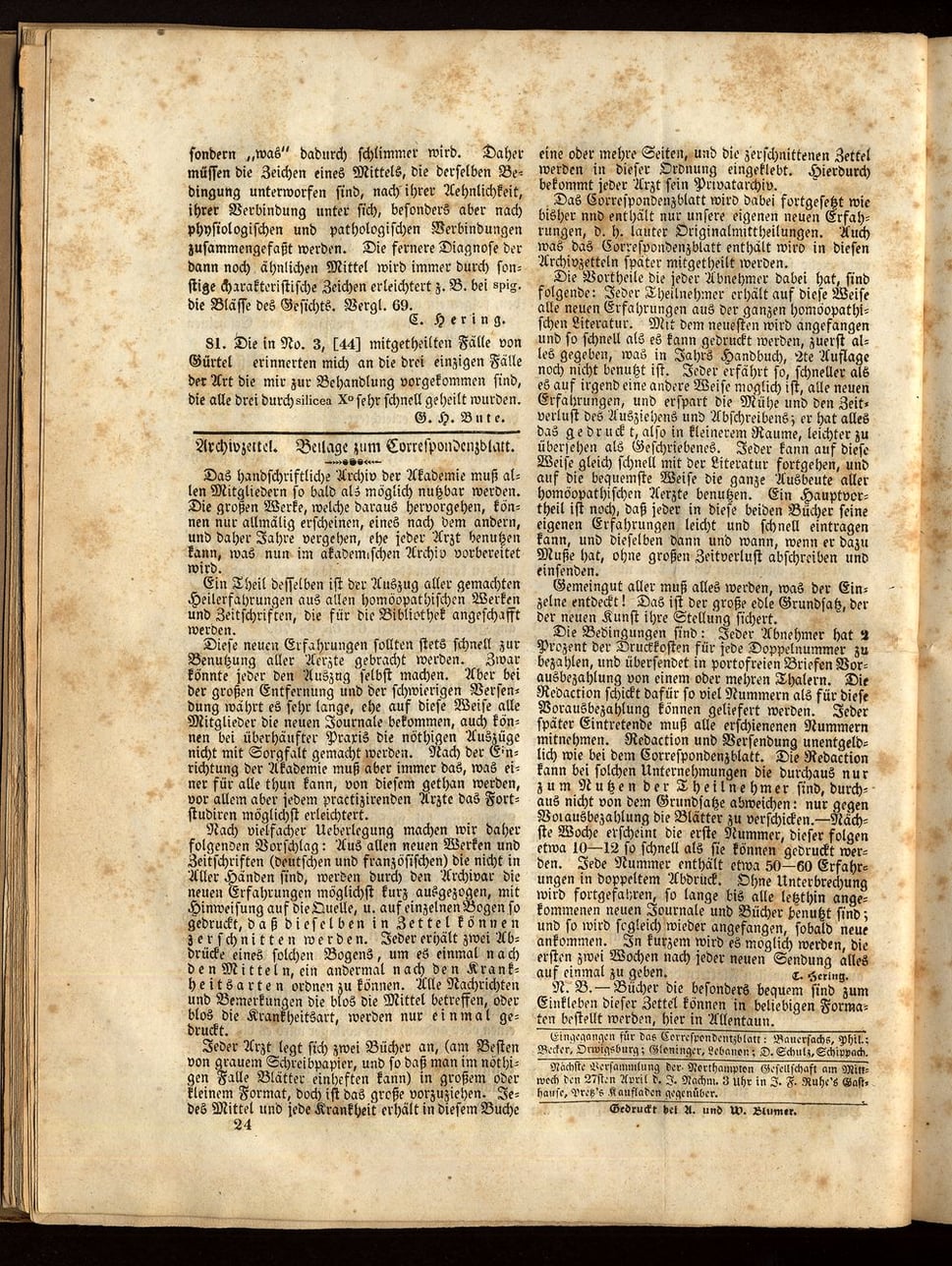
fördern „was" dadurch schlimmer wird. Daher müssen die Zeichen eines Mittels, die der selben Bedingung unterworfen sind, nach ihrer Lehnlichkeit, ihrer Verbindung unter sich, besonders aber nach physiologischen und pathologischen Verbindungen zusammengesetzt werden. Die fernere Diagnose der dann noch ähnlichen Mittel wird immer durch sonstige charakteristische Zeichen erleichtert z. B. bei spig. die Blässe des Gesichts. Bergl. 69. C. Hering. 81. Die in No. 3, [44] mitgetheilten Fälle von Gürtel erinnerten mich an die drei einzigen Fälle der Art die mir zur Behandlung vorgekommen sind, die alle drei durchsilicea Xo sehr schnell geheilt wurden. G. H. Bute. Archivzettel. Beilage zum Correspondenzblatt. Das handelsmässige Archiv der Akademie muss allen Mitgliedern so bald als möglich zuhab werden. Die großen Werke, welche daraus hervorgehen, können nur allmälig erscheinen, eines nach dem andern, und daher Jahre vergehen, ehe jeder Arzt benutzen kann, was nun im akademischen Archiv vorbereitet wird. Ein Theil desselben ist der Auszug aller gemachten Heilerfahrungen aus allen homöopathischen Werken und Zeitschriften, die für die Bibliothek angeschafft werden. Diese neuen Erfahrungen sollten stets schnell zur Benutzung aller Ärzte gebracht werden. Zwar könnte jeder den Auszug selbst machen. Aber bei der grossen Entfernung und der schwierigen Berufung währet es sehr lange, ehe auf diese Weise alle Mitglieder die neuen Journale bekommen, auch können bei überhauster Praxis die nötigen Auszüge nicht mit Sorgfalt gemacht werden. Nach der Einrichtung der Akademie muss aber immer das, was einer für alle thun kann, von diesem gethan werden, vor allem aber jedem praktizirenden Arzte das Fortstudiren möglichst erleichtert. Nach vielfacher Uberlegung machen wir daher folgenden Vorschlag: Aus allen neuen Werken und Zeitschriften (deutschen und französischen) die nicht in Allen Händen sind, werden durch den Archivar die neuen Erfahrungen möglichst kurz ausgezogen, mit Hinweisung auf die Quelle, u. auf einzelnen Bogen so gedruckt, dass dieselben in Zettel können erschritten werden. Jeder erhält zwei Abdrücke eines solchen Bogens, um es einmal nach den Mitteln, ein andermal nach den Krankheitsarten ordnen zu können. Alle Nachrichten und Bemerkungen die bloss die Mittel betreffen, oder bloss die Krankheitssatz, werden nur einmal gedruckt. Jeder Arzt legt sich zwei Bücher an, (am Besten von grauem Schreibpapier, und so dass man im nothigen Falle Blätter einheften kann) in grossen oder kleinen Format, doch ist das grosse vorzuziehen. Zeichn. Mittel und jede Krankheit erhält in diesem Buche eine oder mehrere Seiten, und die erschrittenen Zettel werden in dieser Ordnung eingelebt. Hierdurch kommt jedes Arzt sein Privatarchiv. Das Correspondenzblatt wird dabei fortgesetzt wie bisher und enthalt nur unsere eigenen neuen Erfahrungen, d. h. lauter Originalmittheilungen. Auch was das Correspondenzblatt enthält wird in diesen Archivzetteln später mitgetheilt werden. Die Vortheile die jeder Abnehmerei dabei hat, sind folgende: Jeder Theilnehmer erhält auf diese Weise alle neuen Erfahrungen aus der ganzen homöopathischen Literatur. Mit dem neuesten wird angefangen und so schnell als es kann gedruckt werden, zuerst alles gegeben, was in Jahres Handbuch, 2te Auflage noch nicht benutzt ist. Jeder erfährt so schneller als es auf irgend eine andere Weise möglich ist, alle neuen Erfahrungen, und erspart die Mühe und den Zeitverlust des Aussiehens und Abschreibens; er hat alles das g e d r u c k t , also in kleinem Raum, leichter zu übersehen als Geschriebenes. Jeder kann auf diese Weise gleich schnell mit der Literatur fortgehen, und auf die bequemste Weise die ganze Ausbeute aller homöopathischen Arznei benutzen. Ein Hauptvortheil ist noch, dass jeder in diese beiden Bücher seine eigenen Erfahrungen leicht und schnell eintragen kann, und dieselben dann und wann, wenn er dazu Muße hat, ohne großen Zeitverlust abschreiben und einsenden. Gemeinsam aller muss alles werden, was der Einzelne entdeckt! Das ist der große edle Grundfag, der der neuen Kunst ihre Stellung sichert. Die Bedingungen sind: Jeder Abnehmer hat 2 Prozent der Druckkosten für jede Doppelnummer zu bezahlen, und übersehnet in portofreien Briefen Vorabbezahlang von einem oder mehreren Thalern. Die Redaction schickt dafür so viel Nummern als für diese Vorabbezahlang können geliefert werden. Jeder später Eintretende muss alle erschienenen Nummern mitnehmen. Redaction und Versendung unentgeltlich wie bei dem Correspondenzblatt. Die Redaction kann bei solchen Unternehmungen die durchaus nur zum N u t z e n d e r T e i l n e h m e r sind, durchaus nicht von dem Grundsache abweichen: nur gegen Vorabbezahlang die Blätter zu verschicken.—Nächste Woche erscheint die erste Nummer, dieser folgen etwa 10—12 so schnell als sie können gedruckt werden. Jede Nummer enthält etwa 50—60 Erfahrungen in doppelter Abdruck. Ohne Unterbrechung wird fortgesetzt, so lange bis alle lebhin angekommenen neuen Journale und Bücher benutzt sind; und so wird gleich wieder angefangen, sobald neue ankommen. In kurzem wird es möglich werden, die ersten zwei Wochen nach jeder neuen Sendung alles auf einmal zu geben. C. Hering. N. B. — Bücher die besonders bequem sind zum Einkleben dieser Zettel können in beliebigem Formate bestellt werden, hier in Altenau. Eingangsort für das Correspondenzblatt: Bauersachs, Phil.: Mieder, Dornburg; Glenninger, Leoben; D. Schulz, Schipbach. Nächste Veranlassung der Northampton Gesellschaft am Mittwoch den 27ten April &. 7. Nachm. 3 Uhr in F. R. Ruhe's Gasthaus, Preis's Kaufladen gegenüber. Gedruckt bei A. und W. Blumer.
OCR Text
reason in changing my course of view or conduct. I cannot permit myself to be a party any more to the grade-striving or incapacitants. If any means can be devised to secure herself from such results as have been reached this session, I shall only be too happy & labor on in St. College & for the Cause as heretofore—but a mere resolve & pledge will not assure me: thus we have had before—several probably did so & really have a stronger desire to do right than previous to the voting this Spring. I yet—in my view & in yours too, now, if I mistake not—the faculty immutably proceed to do wrong—what will prevent such things from recurring? Not resolutions—not pledges. One may as many others have done—"resolve & unresolve—time is the same"—If a reconstruction of regulations or any other mode of effecting the object can be devised I shall be glad, if not—I cannot be induced to remain—for I have full made up my mind never to sign an invalid diploma.
Version History (3 versions)
- ✓ v3 (current) · 12/16/2025, 3:34:16 AM
"OCR: Updated 2 refs" - v2 · 12/16/2025, 3:28:10 AM · View this version
"Added to parent 01KCJK6ZB2Q6SB5TW1WTJN7KE4" - v1 · 12/16/2025, 3:28:09 AM · View this version
"Initial discovery snapshot"
Additional Components
book_08.txt
BOOK VIII


BANQUET IN THE HOUSE OF ALCINOUS—THE GAMES.


Now when the child of morning, rosy-fingered Dawn, appeared, Alcinous
and Ulysses both rose, and Alcinous led the way to the Phaeacian place
of assembly, which was near the ships. When they got there they sat
down side by side on a seat of polished stone, while Minerva took the
form of one of Alcinous’ servants, and went round the town in order to
help Ulysses to get home. She went up to the citizens, man by man, and
said, “Aldermen and town councillors of the Phaeacians, come to the
assembly all of you and listen to the stranger who has just come off a
long voyage to the house of King Alcinous; he looks like an immortal
god.”

With these words she made them all want to come, and they flocked to
the assembly till seats and standing room were alike crowded. Every one
was struck with the appearance of Ulysses, for Minerva had beautified
him about the head and shoulders, making him look taller and stouter
than he really was, that he might impress the Phaeacians favourably as
being a very remarkable man, and might come off well in the many trials
of skill to which they would challenge him. Then, when they were got
together, Alcinous spoke:

“Hear me,” said he, “aldermen and town councillors of the Phaeacians,
that I may speak even as I am minded. This stranger, whoever he may be,
has found his way to my house from somewhere or other either East or
West. He wants an escort and wishes to have the matter settled. Let us
then get one ready for him, as we have done for others before him;
indeed, no one who ever yet came to my house has been able to complain
of me for not speeding on his way soon enough. Let us draw a ship into
the sea—one that has never yet made a voyage—and man her with two and
fifty of our smartest young sailors. Then when you have made fast your
oars each by his own seat, leave the ship and come to my house to
prepare a feast.65 I will find you in everything. I am giving these
instructions to the young men who will form the crew, for as regards
you aldermen and town councillors, you will join me in entertaining our
guest in the cloisters. I can take no excuses, and we will have
Demodocus to sing to us; for there is no bard like him whatever he may
choose to sing about.”

Alcinous then led the way, and the others followed after, while a
servant went to fetch Demodocus. The fifty-two picked oarsmen went to
the sea shore as they had been told, and when they got there they drew
the ship into the water, got her mast and sails inside her, bound the
oars to the thole-pins with twisted thongs of leather, all in due
course, and spread the white sails aloft. They moored the vessel a
little way out from land, and then came on shore and went to the house
of King Alcinous. The out houses,66 yards, and all the precincts were
filled with crowds of men in great multitudes both old and young; and
Alcinous killed them a dozen sheep, eight full grown pigs, and two
oxen. These they skinned and dressed so as to provide a magnificent
banquet.

A servant presently led in the famous bard Demodocus, whom the muse had
dearly loved, but to whom she had given both good and evil, for though
she had endowed him with a divine gift of song, she had robbed him of
his eyesight. Pontonous set a seat for him among the guests, leaning it
up against a bearing-post. He hung the lyre for him on a peg over his
head, and showed him where he was to feel for it with his hands. He
also set a fair table with a basket of victuals by his side, and a cup
of wine from which he might drink whenever he was so disposed.

The company then laid their hands upon the good things that were before
them, but as soon as they had had enough to eat and drink, the muse
inspired Demodocus to sing the feats of heroes, and more especially a
matter that was then in the mouths of all men, to wit, the quarrel
between Ulysses and Achilles, and the fierce words that they heaped on
one another as they sat together at a banquet. But Agamemnon was glad
when he heard his chieftains quarrelling with one another, for Apollo
had foretold him this at Pytho when he crossed the stone floor to
consult the oracle. Here was the beginning of the evil that by the will
of Jove fell both upon Danaans and Trojans.

Thus sang the bard, but Ulysses drew his purple mantle over his head
and covered his face, for he was ashamed to let the Phaeacians see that
he was weeping. When the bard left off singing he wiped the tears from
his eyes, uncovered his face, and, taking his cup, made a
drink-offering to the gods; but when the Phaeacians pressed Demodocus
to sing further, for they delighted in his lays, then Ulysses again
drew his mantle over his head and wept bitterly. No one noticed his
distress except Alcinous, who was sitting near him, and heard the heavy
sighs that he was heaving. So he at once said, “Aldermen and town
councillors of the Phaeacians, we have had enough now, both of the
feast, and of the minstrelsy that is its due accompaniment; let us
proceed therefore to the athletic sports, so that our guest on his
return home may be able to tell his friends how much we surpass all
other nations as boxers, wrestlers, jumpers, and runners.”

With these words he led the way, and the others followed after. A
servant hung Demodocus’s lyre on its peg for him, led him out of the
cloister, and set him on the same way as that along which all the chief
men of the Phaeacians were going to see the sports; a crowd of several
thousands of people followed them, and there were many excellent
competitors for all the prizes. Acroneos, Ocyalus, Elatreus, Nauteus,
Prymneus, Anchialus, Eretmeus, Ponteus, Proreus, Thoon, Anabesineus,
and Amphialus son of Polyneus son of Tecton. There was also Euryalus
son of Naubolus, who was like Mars himself, and was the best looking
man among the Phaeacians except Laodamas. Three sons of Alcinous,
Laodamas, Halios, and Clytoneus, competed also.

The foot races came first. The course was set out for them from the
starting post, and they raised a dust upon the plain as they all flew
forward at the same moment. Clytoneus came in first by a long way; he
left every one else behind him by the length of the furrow that a
couple of mules can plough in a fallow field.67 They then turned to the
painful art of wrestling, and here Euryalus proved to be the best man.
Amphialus excelled all the others in jumping, while at throwing the
disc there was no one who could approach Elatreus. Alcinous’s son
Laodamas was the best boxer, and he it was who presently said, when
they had all been diverted with the games, “Let us ask the stranger
whether he excels in any of these sports; he seems very powerfully
built; his thighs, calves, hands, and neck are of prodigious strength,
nor is he at all old, but he has suffered much lately, and there is
nothing like the sea for making havoc with a man, no matter how strong
he is.”

“You are quite right, Laodamas,” replied Euryalus, “go up to your guest
and speak to him about it yourself.”

When Laodamas heard this he made his way into the middle of the crowd
and said to Ulysses, “I hope, Sir, that you will enter yourself for
some one or other of our competitions if you are skilled in any of
them—and you must have gone in for many a one before now. There is
nothing that does any one so much credit all his life long as the
showing himself a proper man with his hands and feet. Have a try
therefore at something, and banish all sorrow from your mind. Your
return home will not be long delayed, for the ship is already drawn
into the water, and the crew is found.”

Ulysses answered, “Laodamas, why do you taunt me in this way? my mind
is set rather on cares than contests; I have been through infinite
trouble, and am come among you now as a suppliant, praying your king
and people to further me on my return home.”

Then Euryalus reviled him outright and said, “I gather, then, that you
are unskilled in any of the many sports that men generally delight in.
I suppose you are one of those grasping traders that go about in ships
as captains or merchants, and who think of nothing but of their outward
freights and homeward cargoes. There does not seem to be much of the
athlete about you.”

“For shame, Sir,” answered Ulysses, fiercely, “you are an insolent
fellow—so true is it that the gods do not grace all men alike in
speech, person, and understanding. One man may be of weak presence, but
heaven has adorned this with such a good conversation that he charms
every one who sees him; his honeyed moderation carries his hearers with
him so that he is leader in all assemblies of his fellows, and wherever
he goes he is looked up to. Another may be as handsome as a god, but
his good looks are not crowned with discretion. This is your case. No
god could make a finer looking fellow than you are, but you are a fool.
Your ill-judged remarks have made me exceedingly angry, and you are
quite mistaken, for I excel in a great many athletic exercises; indeed,
so long as I had youth and strength, I was among the first athletes of
the age. Now, however, I am worn out by labour and sorrow, for I have
gone through much both on the field of battle and by the waves of the
weary sea; still, in spite of all this I will compete, for your taunts
have stung me to the quick.”

So he hurried up without even taking his cloak off, and seized a disc,
larger, more massive and much heavier than those used by the Phaeacians
when disc-throwing among themselves.68 Then, swinging it back, he threw
it from his brawny hand, and it made a humming sound in the air as he
did so. The Phaeacians quailed beneath the rushing of its flight as it
sped gracefully from his hand, and flew beyond any mark that had been
made yet. Minerva, in the form of a man, came and marked the place
where it had fallen. “A blind man, Sir,” said she, “could easily tell
your mark by groping for it—it is so far ahead of any other. You may
make your mind easy about this contest, for no Phaeacian can come near
to such a throw as yours.”

Ulysses was glad when he found he had a friend among the lookers-on, so
he began to speak more pleasantly. “Young men,” said he, “come up to
that throw if you can, and I will throw another disc as heavy or even
heavier. If anyone wants to have a bout with me let him come on, for I
am exceedingly angry; I will box, wrestle, or run, I do not care what
it is, with any man of you all except Laodamas, but not with him
because I am his guest, and one cannot compete with one’s own personal
friend. At least I do not think it a prudent or a sensible thing for a
guest to challenge his host’s family at any game, especially when he is
in a foreign country. He will cut the ground from under his own feet if
he does; but I make no exception as regards any one else, for I want to
have the matter out and know which is the best man. I am a good hand at
every kind of athletic sport known among mankind. I am an excellent
archer. In battle I am always the first to bring a man down with my
arrow, no matter how many more are taking aim at him alongside of me.
Philoctetes was the only man who could shoot better than I could when
we Achaeans were before Troy and in practice. I far excel every one
else in the whole world, of those who still eat bread upon the face of
the earth, but I should not like to shoot against the mighty dead, such
as Hercules, or Eurytus the Oechalian—men who could shoot against the
gods themselves. This in fact was how Eurytus came prematurely by his
end, for Apollo was angry with him and killed him because he challenged
him as an archer. I can throw a dart farther than any one else can
shoot an arrow. Running is the only point in respect of which I am
afraid some of the Phaeacians might beat me, for I have been brought
down very low at sea; my provisions ran short, and therefore I am still
weak.”

They all held their peace except King Alcinous, who began, “Sir, we
have had much pleasure in hearing all that you have told us, from which
I understand that you are willing to show your prowess, as having been
displeased with some insolent remarks that have been made to you by one
of our athletes, and which could never have been uttered by any one who
knows how to talk with propriety. I hope you will apprehend my meaning,
and will explain to any one of your chief men who may be dining with
yourself and your family when you get home, that we have an hereditary
aptitude for accomplishments of all kinds. We are not particularly
remarkable for our boxing, nor yet as wrestlers, but we are singularly
fleet of foot and are excellent sailors. We are extremely fond of good
dinners, music, and dancing; we also like frequent changes of linen,
warm baths, and good beds, so now, please, some of you who are the best
dancers set about dancing, that our guest on his return home may be
able to tell his friends how much we surpass all other nations as
sailors, runners, dancers, and minstrels. Demodocus has left his lyre
at my house, so run some one or other of you and fetch it for him.”

On this a servant hurried off to bring the lyre from the king’s house,
and the nine men who had been chosen as stewards stood forward. It was
their business to manage everything connected with the sports, so they
made the ground smooth and marked a wide space for the dancers.
Presently the servant came back with Demodocus’s lyre, and he took his
place in the midst of them, whereon the best young dancers in the town
began to foot and trip it so nimbly that Ulysses was delighted with the
merry twinkling of their feet.

Meanwhile the bard began to sing the loves of Mars and Venus, and how
they first began their intrigue in the house of Vulcan. Mars made Venus
many presents, and defiled King Vulcan’s marriage bed, so the sun, who
saw what they were about, told Vulcan. Vulcan was very angry when he
heard such dreadful news, so he went to his smithy brooding mischief,
got his great anvil into its place, and began to forge some chains
which none could either unloose or break, so that they might stay there
in that place.69 When he had finished his snare he went into his
bedroom and festooned the bed-posts all over with chains like cobwebs;
he also let many hang down from the great beam of the ceiling. Not even
a god could see them so fine and subtle were they. As soon as he had
spread the chains all over the bed, he made as though he were setting
out for the fair state of Lemnos, which of all places in the world was
the one he was most fond of. But Mars kept no blind look out, and as
soon as he saw him start, hurried off to his house, burning with love
for Venus.

Now Venus was just come in from a visit to her father Jove, and was
about sitting down when Mars came inside the house, and said as he took
her hand in his own, “Let us go to the couch of Vulcan: he is not at
home, but is gone off to Lemnos among the Sintians, whose speech is
barbarous.”

She was nothing loth, so they went to the couch to take their rest,
whereon they were caught in the toils which cunning Vulcan had spread
for them, and could neither get up nor stir hand or foot, but found too
late that they were in a trap. Then Vulcan came up to them, for he had
turned back before reaching Lemnos, when his scout the sun told him
what was going on. He was in a furious passion, and stood in the
vestibule making a dreadful noise as he shouted to all the gods.

“Father Jove,” he cried, “and all you other blessed gods who live for
ever, come here and see the ridiculous and disgraceful sight that I
will show you. Jove’s daughter Venus is always dishonouring me because
I am lame. She is in love with Mars, who is handsome and clean built,
whereas I am a cripple—but my parents are to blame for that, not I;
they ought never to have begotten me. Come and see the pair together
asleep on my bed. It makes me furious to look at them. They are very
fond of one another, but I do not think they will lie there longer than
they can help, nor do I think that they will sleep much; there,
however, they shall stay till her father has repaid me the sum I gave
him for his baggage of a daughter, who is fair but not honest.”

On this the gods gathered to the house of Vulcan. Earth-encircling
Neptune came, and Mercury the bringer of luck, and King Apollo, but the
goddesses staid at home all of them for shame. Then the givers of all
good things stood in the doorway, and the blessed gods roared with
inextinguishable laughter, as they saw how cunning Vulcan had been,
whereon one would turn towards his neighbour saying:

“Ill deeds do not prosper, and the weak confound the strong. See how
limping Vulcan, lame as he is, has caught Mars who is the fleetest god
in heaven; and now Mars will be cast in heavy damages.”

Thus did they converse, but King Apollo said to Mercury, “Messenger
Mercury, giver of good things, you would not care how strong the chains
were, would you, if you could sleep with Venus?”

“King Apollo,” answered Mercury, “I only wish I might get the chance,
though there were three times as many chains—and you might look on, all
of you, gods and goddesses, but I would sleep with her if I could.”

The immortal gods burst out laughing as they heard him, but Neptune
took it all seriously, and kept on imploring Vulcan to set Mars free
again. “Let him go,” he cried, “and I will undertake, as you require,
that he shall pay you all the damages that are held reasonable among
the immortal gods.”

“Do not,” replied Vulcan, “ask me to do this; a bad man’s bond is bad
security; what remedy could I enforce against you if Mars should go
away and leave his debts behind him along with his chains?”

“Vulcan,” said Neptune, “if Mars goes away without paying his damages,
I will pay you myself.” So Vulcan answered, “In this case I cannot and
must not refuse you.”

Thereon he loosed the bonds that bound them, and as soon as they were
free they scampered off, Mars to Thrace and laughter-loving Venus to
Cyprus and to Paphos, where is her grove and her altar fragrant with
burnt offerings. Here the Graces bathed her, and anointed her with oil
of ambrosia such as the immortal gods make use of, and they clothed her
in raiment of the most enchanting beauty.

Thus sang the bard, and both Ulysses and the seafaring Phaeacians were
charmed as they heard him.

Then Alcinous told Laodamas and Halius to dance alone, for there was no
one to compete with them. So they took a red ball which Polybus had
made for them, and one of them bent himself backwards and threw it up
towards the clouds, while the other jumped from off the ground and
caught it with ease before it came down again. When they had done
throwing the ball straight up into the air they began to dance, and at
the same time kept on throwing it backwards and forwards to one
another, while all the young men in the ring applauded and made a great
stamping with their feet. Then Ulysses said:

“King Alcinous, you said your people were the nimblest dancers in the
world, and indeed they have proved themselves to be so. I was
astonished as I saw them.”

The king was delighted at this, and exclaimed to the Phaeacians,
“Aldermen and town councillors, our guest seems to be a person of
singular judgement; let us give him such proof of our hospitality as he
may reasonably expect. There are twelve chief men among you, and
counting myself there are thirteen; contribute, each of you, a clean
cloak, a shirt, and a talent of fine gold; let us give him all this in
a lump down at once, so that when he gets his supper he may do so with
a light heart. As for Euryalus he will have to make a formal apology
and a present too, for he has been rude.”

Thus did he speak. The others all of them applauded his saying, and
sent their servants to fetch the presents. Then Euryalus said, “King
Alcinous, I will give the stranger all the satisfaction you require. He
shall have my sword, which is of bronze, all but the hilt, which is of
silver. I will also give him the scabbard of newly sawn ivory into
which it fits. It will be worth a great deal to him.”

As he spoke he placed the sword in the hands of Ulysses and said, “Good
luck to you, father stranger; if anything has been said amiss may the
winds blow it away with them, and may heaven grant you a safe return,
for I understand you have been long away from home, and have gone
through much hardship.”

To which Ulysses answered, “Good luck to you too my friend, and may the
gods grant you every happiness. I hope you will not miss the sword you
have given me along with your apology.”

With these words he girded the sword about his shoulders and towards
sundown the presents began to make their appearance, as the servants of
the donors kept bringing them to the house of King Alcinous; here his
sons received them, and placed them under their mother’s charge. Then
Alcinous led the way to the house and bade his guests take their seats.

“Wife,” said he, turning to Queen Arete, “Go, fetch the best chest we
have, and put a clean cloak and shirt in it. Also, set a copper on the
fire and heat some water; our guest will take a warm bath; see also to
the careful packing of the presents that the noble Phaeacians have made
him; he will thus better enjoy both his supper and the singing that
will follow. I shall myself give him this golden goblet—which is of
exquisite workmanship—that he may be reminded of me for the rest of his
life whenever he makes a drink offering to Jove, or to any of the
gods.”70

Then Arete told her maids to set a large tripod upon the fire as fast
as they could, whereon they set a tripod full of bath water on to a
clear fire; they threw on sticks to make it blaze, and the water became
hot as the flame played about the belly of the tripod.71 Meanwhile
Arete brought a magnificent chest from her own room, and inside it she
packed all the beautiful presents of gold and raiment which the
Phaeacians had brought. Lastly she added a cloak and a good shirt from
Alcinous, and said to Ulysses:

“See to the lid yourself, and have the whole bound round at once, for
fear any one should rob you by the way when you are asleep in your
ship.” 72

When Ulysses heard this he put the lid on the chest and made it fast
with a bond that Circe had taught him. He had done so before an upper
servant told him to come to the bath and wash himself. He was very glad
of a warm bath, for he had had no one to wait upon him ever since he
left the house of Calypso, who as long as he remained with her had
taken as good care of him as though he had been a god. When the
servants had done washing and anointing him with oil, and had given him
a clean cloak and shirt, he left the bath room and joined the guests
who were sitting over their wine. Lovely Nausicaa stood by one of the
bearing-posts supporting the roof of the cloister, and admired him as
she saw him pass. “Farewell stranger,” said she, “do not forget me when
you are safe at home again, for it is to me first that you owe a ransom
for having saved your life.”

And Ulysses said, “Nausicaa, daughter of great Alcinous, may Jove the
mighty husband of Juno, grant that I may reach my home; so shall I
bless you as my guardian angel all my days, for it was you who saved
me.”

When he had said this, he seated himself beside Alcinous. Supper was
then served, and the wine was mixed for drinking. A servant led in the
favourite bard Demodocus, and set him in the midst of the company, near
one of the bearing-posts supporting the cloister, that he might lean
against it. Then Ulysses cut off a piece of roast pork with plenty of
fat (for there was abundance left on the joint) and said to a servant,
“Take this piece of pork over to Demodocus and tell him to eat it; for
all the pain his lays may cause me I will salute him none the less;
bards are honoured and respected throughout the world, for the muse
teaches them their songs and loves them.”

The servant carried the pork in his fingers over to Demodocus, who took
it and was very much pleased. They then laid their hands on the good
things that were before them, and as soon as they had had to eat and
drink, Ulysses said to Demodocus, “Demodocus, there is no one in the
world whom I admire more than I do you. You must have studied under the
Muse, Jove’s daughter, and under Apollo, so accurately do you sing the
return of the Achaeans with all their sufferings and adventures. If you
were not there yourself, you must have heard it all from some one who
was. Now, however, change your song and tell us of the wooden horse
which Epeus made with the assistance of Minerva, and which Ulysses got
by stratagem into the fort of Troy after freighting it with the men who
afterwards sacked the city. If you will sing this tale aright I will
tell all the world how magnificently heaven has endowed you.”

The bard inspired of heaven took up the story at the point where some
of the Argives set fire to their tents and sailed away while others,
hidden within the horse,73 were waiting with Ulysses in the Trojan
place of assembly. For the Trojans themselves had drawn the horse into
their fortress, and it stood there while they sat in council round it,
and were in three minds as to what they should do. Some were for
breaking it up then and there; others would have it dragged to the top
of the rock on which the fortress stood, and then thrown down the
precipice; while yet others were for letting it remain as an offering
and propitiation for the gods. And this was how they settled it in the
end, for the city was doomed when it took in that horse, within which
were all the bravest of the Argives waiting to bring death and
destruction on the Trojans. Anon he sang how the sons of the Achaeans
issued from the horse, and sacked the town, breaking out from their
ambuscade. He sang how they overran the city hither and thither and
ravaged it, and how Ulysses went raging like Mars along with Menelaus
to the house of Deiphobus. It was there that the fight raged most
furiously, nevertheless by Minerva’s help he was victorious.

All this he told, but Ulysses was overcome as he heard him, and his
cheeks were wet with tears. He wept as a woman weeps when she throws
herself on the body of her husband who has fallen before his own city
and people, fighting bravely in defence of his home and children. She
screams aloud and flings her arms about him as he lies gasping for
breath and dying, but her enemies beat her from behind about the back
and shoulders, and carry her off into slavery, to a life of labour and
sorrow, and the beauty fades from her cheeks—even so piteously did
Ulysses weep, but none of those present perceived his tears except
Alcinous, who was sitting near him, and could hear the sobs and sighs
that he was heaving. The king, therefore, at once rose and said:

“Aldermen and town councillors of the Phaeacians, let Demodocus cease
his song, for there are those present who do not seem to like it. From
the moment that we had done supper and Demodocus began to sing, our
guest has been all the time groaning and lamenting. He is evidently in
great trouble, so let the bard leave off, that we may all enjoy
ourselves, hosts and guest alike. This will be much more as it should
be, for all these festivities, with the escort and the presents that we
are making with so much good will are wholly in his honour, and any one
with even a moderate amount of right feeling knows that he ought to
treat a guest and a suppliant as though he were his own brother.

“Therefore, Sir, do you on your part affect no more concealment nor
reserve in the matter about which I shall ask you; it will be more
polite in you to give me a plain answer; tell me the name by which your
father and mother over yonder used to call you, and by which you were
known among your neighbours and fellow-citizens. There is no one,
neither rich nor poor, who is absolutely without any name whatever, for
people’s fathers and mothers give them names as soon as they are born.
Tell me also your country, nation, and city, that our ships may shape
their purpose accordingly and take you there. For the Phaeacians have
no pilots; their vessels have no rudders as those of other nations
have, but the ships themselves understand what it is that we are
thinking about and want; they know all the cities and countries in the
whole world, and can traverse the sea just as well even when it is
covered with mist and cloud, so that there is no danger of being
wrecked or coming to any harm. Still I do remember hearing my father
say that Neptune was angry with us for being too easy-going in the
matter of giving people escorts. He said that one of these days he
should wreck a ship of ours as it was returning from having escorted
some one,74 and bury our city under a high mountain. This is what my
father used to say, but whether the god will carry out his threat or no
is a matter which he will decide for himself.

“And now, tell me and tell me true. Where have you been wandering, and
in what countries have you travelled? Tell us of the peoples
themselves, and of their cities—who were hostile, savage and
uncivilised, and who, on the other hand, hospitable and humane. Tell us
also why you are made so unhappy on hearing about the return of the
Argive Danaans from Troy. The gods arranged all this, and sent them
their misfortunes in order that future generations might have something
to sing about. Did you lose some brave kinsman of your wife’s when you
were before Troy? a son-in-law or father-in-law—which are the nearest
relations a man has outside his own flesh and blood? or was it some
brave and kindly-natured comrade—for a good friend is as dear to a man
as his own brother?”
book_09.txt
BOOK IX


ULYSSES DECLARES HIMSELF AND BEGINS HIS STORY—-THE CICONS, LOTOPHAGI,
AND CYCLOPES.


And Ulysses answered, “King Alcinous, it is a good thing to hear a bard
with such a divine voice as this man has. There is nothing better or
more delightful than when a whole people make merry together, with the
guests sitting orderly to listen, while the table is loaded with bread
and meats, and the cup-bearer draws wine and fills his cup for every
man. This is indeed as fair a sight as a man can see. Now, however,
since you are inclined to ask the story of my sorrows, and rekindle my
own sad memories in respect of them, I do not know how to begin, nor
yet how to continue and conclude my tale, for the hand of heaven has
been laid heavily upon me.

“Firstly, then, I will tell you my name that you too may know it, and
one day, if I outlive this time of sorrow, may become my guests though
I live so far away from all of you. I am Ulysses son of Laertes,
renowned among mankind for all manner of subtlety, so that my fame
ascends to heaven. I live in Ithaca, where there is a high mountain
called Neritum, covered with forests; and not far from it there is a
group of islands very near to one another—Dulichium, Same, and the
wooded island of Zacynthus. It lies squat on the horizon, all highest
up in the sea towards the sunset, while the others lie away from it
towards dawn.75 It is a rugged island, but it breeds brave men, and my
eyes know none that they better love to look upon. The goddess Calypso
kept me with her in her cave, and wanted me to marry her, as did also
the cunning Aeaean goddess Circe; but they could neither of them
persuade me, for there is nothing dearer to a man than his own country
and his parents, and however splendid a home he may have in a foreign
country, if it be far from father or mother, he does not care about it.
Now, however, I will tell you of the many hazardous adventures which by
Jove’s will I met with on my return from Troy.

“When I had set sail thence the wind took me first to Ismarus, which is
the city of the Cicons. There I sacked the town and put the people to
the sword. We took their wives and also much booty, which we divided
equitably amongst us, so that none might have reason to complain. I
then said that we had better make off at once, but my men very
foolishly would not obey me, so they staid there drinking much wine and
killing great numbers of sheep and oxen on the sea shore. Meanwhile the
Cicons cried out for help to other Cicons who lived inland. These were
more in number, and stronger, and they were more skilled in the art of
war, for they could fight, either from chariots or on foot as the
occasion served; in the morning, therefore, they came as thick as
leaves and bloom in summer, and the hand of heaven was against us, so
that we were hard pressed. They set the battle in array near the ships,
and the hosts aimed their bronze-shod spears at one another.76 So long
as the day waxed and it was still morning, we held our own against
them, though they were more in number than we; but as the sun went
down, towards the time when men loose their oxen, the Cicons got the
better of us, and we lost half a dozen men from every ship we had; so
we got away with those that were left.

“Thence we sailed onward with sorrow in our hearts, but glad to have
escaped death though we had lost our comrades, nor did we leave till we
had thrice invoked each one of the poor fellows who had perished by the
hands of the Cicons. Then Jove raised the North wind against us till it
blew a hurricane, so that land and sky were hidden in thick clouds, and
night sprang forth out of the heavens. We let the ships run before the
gale, but the force of the wind tore our sails to tatters, so we took
them down for fear of shipwreck, and rowed our hardest towards the
land. There we lay two days and two nights suffering much alike from
toil and distress of mind, but on the morning of the third day we again
raised our masts, set sail, and took our places, letting the wind and
steersmen direct our ship. I should have got home at that time unharmed
had not the North wind and the currents been against me as I was
doubling Cape Malea, and set me off my course hard by the island of
Cythera.

“I was driven thence by foul winds for a space of nine days upon the
sea, but on the tenth day we reached the land of the Lotus-eaters, who
live on a food that comes from a kind of flower. Here we landed to take
in fresh water, and our crews got their mid-day meal on the shore near
the ships. When they had eaten and drunk I sent two of my company to
see what manner of men the people of the place might be, and they had a
third man under them. They started at once, and went about among the
Lotus-eaters, who did them no hurt, but gave them to eat of the lotus,
which was so delicious that those who ate of it left off caring about
home, and did not even want to go back and say what had happened to
them, but were for staying and munching lotus77 with the Lotus-eaters
without thinking further of their return; nevertheless, though they
wept bitterly I forced them back to the ships and made them fast under
the benches. Then I told the rest to go on board at once, lest any of
them should taste of the lotus and leave off wanting to get home, so
they took their places and smote the grey sea with their oars.

“We sailed hence, always in much distress, till we came to the land of
the lawless and inhuman Cyclopes. Now the Cyclopes neither plant nor
plough, but trust in providence, and live on such wheat, barley, and
grapes as grow wild without any kind of tillage, and their wild grapes
yield them wine as the sun and the rain may grow them. They have no
laws nor assemblies of the people, but live in caves on the tops of
high mountains; each is lord and master in his family, and they take no
account of their neighbours.

“Now off their harbour there lies a wooded and fertile island not quite
close to the land of the Cyclopes, but still not far. It is over-run
with wild goats, that breed there in great numbers and are never
disturbed by foot of man; for sportsmen—who as a rule will suffer so
much hardship in forest or among mountain precipices—do not go there,
nor yet again is it ever ploughed or fed down, but it lies a wilderness
untilled and unsown from year to year, and has no living thing upon it
but only goats. For the Cyclopes have no ships, nor yet shipwrights who
could make ships for them; they cannot therefore go from city to city,
or sail over the sea to one another’s country as people who have ships
can do; if they had had these they would have colonised the island,78
for it is a very good one, and would yield everything in due season.
There are meadows that in some places come right down to the sea shore,
well watered and full of luscious grass; grapes would do there
excellently; there is level land for ploughing, and it would always
yield heavily at harvest time, for the soil is deep. There is a good
harbour where no cables are wanted, nor yet anchors, nor need a ship be
moored, but all one has to do is to beach one’s vessel and stay there
till the wind becomes fair for putting out to sea again. At the head of
the harbour there is a spring of clear water coming out of a cave, and
there are poplars growing all round it.

“Here we entered, but so dark was the night that some god must have
brought us in, for there was nothing whatever to be seen. A thick mist
hung all round our ships;79 the moon was hidden behind a mass of clouds
so that no one could have seen the island if he had looked for it, nor
were there any breakers to tell us we were close in shore before we
found ourselves upon the land itself; when, however, we had beached the
ships, we took down the sails, went ashore and camped upon the beach
till daybreak.

“When the child of morning, rosy-fingered Dawn appeared, we admired the
island and wandered all over it, while the nymphs Jove’s daughters
roused the wild goats that we might get some meat for our dinner. On
this we fetched our spears and bows and arrows from the ships, and
dividing ourselves into three bands began to shoot the goats. Heaven
sent us excellent sport; I had twelve ships with me, and each ship got
nine goats, while my own ship had ten; thus through the livelong day to
the going down of the sun we ate and drank our fill, and we had plenty
of wine left, for each one of us had taken many jars full when we
sacked the city of the Cicons, and this had not yet run out. While we
were feasting we kept turning our eyes towards the land of the
Cyclopes, which was hard by, and saw the smoke of their stubble fires.
We could almost fancy we heard their voices and the bleating of their
sheep and goats, but when the sun went down and it came on dark, we
camped down upon the beach, and next morning I called a council.

“‘Stay here, my brave fellows,’ said I, ‘all the rest of you, while I
go with my ship and exploit these people myself: I want to see if they
are uncivilised savages, or a hospitable and humane race.’

“I went on board, bidding my men to do so also and loose the hawsers;
so they took their places and smote the grey sea with their oars. When
we got to the land, which was not far, there, on the face of a cliff
near the sea, we saw a great cave overhung with laurels. It was a
station for a great many sheep and goats, and outside there was a large
yard, with a high wall round it made of stones built into the ground
and of trees both pine and oak. This was the abode of a huge monster
who was then away from home shepherding his flocks. He would have
nothing to do with other people, but led the life of an outlaw. He was
a horrid creature, not like a human being at all, but resembling rather
some crag that stands out boldly against the sky on the top of a high
mountain.

“I told my men to draw the ship ashore, and stay where they were, all
but the twelve best among them, who were to go along with myself. I
also took a goatskin of sweet black wine which had been given me by
Maron, son of Euanthes, who was priest of Apollo the patron god of
Ismarus, and lived within the wooded precincts of the temple. When we
were sacking the city we respected him, and spared his life, as also
his wife and child; so he made me some presents of great value—seven
talents of fine gold, and a bowl of silver, with twelve jars of sweet
wine, unblended, and of the most exquisite flavour. Not a man nor maid
in the house knew about it, but only himself, his wife, and one
housekeeper: when he drank it he mixed twenty parts of water to one of
wine, and yet the fragrance from the mixing-bowl was so exquisite that
it was impossible to refrain from drinking. I filled a large skin with
this wine, and took a wallet full of provisions with me, for my mind
misgave me that I might have to deal with some savage who would be of
great strength, and would respect neither right nor law.

“We soon reached his cave, but he was out shepherding, so we went
inside and took stock of all that we could see. His cheese-racks were
loaded with cheeses, and he had more lambs and kids than his pens could
hold. They were kept in separate flocks; first there were the hoggets,
then the oldest of the younger lambs and lastly the very young ones80
all kept apart from one another; as for his dairy, all the vessels,
bowls, and milk pails into which he milked, were swimming with whey.
When they saw all this, my men begged me to let them first steal some
cheeses, and make off with them to the ship; they would then return,
drive down the lambs and kids, put them on board and sail away with
them. It would have been indeed better if we had done so but I would
not listen to them, for I wanted to see the owner himself, in the hope
that he might give me a present. When, however, we saw him my poor men
found him ill to deal with.

“We lit a fire, offered some of the cheeses in sacrifice, ate others of
them, and then sat waiting till the Cyclops should come in with his
sheep. When he came, he brought in with him a huge load of dry firewood
to light the fire for his supper, and this he flung with such a noise
on to the floor of his cave that we hid ourselves for fear at the far
end of the cavern. Meanwhile he drove all the ewes inside, as well as
the she-goats that he was going to milk, leaving the males, both rams
and he-goats, outside in the yards. Then he rolled a huge stone to the
mouth of the cave—so huge that two and twenty strong four-wheeled
waggons would not be enough to draw it from its place against the
doorway. When he had so done he sat down and milked his ewes and goats,
all in due course, and then let each of them have her own young. He
curdled half the milk and set it aside in wicker strainers, but the
other half he poured into bowls that he might drink it for his supper.
When he had got through with all his work, he lit the fire, and then
caught sight of us, whereon he said:

“‘Strangers, who are you? Where do sail from? Are you traders, or do
you sail the sea as rovers, with your hands against every man, and
every man’s hand against you?’

“We were frightened out of our senses by his loud voice and monstrous
form, but I managed to say, ‘We are Achaeans on our way home from Troy,
but by the will of Jove, and stress of weather, we have been driven far
out of our course. We are the people of Agamemnon, son of Atreus, who
has won infinite renown throughout the whole world, by sacking so great
a city and killing so many people. We therefore humbly pray you to show
us some hospitality, and otherwise make us such presents as visitors
may reasonably expect. May your excellency fear the wrath of heaven,
for we are your suppliants, and Jove takes all respectable travellers
under his protection, for he is the avenger of all suppliants and
foreigners in distress.’

“To this he gave me but a pitiless answer, ‘Stranger,’ said he, ‘you
are a fool, or else you know nothing of this country. Talk to me,
indeed, about fearing the gods or shunning their anger? We Cyclopes do
not care about Jove or any of your blessed gods, for we are ever so
much stronger than they. I shall not spare either yourself or your
companions out of any regard for Jove, unless I am in the humour for
doing so. And now tell me where you made your ship fast when you came
on shore. Was it round the point, or is she lying straight off the
land?’

“He said this to draw me out, but I was too cunning to be caught in
that way, so I answered with a lie; ‘Neptune,’ said I, ‘sent my ship on
to the rocks at the far end of your country, and wrecked it. We were
driven on to them from the open sea, but I and those who are with me
escaped the jaws of death.’

“The cruel wretch vouchsafed me not one word of answer, but with a
sudden clutch he gripped up two of my men at once and dashed them down
upon the ground as though they had been puppies. Their brains were shed
upon the ground, and the earth was wet with their blood. Then he tore
them limb from limb and supped upon them. He gobbled them up like a
lion in the wilderness, flesh, bones, marrow, and entrails, without
leaving anything uneaten. As for us, we wept and lifted up our hands to
heaven on seeing such a horrid sight, for we did not know what else to
do; but when the Cyclops had filled his huge paunch, and had washed
down his meal of human flesh with a drink of neat milk, he stretched
himself full length upon the ground among his sheep, and went to sleep.
I was at first inclined to seize my sword, draw it, and drive it into
his vitals, but I reflected that if I did we should all certainly be
lost, for we should never be able to shift the stone which the monster
had put in front of the door. So we stayed sobbing and sighing where we
were till morning came.

“When the child of morning, rosy-fingered dawn, appeared, he again lit
his fire, milked his goats and ewes, all quite rightly, and then let
each have her own young one; as soon as he had got through with all his
work, he clutched up two more of my men, and began eating them for his
morning’s meal. Presently, with the utmost ease, he rolled the stone
away from the door and drove out his sheep, but he at once put it back
again—as easily as though he were merely clapping the lid on to a
quiver full of arrows. As soon as he had done so he shouted, and cried
‘Shoo, shoo,’ after his sheep to drive them on to the mountain; so I
was left to scheme some way of taking my revenge and covering myself
with glory.

“In the end I deemed it would be the best plan to do as follows: The
Cyclops had a great club which was lying near one of the sheep pens; it
was of green olive wood, and he had cut it intending to use it for a
staff as soon as it should be dry. It was so huge that we could only
compare it to the mast of a twenty-oared merchant vessel of large
burden, and able to venture out into open sea. I went up to this club
and cut off about six feet of it; I then gave this piece to the men and
told them to fine it evenly off at one end, which they proceeded to do,
and lastly I brought it to a point myself, charring the end in the fire
to make it harder. When I had done this I hid it under dung, which was
lying about all over the cave, and told the men to cast lots which of
them should venture along with myself to lift it and bore it into the
monster’s eye while he was asleep. The lot fell upon the very four whom
I should have chosen, and I myself made five. In the evening the wretch
came back from shepherding, and drove his flocks into the cave—this
time driving them all inside, and not leaving any in the yards; I
suppose some fancy must have taken him, or a god must have prompted him
to do so. As soon as he had put the stone back to its place against the
door, he sat down, milked his ewes and his goats all quite rightly, and
then let each have her own young one; when he had got through with all
this work, he gripped up two more of my men, and made his supper off
them. So I went up to him with an ivy-wood bowl of black wine in my
hands:

“‘Look here, Cyclops,’ said I, you have been eating a great deal of
man’s flesh, so take this and drink some wine, that you may see what
kind of liquor we had on board my ship. I was bringing it to you as a
drink-offering, in the hope that you would take compassion upon me and
further me on my way home, whereas all you do is to go on ramping and
raving most intolerably. You ought to be ashamed of yourself; how can
you expect people to come see you any more if you treat them in this
way?’

“He then took the cup and drank. He was so delighted with the taste of
the wine that he begged me for another bowl full. ‘Be so kind,’ he
said, ‘as to give me some more, and tell me your name at once. I want
to make you a present that you will be glad to have. We have wine even
in this country, for our soil grows grapes and the sun ripens them, but
this drinks like Nectar and Ambrosia all in one.’

“I then gave him some more; three times did I fill the bowl for him,
and three times did he drain it without thought or heed; then, when I
saw that the wine had got into his head, I said to him as plausibly as
I could: ‘Cyclops, you ask my name and I will tell it you; give me,
therefore, the present you promised me; my name is Noman; this is what
my father and mother and my friends have always called me.’

“But the cruel wretch said, ‘Then I will eat all Noman’s comrades
before Noman himself, and will keep Noman for the last. This is the
present that I will make him.’

“As he spoke he reeled, and fell sprawling face upwards on the ground.
His great neck hung heavily backwards and a deep sleep took hold upon
him. Presently he turned sick, and threw up both wine and the gobbets
of human flesh on which he had been gorging, for he was very drunk.
Then I thrust the beam of wood far into the embers to heat it, and
encouraged my men lest any of them should turn faint-hearted. When the
wood, green though it was, was about to blaze, I drew it out of the
fire glowing with heat, and my men gathered round me, for heaven had
filled their hearts with courage. We drove the sharp end of the beam
into the monster’s eye, and bearing upon it with all my weight I kept
turning it round and round as though I were boring a hole in a ship’s
plank with an auger, which two men with a wheel and strap can keep on
turning as long as they choose. Even thus did we bore the red hot beam
into his eye, till the boiling blood bubbled all over it as we worked
it round and round, so that the steam from the burning eyeball scalded
his eyelids and eyebrows, and the roots of the eye sputtered in the
fire. As a blacksmith plunges an axe or hatchet into cold water to
temper it—for it is this that gives strength to the iron—and it makes a
great hiss as he does so, even thus did the Cyclops’ eye hiss round the
beam of olive wood, and his hideous yells made the cave ring again. We
ran away in a fright, but he plucked the beam all besmirched with gore
from his eye, and hurled it from him in a frenzy of rage and pain,
shouting as he did so to the other Cyclopes who lived on the bleak
headlands near him; so they gathered from all quarters round his cave
when they heard him crying, and asked what was the matter with him.

“‘What ails you, Polyphemus,’ said they, ‘that you make such a noise,
breaking the stillness of the night, and preventing us from being able
to sleep? Surely no man is carrying off your sheep? Surely no man is
trying to kill you either by fraud or by force?’

“But Polyphemus shouted to them from inside the cave, ‘Noman is killing
me by fraud; no man is killing me by force.’

“‘Then,’ said they, ‘if no man is attacking you, you must be ill; when
Jove makes people ill, there is no help for it, and you had better pray
to your father Neptune.’

“Then they went away, and I laughed inwardly at the success of my
clever stratagem, but the Cyclops, groaning and in an agony of pain,
felt about with his hands till he found the stone and took it from the
door; then he sat in the doorway and stretched his hands in front of it
to catch anyone going out with the sheep, for he thought I might be
foolish enough to attempt this.

“As for myself I kept on puzzling to think how I could best save my own
life and those of my companions; I schemed and schemed, as one who
knows that his life depends upon it, for the danger was very great. In
the end I deemed that this plan would be the best; the male sheep were
well grown, and carried a heavy black fleece, so I bound them
noiselessly in threes together, with some of the withies on which the
wicked monster used to sleep. There was to be a man under the middle
sheep, and the two on either side were to cover him, so that there were
three sheep to each man. As for myself there was a ram finer than any
of the others, so I caught hold of him by the back, esconced myself in
the thick wool under his belly, and hung on patiently to his fleece,
face upwards, keeping a firm hold on it all the time.

“Thus, then, did we wait in great fear of mind till morning came, but
when the child of morning, rosy-fingered Dawn, appeared, the male sheep
hurried out to feed, while the ewes remained bleating about the pens
waiting to be milked, for their udders were full to bursting; but their
master in spite of all his pain felt the backs of all the sheep as they
stood upright, without being sharp enough to find out that the men were
underneath their bellies. As the ram was going out, last of all, heavy
with its fleece and with the weight of my crafty self, Polyphemus laid
hold of it and said:

“‘My good ram, what is it that makes you the last to leave my cave this
morning? You are not wont to let the ewes go before you, but lead the
mob with a run whether to flowery mead or bubbling fountain, and are
the first to come home again at night; but now you lag last of all. Is
it because you know your master has lost his eye, and are sorry because
that wicked Noman and his horrid crew has got him down in his drink and
blinded him? But I will have his life yet. If you could understand and
talk, you would tell me where the wretch is hiding, and I would dash
his brains upon the ground till they flew all over the cave. I should
thus have some satisfaction for the harm this no-good Noman has done
me.’

“As he spoke he drove the ram outside, but when we were a little way
out from the cave and yards, I first got from under the ram’s belly,
and then freed my comrades; as for the sheep, which were very fat, by
constantly heading them in the right direction we managed to drive them
down to the ship. The crew rejoiced greatly at seeing those of us who
had escaped death, but wept for the others whom the Cyclops had killed.
However, I made signs to them by nodding and frowning that they were to
hush their crying, and told them to get all the sheep on board at once
and put out to sea; so they went aboard, took their places, and smote
the grey sea with their oars. Then, when I had got as far out as my
voice would reach, I began to jeer at the Cyclops.

“‘Cyclops,’ said I, ‘you should have taken better measure of your man
before eating up his comrades in your cave. You wretch, eat up your
visitors in your own house? You might have known that your sin would
find you out, and now Jove and the other gods have punished you.’

“He got more and more furious as he heard me, so he tore the top from
off a high mountain, and flung it just in front of my ship so that it
was within a little of hitting the end of the rudder.81 The sea quaked
as the rock fell into it, and the wash of the wave it raised carried us
back towards the mainland, and forced us towards the shore. But I
snatched up a long pole and kept the ship off, making signs to my men
by nodding my head, that they must row for their lives, whereon they
laid out with a will. When we had got twice as far as we were before, I
was for jeering at the Cyclops again, but the men begged and prayed of
me to hold my tongue.

“‘Do not,’ they exclaimed, ‘be mad enough to provoke this savage
creature further; he has thrown one rock at us already which drove us
back again to the mainland, and we made sure it had been the death of
us; if he had then heard any further sound of voices he would have
pounded our heads and our ship’s timbers into a jelly with the rugged
rocks he would have heaved at us, for he can throw them a long way.’

“But I would not listen to them, and shouted out to him in my rage,
‘Cyclops, if any one asks you who it was that put your eye out and
spoiled your beauty, say it was the valiant warrior Ulysses, son of
Laertes, who lives in Ithaca.’

“On this he groaned, and cried out, ‘Alas, alas, then the old prophecy
about me is coming true. There was a prophet here, at one time, a man
both brave and of great stature, Telemus son of Eurymus, who was an
excellent seer, and did all the prophesying for the Cyclopes till he
grew old; he told me that all this would happen to me some day, and
said I should lose my sight by the hand of Ulysses. I have been all
along expecting some one of imposing presence and superhuman strength,
whereas he turns out to be a little insignificant weakling, who has
managed to blind my eye by taking advantage of me in my drink; come
here, then, Ulysses, that I may make you presents to show my
hospitality, and urge Neptune to help you forward on your journey—for
Neptune and I are father and son. He, if he so will, shall heal me,
which no one else neither god nor man can do.’

“Then I said, ‘I wish I could be as sure of killing you outright and
sending you down to the house of Hades, as I am that it will take more
than Neptune to cure that eye of yours.’

“On this he lifted up his hands to the firmament of heaven and prayed,
saying, ‘Hear me, great Neptune; if I am indeed your own true begotten
son, grant that Ulysses may never reach his home alive; or if he must
get back to his friends at last, let him do so late and in sore plight
after losing all his men [let him reach his home in another man’s ship
and find trouble in his house.’82

“Thus did he pray, and Neptune heard his prayer. Then he picked up a
rock much larger than the first, swung it aloft and hurled it with
prodigious force. It fell just short of the ship, but was within a
little of hitting the end of the rudder. The sea quaked as the rock
fell into it, and the wash of the wave it raised drove us onwards on
our way towards the shore of the island.

“When at last we got to the island where we had left the rest of our
ships, we found our comrades lamenting us, and anxiously awaiting our
return. We ran our vessel upon the sands and got out of her on to the
sea shore; we also landed the Cyclops’ sheep, and divided them
equitably amongst us so that none might have reason to complain. As for
the ram, my companions agreed that I should have it as an extra share;
so I sacrificed it on the sea shore, and burned its thigh bones to
Jove, who is the lord of all. But he heeded not my sacrifice, and only
thought how he might destroy both my ships and my comrades.

“Thus through the livelong day to the going down of the sun we feasted
our fill on meat and drink, but when the sun went down and it came on
dark, we camped upon the beach. When the child of morning rosy-fingered
Dawn appeared, I bade my men on board and loose the hawsers. Then they
took their places and smote the grey sea with their oars; so we sailed
on with sorrow in our hearts, but glad to have escaped death though we
had lost our comrades.
book_10.txt
BOOK X


AEOLUS, THE LAESTRYGONES, CIRCE.


“Thence we went on to the Aeolian island where lives Aeolus son of
Hippotas, dear to the immortal gods. It is an island that floats (as it
were) upon the sea,83 iron bound with a wall that girds it. Now, Aeolus
has six daughters and six lusty sons, so he made the sons marry the
daughters, and they all live with their dear father and mother,
feasting and enjoying every conceivable kind of luxury. All day long
the atmosphere of the house is loaded with the savour of roasting meats
till it groans again, yard and all; but by night they sleep on their
well made bedsteads, each with his own wife between the blankets. These
were the people among whom we had now come.

“Aeolus entertained me for a whole month asking me questions all the
time about Troy, the Argive fleet, and the return of the Achaeans. I
told him exactly how everything had happened, and when I said I must
go, and asked him to further me on my way, he made no sort of
difficulty, but set about doing so at once. Moreover, he flayed me a
prime ox-hide to hold the ways of the roaring winds, which he shut up
in the hide as in a sack—for Jove had made him captain over the winds,
and he could stir or still each one of them according to his own
pleasure. He put the sack in the ship and bound the mouth so tightly
with a silver thread that not even a breath of a side-wind could blow
from any quarter. The West wind which was fair for us did he alone let
blow as it chose; but it all came to nothing, for we were lost through
our own folly.

“Nine days and nine nights did we sail, and on the tenth day our native
land showed on the horizon. We got so close in that we could see the
stubble fires burning, and I, being then dead beat, fell into a light
sleep, for I had never let the rudder out of my own hands, that we
might get home the faster. On this the men fell to talking among
themselves, and said I was bringing back gold and silver in the sack
that Aeolus had given me. ‘Bless my heart,’ would one turn to his
neighbour, saying, ‘how this man gets honoured and makes friends to
whatever city or country he may go. See what fine prizes he is taking
home from Troy, while we, who have travelled just as far as he has,
come back with hands as empty as we set out with—and now Aeolus has
given him ever so much more. Quick—let us see what it all is, and how
much gold and silver there is in the sack he gave him.’

“Thus they talked and evil counsels prevailed. They loosed the sack,
whereupon the wind flew howling forth and raised a storm that carried
us weeping out to sea and away from our own country. Then I awoke, and
knew not whether to throw myself into the sea or to live on and make
the best of it; but I bore it, covered myself up, and lay down in the
ship, while the men lamented bitterly as the fierce winds bore our
fleet back to the Aeolian island.

“When we reached it we went ashore to take in water, and dined hard by
the ships. Immediately after dinner I took a herald and one of my men
and went straight to the house of Aeolus, where I found him feasting
with his wife and family; so we sat down as suppliants on the
threshold. They were astounded when they saw us and said, ‘Ulysses,
what brings you here? What god has been ill-treating you? We took great
pains to further you on your way home to Ithaca, or wherever it was
that you wanted to go to.’

“Thus did they speak, but I answered sorrowfully, ‘My men have undone
me; they, and cruel sleep, have ruined me. My friends, mend me this
mischief, for you can if you will.’

“I spoke as movingly as I could, but they said nothing, till their
father answered, ‘Vilest of mankind, get you gone at once out of the
island; him whom heaven hates will I in no wise help. Be off, for you
come here as one abhorred of heaven.’ And with these words he sent me
sorrowing from his door.

“Thence we sailed sadly on till the men were worn out with long and
fruitless rowing, for there was no longer any wind to help them. Six
days, night and day did we toil, and on the seventh day we reached the
rocky stronghold of Lamus—Telepylus, the city of the Laestrygonians,
where the shepherd who is driving in his sheep and goats [to be milked]
salutes him who is driving out his flock [to feed] and this last
answers the salute. In that country a man who could do without sleep
might earn double wages, one as a herdsman of cattle, and another as a
shepherd, for they work much the same by night as they do by day.84

“When we reached the harbour we found it land-locked under steep
cliffs, with a narrow entrance between two headlands. My captains took
all their ships inside, and made them fast close to one another, for
there was never so much as a breath of wind inside, but it was always
dead calm. I kept my own ship outside, and moored it to a rock at the
very end of the point; then I climbed a high rock to reconnoitre, but
could see no sign neither of man nor cattle, only some smoke rising
from the ground. So I sent two of my company with an attendant to find
out what sort of people the inhabitants were.

“The men when they got on shore followed a level road by which the
people draw their firewood from the mountains into the town, till
presently they met a young woman who had come outside to fetch water,
and who was daughter to a Laestrygonian named Antiphates. She was going
to the fountain Artacia from which the people bring in their water, and
when my men had come close up to her, they asked her who the king of
that country might be, and over what kind of people he ruled; so she
directed them to her father’s house, but when they got there they found
his wife to be a giantess as huge as a mountain, and they were
horrified at the sight of her.

“She at once called her husband Antiphates from the place of assembly,
and forthwith he set about killing my men. He snatched up one of them,
and began to make his dinner off him then and there, whereon the other
two ran back to the ships as fast as ever they could. But Antiphates
raised a hue-and-cry after them, and thousands of sturdy Laestrygonians
sprang up from every quarter—ogres, not men. They threw vast rocks at
us from the cliffs as though they had been mere stones, and I heard the
horrid sound of the ships crunching up against one another, and the
death cries of my men, as the Laestrygonians speared them like fishes
and took them home to eat them. While they were thus killing my men
within the harbour I drew my sword, cut the cable of my own ship, and
told my men to row with all their might if they too would not fare like
the rest; so they laid out for their lives, and we were thankful enough
when we got into open water out of reach of the rocks they hurled at
us. As for the others there was not one of them left.

“Thence we sailed sadly on, glad to have escaped death, though we had
lost our comrades, and came to the Aeaean island, where Circe lives—a
great and cunning goddess who is own sister to the magician Aeetes—for
they are both children of the sun by Perse, who is daughter to Oceanus.
We brought our ship into a safe harbour without a word, for some god
guided us thither, and having landed we lay there for two days and two
nights, worn out in body and mind. When the morning of the third day
came I took my spear and my sword, and went away from the ship to
reconnoitre, and see if I could discover signs of human handiwork, or
hear the sound of voices. Climbing to the top of a high look-out I
espied the smoke of Circe’s house rising upwards amid a dense forest of
trees, and when I saw this I doubted whether, having seen the smoke, I
would not go on at once and find out more, but in the end I deemed it
best to go back to the ship, give the men their dinners, and send some
of them instead of going myself.

“When I had nearly got back to the ship some god took pity upon my
solitude, and sent a fine antlered stag right into the middle of my
path. He was coming down his pasture in the forest to drink of the
river, for the heat of the sun drove him, and as he passed I struck him
in the middle of the back; the bronze point of the spear went clean
through him, and he lay groaning in the dust until the life went out of
him. Then I set my foot upon him, drew my spear from the wound, and
laid it down; I also gathered rough grass and rushes and twisted them
into a fathom or so of good stout rope, with which I bound the four
feet of the noble creature together; having so done I hung him round my
neck and walked back to the ship leaning upon my spear, for the stag
was much too big for me to be able to carry him on my shoulder,
steadying him with one hand. As I threw him down in front of the ship,
I called the men and spoke cheeringly man by man to each of them. ‘Look
here my friends,’ said I, ‘we are not going to die so much before our
time after all, and at any rate we will not starve so long as we have
got something to eat and drink on board.’ On this they uncovered their
heads upon the sea shore and admired the stag, for he was indeed a
splendid fellow. Then, when they had feasted their eyes upon him
sufficiently, they washed their hands and began to cook him for dinner.

“Thus through the livelong day to the going down of the sun we stayed
there eating and drinking our fill, but when the sun went down and it
came on dark, we camped upon the sea shore. When the child of morning,
rosy-fingered Dawn, appeared, I called a council and said, ‘My friends,
we are in very great difficulties; listen therefore to me. We have no
idea where the sun either sets or rises,85 so that we do not even know
East from West. I see no way out of it; nevertheless, we must try and
find one. We are certainly on an island, for I went as high as I could
this morning, and saw the sea reaching all round it to the horizon; it
lies low, but towards the middle I saw smoke rising from out of a thick
forest of trees.’

“Their hearts sank as they heard me, for they remembered how they had
been treated by the Laestrygonian Antiphates, and by the savage ogre
Polyphemus. They wept bitterly in their dismay, but there was nothing
to be got by crying, so I divided them into two companies and set a
captain over each; I gave one company to Eurylochus, while I took
command of the other myself. Then we cast lots in a helmet, and the lot
fell upon Eurylochus; so he set out with his twenty-two men, and they
wept, as also did we who were left behind.

“When they reached Circe’s house they found it built of cut stones, on
a site that could be seen from far, in the middle of the forest. There
were wild mountain wolves and lions prowling all round it—poor
bewitched creatures whom she had tamed by her enchantments and drugged
into subjection. They did not attack my men, but wagged their great
tails, fawned upon them, and rubbed their noses lovingly against
them.86 As hounds crowd round their master when they see him coming
from dinner—for they know he will bring them something—even so did
these wolves and lions with their great claws fawn upon my men, but the
men were terribly frightened at seeing such strange creatures.
Presently they reached the gates of the goddess’s house, and as they
stood there they could hear Circe within, singing most beautifully as
she worked at her loom, making a web so fine, so soft, and of such
dazzling colours as no one but a goddess could weave. On this Polites,
whom I valued and trusted more than any other of my men, said, ‘There
is some one inside working at a loom and singing most beautifully; the
whole place resounds with it, let us call her and see whether she is
woman or goddess.’

“They called her and she came down, unfastened the door, and bade them
enter. They, thinking no evil, followed her, all except Eurylochus, who
suspected mischief and staid outside. When she had got them into her
house, she set them upon benches and seats and mixed them a mess with
cheese, honey, meal, and Pramnian wine, but she drugged it with wicked
poisons to make them forget their homes, and when they had drunk she
turned them into pigs by a stroke of her wand, and shut them up in her
pig-styes. They were like pigs—head, hair, and all, and they grunted
just as pigs do; but their senses were the same as before, and they
remembered everything.

“Thus then were they shut up squealing, and Circe threw them some
acorns and beech masts such as pigs eat, but Eurylochus hurried back to
tell me about the sad fate of our comrades. He was so overcome with
dismay that though he tried to speak he could find no words to do so;
his eyes filled with tears and he could only sob and sigh, till at last
we forced his story out of him, and he told us what had happened to the
others.

“‘We went,’ said he, ‘as you told us, through the forest, and in the
middle of it there was a fine house built with cut stones in a place
that could be seen from far. There we found a woman, or else she was a
goddess, working at her loom and singing sweetly; so the men shouted to
her and called her, whereon she at once came down, opened the door, and
invited us in. The others did not suspect any mischief so they followed
her into the house, but I staid where I was, for I thought there might
be some treachery. From that moment I saw them no more, for not one of
them ever came out, though I sat a long time watching for them.’

“Then I took my sword of bronze and slung it over my shoulders; I also
took my bow, and told Eurylochus to come back with me and shew me the
way. But he laid hold of me with both his hands and spoke piteously,
saying, ‘Sir, do not force me to go with you, but let me stay here, for
I know you will not bring one of them back with you, nor even return
alive yourself; let us rather see if we cannot escape at any rate with
the few that are left us, for we may still save our lives.’

“‘Stay where you are, then,’ answered I, ‘eating and drinking at the
ship, but I must go, for I am most urgently bound to do so.’

“With this I left the ship and went up inland. When I got through the
charmed grove, and was near the great house of the enchantress Circe, I
met Mercury with his golden wand, disguised as a young man in the
hey-day of his youth and beauty with the down just coming upon his
face. He came up to me and took my hand within his own, saying, ‘My
poor unhappy man, whither are you going over this mountain top, alone
and without knowing the way? Your men are shut up in Circe’s pigstyes,
like so many wild boars in their lairs. You surely do not fancy that
you can set them free? I can tell you that you will never get back and
will have to stay there with the rest of them. But never mind, I will
protect you and get you out of your difficulty. Take this herb, which
is one of great virtue, and keep it about you when you go to Circe’s
house, it will be a talisman to you against every kind of mischief.

“‘And I will tell you of all the wicked witchcraft that Circe will try
to practice upon you. She will mix a mess for you to drink, and she
will drug the meal with which she makes it, but she will not be able to
charm you, for the virtue of the herb that I shall give you will
prevent her spells from working. I will tell you all about it. When
Circe strikes you with her wand, draw your sword and spring upon her as
though you were going to kill her. She will then be frightened, and
will desire you to go to bed with her; on this you must not point blank
refuse her, for you want her to set your companions free, and to take
good care also of yourself, but you must make her swear solemnly by all
the blessed gods that she will plot no further mischief against you, or
else when she has got you naked she will unman you and make you fit for
nothing.’

“As he spoke he pulled the herb out of the ground and shewed me what it
was like. The root was black, while the flower was as white as milk;
the gods call it Moly, and mortal men cannot uproot it, but the gods
can do whatever they like.

“Then Mercury went back to high Olympus passing over the wooded island;
but I fared onward to the house of Circe, and my heart was clouded with
care as I walked along. When I got to the gates I stood there and
called the goddess, and as soon as she heard me she came down, opened
the door, and asked me to come in; so I followed her—much troubled in
my mind. She set me on a richly decorated seat inlaid with silver,
there was a footstool also under my feet, and she mixed a mess in a
golden goblet for me to drink; but she drugged it, for she meant me
mischief. When she had given it me, and I had drunk it without its
charming me, she struck me with her wand. ‘There now,’ she cried, ‘be
off to the pigstye, and make your lair with the rest of them.’

“But I rushed at her with my sword drawn as though I would kill her,
whereon she fell with a loud scream, clasped my knees, and spoke
piteously, saying, ‘Who and whence are you? from what place and people
have you come? How can it be that my drugs have no power to charm you?
Never yet was any man able to stand so much as a taste of the herb I
gave you; you must be spell-proof; surely you can be none other than
the bold hero Ulysses, who Mercury always said would come here some day
with his ship while on his way home from Troy; so be it then; sheathe
your sword and let us go to bed, that we may make friends and learn to
trust each other.’

“And I answered, ‘Circe, how can you expect me to be friendly with you
when you have just been turning all my men into pigs? And now that you
have got me here myself, you mean me mischief when you ask me to go to
bed with you, and will unman me and make me fit for nothing. I shall
certainly not consent to go to bed with you unless you will first take
your solemn oath to plot no further harm against me.’

“So she swore at once as I had told her, and when she had completed her
oath then I went to bed with her.

“Meanwhile her four servants, who are her housemaids, set about their
work. They are the children of the groves and fountains, and of the
holy waters that run down into the sea. One of them spread a fair
purple cloth over a seat, and laid a carpet underneath it. Another
brought tables of silver up to the seats, and set them with baskets of
gold. A third mixed some sweet wine with water in a silver bowl and put
golden cups upon the tables, while the fourth brought in water and set
it to boil in a large cauldron over a good fire which she had lighted.
When the water in the cauldron was boiling,87 she poured cold into it
till it was just as I liked it, and then she set me in a bath and began
washing me from the cauldron about the head and shoulders, to take the
tire and stiffness out of my limbs. As soon as she had done washing me
and anointing me with oil, she arrayed me in a good cloak and shirt and
led me to a richly decorated seat inlaid with silver; there was a
footstool also under my feet. A maid servant then brought me water in a
beautiful golden ewer and poured it into a silver basin for me to wash
my hands, and she drew a clean table beside me; an upper servant
brought me bread and offered me many things of what there was in the
house, and then Circe bade me eat, but I would not, and sat without
heeding what was before me, still moody and suspicious.

“When Circe saw me sitting there without eating, and in great grief,
she came to me and said, ‘Ulysses, why do you sit like that as though
you were dumb, gnawing at your own heart, and refusing both meat and
drink? Is it that you are still suspicious? You ought not to be, for I
have already sworn solemnly that I will not hurt you.’

“And I said, ‘Circe, no man with any sense of what is right can think
of either eating or drinking in your house until you have set his
friends free and let him see them. If you want me to eat and drink, you
must free my men and bring them to me that I may see them with my own
eyes.’

“When I had said this she went straight through the court with her wand
in her hand and opened the pigstye doors. My men came out like so many
prime hogs and stood looking at her, but she went about among them and
anointed each with a second drug, whereon the bristles that the bad
drug had given them fell off, and they became men again, younger than
they were before, and much taller and better looking. They knew me at
once, seized me each of them by the hand, and wept for joy till the
whole house was filled with the sound of their halloa-ballooing, and
Circe herself was so sorry for them that she came up to me and said,
‘Ulysses, noble son of Laertes, go back at once to the sea where you
have left your ship, and first draw it on to the land. Then, hide all
your ship’s gear and property in some cave, and come back here with
your men.’

“I agreed to this, so I went back to the sea shore, and found the men
at the ship weeping and wailing most piteously. When they saw me the
silly blubbering fellows began frisking round me as calves break out
and gambol round their mothers, when they see them coming home to be
milked after they have been feeding all day, and the homestead resounds
with their lowing. They seemed as glad to see me as though they had got
back to their own rugged Ithaca, where they had been born and bred.
‘Sir,’ said the affectionate creatures, ‘we are as glad to see you back
as though we had got safe home to Ithaca; but tell us all about the
fate of our comrades.’

“I spoke comfortingly to them and said, ‘We must draw our ship on to
the land, and hide the ship’s gear with all our property in some cave;
then come with me all of you as fast as you can to Circe’s house, where
you will find your comrades eating and drinking in the midst of great
abundance.’

“On this the men would have come with me at once, but Eurylochus tried
to hold them back and said, ‘Alas, poor wretches that we are, what will
become of us? Rush not on your ruin by going to the house of Circe, who
will turn us all into pigs or wolves or lions, and we shall have to
keep guard over her house. Remember how the Cyclops treated us when our
comrades went inside his cave, and Ulysses with them. It was all
through his sheer folly that those men lost their lives.’

“When I heard him I was in two minds whether or no to draw the keen
blade that hung by my sturdy thigh and cut his head off in spite of his
being a near relation of my own; but the men interceded for him and
said, ‘Sir, if it may so be, let this fellow stay here and mind the
ship, but take the rest of us with you to Circe’s house.’

“On this we all went inland, and Eurylochus was not left behind after
all, but came on too, for he was frightened by the severe reprimand
that I had given him.

“Meanwhile Circe had been seeing that the men who had been left behind
were washed and anointed with olive oil; she had also given them
woollen cloaks and shirts, and when we came we found them all
comfortably at dinner in her house. As soon as the men saw each other
face to face and knew one another, they wept for joy and cried aloud
till the whole palace rang again. Thereon Circe came up to me and said,
‘Ulysses, noble son of Laertes, tell your men to leave off crying; I
know how much you have all of you suffered at sea, and how ill you have
fared among cruel savages on the mainland, but that is over now, so
stay here, and eat and drink till you are once more as strong and
hearty as you were when you left Ithaca; for at present you are
weakened both in body and mind; you keep all the time thinking of the
hardships you have suffered during your travels, so that you have no
more cheerfulness left in you.’

“Thus did she speak and we assented. We stayed with Circe for a whole
twelvemonth feasting upon an untold quantity both of meat and wine. But
when the year had passed in the waning of moons and the long days had
come round, my men called me apart and said, ‘Sir, it is time you began
to think about going home, if so be you are to be spared to see your
house and native country at all.’

“Thus did they speak and I assented. Thereon through the livelong day
to the going down of the sun we feasted our fill on meat and wine, but
when the sun went down and it came on dark the men laid themselves down
to sleep in the covered cloisters. I, however, after I had got into bed
with Circe, besought her by her knees, and the goddess listened to what
I had got to say. ‘Circe,’ said I, ‘please to keep the promise you made
me about furthering me on my homeward voyage. I want to get back and so
do my men, they are always pestering me with their complaints as soon
as ever your back is turned.’

“And the goddess answered, ‘Ulysses, noble son of Laertes, you shall
none of you stay here any longer if you do not want to, but there is
another journey which you have got to take before you can sail
homewards. You must go to the house of Hades and of dread Proserpine to
consult the ghost of the blind Theban prophet Teiresias, whose reason
is still unshaken. To him alone has Proserpine left his understanding
even in death, but the other ghosts flit about aimlessly.’

“I was dismayed when I heard this. I sat up in bed and wept, and would
gladly have lived no longer to see the light of the sun, but presently
when I was tired of weeping and tossing myself about, I said, ‘And who
shall guide me upon this voyage—for the house of Hades is a port that
no ship can reach.’

“‘You will want no guide,’ she answered; ‘raise your mast, set your
white sails, sit quite still, and the North Wind will blow you there of
itself. When your ship has traversed the waters of Oceanus, you will
reach the fertile shore of Proserpine’s country with its groves of tall
poplars and willows that shed their fruit untimely; here beach your
ship upon the shore of Oceanus, and go straight on to the dark abode of
Hades. You will find it near the place where the rivers Pyriphlegethon
and Cocytus (which is a branch of the river Styx) flow into Acheron,
and you will see a rock near it, just where the two roaring rivers run
into one another.

“‘When you have reached this spot, as I now tell you, dig a trench a
cubit or so in length, breadth, and depth, and pour into it as a
drink-offering to all the dead, first, honey mixed with milk, then
wine, and in the third place water—sprinkling white barley meal over
the whole. Moreover you must offer many prayers to the poor feeble
ghosts, and promise them that when you get back to Ithaca you will
sacrifice a barren heifer to them, the best you have, and will load the
pyre with good things. More particularly you must promise that
Teiresias shall have a black sheep all to himself, the finest in all
your flocks.

“‘When you shall have thus besought the ghosts with your prayers, offer
them a ram and a black ewe, bending their heads towards Erebus; but
yourself turn away from them as though you would make towards the
river. On this, many dead men’s ghosts will come to you, and you must
tell your men to skin the two sheep that you have just killed, and
offer them as a burnt sacrifice with prayers to Hades and to
Proserpine. Then draw your sword and sit there, so as to prevent any
other poor ghost from coming near the spilt blood before Teiresias
shall have answered your questions. The seer will presently come to
you, and will tell you about your voyage—what stages you are to make,
and how you are to sail the sea so as to reach your home.’

“It was day-break by the time she had done speaking, so she dressed me
in my shirt and cloak. As for herself she threw a beautiful light
gossamer fabric over her shoulders, fastening it with a golden girdle
round her waist, and she covered her head with a mantle. Then I went
about among the men everywhere all over the house, and spoke kindly to
each of them man by man: ‘You must not lie sleeping here any longer,’
said I to them, ‘we must be going, for Circe has told me all about it.’
And on this they did as I bade them.

“Even so, however, I did not get them away without misadventure. We had
with us a certain youth named Elpenor, not very remarkable for sense or
courage, who had got drunk and was lying on the house-top away from the
rest of the men, to sleep off his liquor in the cool. When he heard the
noise of the men bustling about, he jumped up on a sudden and forgot
all about coming down by the main staircase, so he tumbled right off
the roof and broke his neck, and his soul went down to the house of
Hades.

“When I had got the men together I said to them, ‘You think you are
about to start home again, but Circe has explained to me that instead
of this, we have got to go to the house of Hades and Proserpine to
consult the ghost of the Theban prophet Teiresias.’

“The men were broken-hearted as they heard me, and threw themselves on
the ground groaning and tearing their hair, but they did not mend
matters by crying. When we reached the sea shore, weeping and lamenting
our fate, Circe brought the ram and the ewe, and we made them fast hard
by the ship. She passed through the midst of us without our knowing it,
for who can see the comings and goings of a god, if the god does not
wish to be seen?
Parent
No children (leaf entity)