Entity: 01KCJK6Z2BAB5V85M1ES6Q8B81
PI
Version: 3 (current) | Updated: 12/16/2025, 3:31:04 AM | Created: 12/16/2025, 3:28:09 AM
OCR: Updated 2 refs
Files (2)
OCR Text
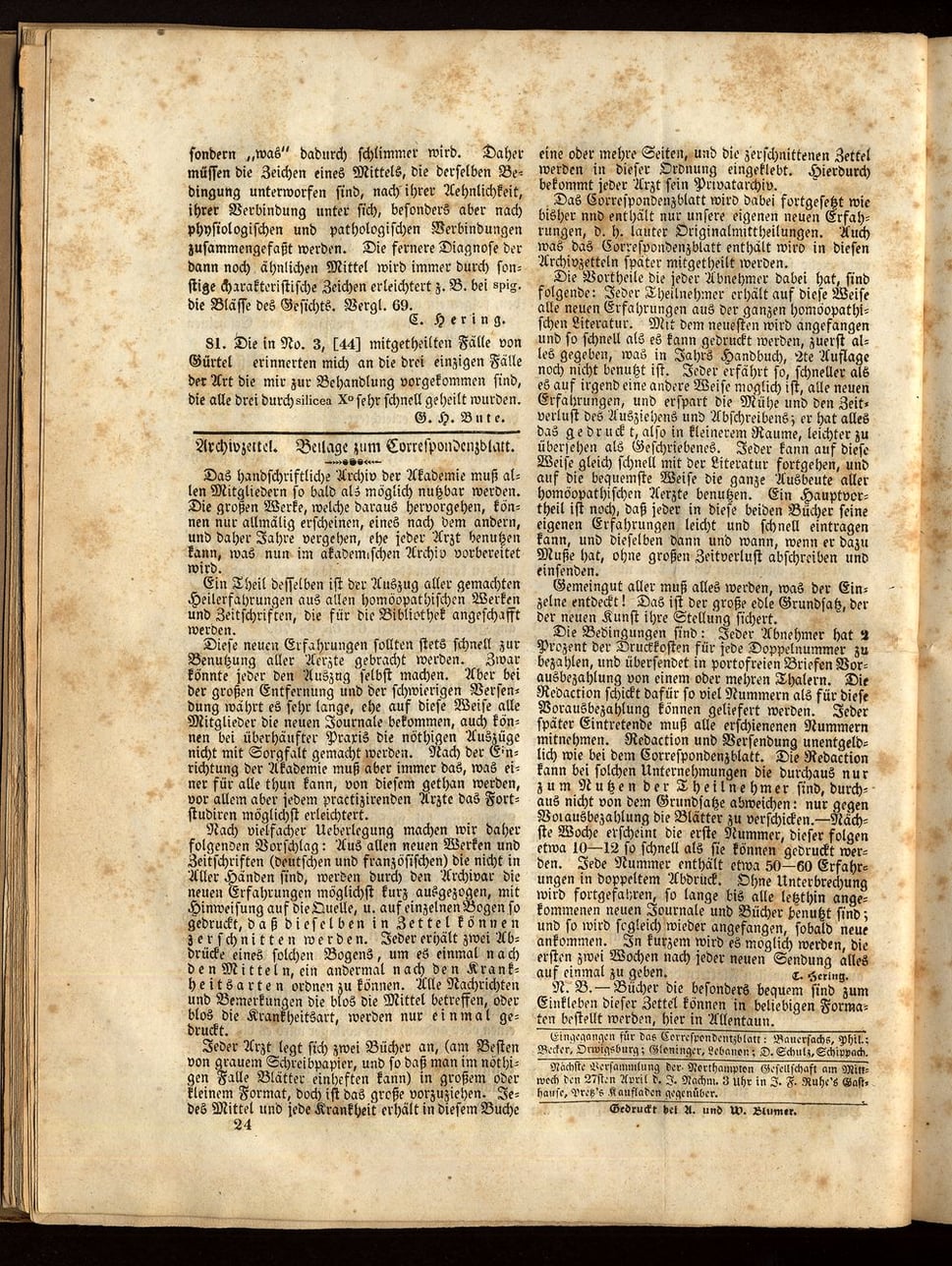
fördern „was" dadurch schlimmer wird. Daher müssen die Zeichen eines Mittels, die der selben Bedingung unterworfen sind, nach ihrer Lehnlichkeit, ihrer Verbindung unter sich, besonders aber nach physiologischen und pathologischen Verbindungen zusammengesetzt werden. Die fernere Diagnose der dann noch ähnlichen Mittel wird immer durch sonstige charakteristische Zeichen erleichtert z. B. bei spig. die Blässe des Gesichts. Bergl. 69. C. Hering. 81. Die in No. 3, [44] mitgetheilten Fälle von Gürtel erinnerten mich an die drei einzigen Fälle der Art die mir zur Behandlung vorgekommen sind, die alle drei durchsilicea Xo sehr schnell geheilt wurden. G. H. Bute. Archivzettel. Beilage zum Correspondenzblatt. Das handelsmässige Archiv der Akademie muss allen Mitgliedern so bald als möglich zugänglich werden. Die großen Werke, welche daraus hervorgehen, können nur allmählich erscheinen, eines nach dem andern, und daher Jahre vergehen, ehe jeder Arzt benutzen kann, was nun im akademischen Archiv vorbereitet wird. Ein Theil desselben ist der Auszug aller gemachten Heilerfahrungen aus allen homöopathischen Werken und Zeitschriften, die für die Bibliothek angeschafft werden. Diese neuen Erfahrungen sollten stets schnell zur Benutzung aller Ärzte gebracht werden. Zwar könnte jeder den Auszug selbst machen. Aber bei der grossen Entfernung und der schwierigen Berufung wählt es sehr lange, ehe auf diese Weise alle Mitglieder die neuen Journale bekommen, auch können bei überhauster Praxis die nötigen Auszüge nicht mit Sorgfalt gemacht werden. Nach der Einrichtung der Akademie muss aber immer das, was einer für alle thun kann, von diesem gethan werden, vor allem aber jedem praktizirenden Arzte das Fortstudiren möglichst erleichtert. Nach vielfacher Uberlegung machen wir daher folgenden Vorschlag: Aus allen neuen Werken und Zeitschriften (deutschen und französischen) die nicht in Allen Händen sind, werden durch den Archivar die neuen Erfahrungen möglichst kurz ausgezogen, mit Hinweisung auf die Quelle, u. auf einzelnen Bogen so gedruckt, dass dieselben in Zettel können erschritten werden. Jeder erhält zwei Abdrücke eines solchen Bogens, um es einmal nach den Mitteln, ein andermal nach den Krankheitsarten ordnen zu können. Alle Nachrichten und Bemerkungen die bloss die Mittel betreffen, oder bloss die Krankheitssatz, werden nur einmal gedruckt. Jeder Arzt legt sich zwei Bücher an, (am Besten von grauem Schreibpapier, und so dass man im nothigen Falle Blätter einheften kann) in grossen oder kleinen Format, doch ist das grosse vorzuziehen. Jede Mittel und jede Krankheit erhält in diesem Buche eine oder mehrere Seiten, und die erschrittenen Zettel werden in dieser Ordnung eingelebt. Hierdurch kommt jedes Arzt sein Privatarchiv. Das Correspondenzblatt wird dabei fortgesetzt wie bisher und enthalt nur unsere eigenen neuen Erfahrungen, d. h. lauter Originalmittheilungen. Auch was das Correspondenzblatt enthält wird in diesen Archivzetteln später mitgetheilt werden. Die Vortheile die jeder Abnehmer dabei hat, sind folgende: Jeder Theilnehmer erhält auf diese Weise alle neuen Erfahrungen aus der ganzen homöopathischen Literatur. Mit dem neuesten wird angefangen und so schnell als es kann gedruckt werden, zuerst alles gegeben, was in Jahres Handbuch, 2te Auflage noch nicht benutzt ist. Jeder erfährt so schneller als es auf irgend eine andere Weise möglich ist, alle neuen Erfahrungen, und erspart die Mühe und den Zeitverlust des Aussiehens und Abschreibens; er hat alles das g e d r u c k t , also in kleinem Raum, leichter zu übersehen als Geschriebenes. Jeder kann auf diese Weise gleich schnell mit der Literatur fortgehen, und auf die bequemste Weise die ganze Ausbeute aller homöopathischen Arznei benutzen. Ein Hauptvortheil ist noch, dass jeder in diese beiden Bücher seine eigenen Erfahrungen leicht und schnell eintragen kann, und dieselben dann und wann, wenn er dazu Muße hat, ohne großen Zeitverlust abschreiben und einsenden. Gemeinsam aller muss alles werden, was der Einzelne entdeckt! Das ist der große edle Grundfag, der der neuen Kunst ihre Stellung sichert. Die Bedingungen sind: Jeder Abnehmer hat 2 Prozent der Druckkosten für jede Doppelnummer zu bezahlen, und übersehnet in portofreien Briefen Vorabbezahlang von einem oder mehreren Thalern. Die Redaction schickt dafür so viel Nummern als für diese Vorabbezahlang können geliefert werden. Jeder später Eintretende muss alle erschienenen Nummern mitnehmen. Redaction und Versendung unentgeltlich wie bei dem Correspondenzblatt. Die Redaction kann bei solchen Unternehmungen die durchaus nur zum N u t z e n d e r T e i l n e h m e r sind, durchaus nicht von dem Grundsache abweichen: nur gegen Vorabbezahlang die Blätter zu verschicken.—Nächste Woche erscheint die erste Nummer, dieser folgen etwa 10—12 so schnell als sie können gedruckt werden. Jede Nummer enthält etwa 50—60 Erfahrungen in doppelter Abdruck. Ohne Unterbrechung wird fortgesetzt, so lange bis alle lebhin angekommenen neuen Journale und Bücher benutzt sind; und so wird gleich wieder angefangen, sobald neue ankommen. In kurzer wird es möglich werden, die ersten zwei Wochen nach jeder neuen Sendung alles auf einmal zu geben. C. Hering. N. B. — Bücher die besonders bequem sind zum Einkleben dieser Zettel können in beliebigem Formate bestellt werden, hier in Altenau. Eingangsort für das Correspondenzblatt: Bauersachs, Phil.: Gieder, Dornburg; Glenninger, Leoben; D. Schulz, Schipbach. Nächste Veranlassung der Northampton Gesellschaft am Mittwoch den 27ten April &. 7. Nachm. 3 Uhr in F. R. Ruhe's Gasthaus, Preis's Kaufladen gegenüber. Gedruckt bei A. und W. Blumer.
OCR Text
reason in changing my course of view or conduct. I cannot permit myself to be a party any more to the grade-striving or incapacitants. If any means can be devised to secure herself from such results as have been reached this session, I shall only be too happy & labor on in St. College & for the Cause as heretofore—but a mere resolve & pledge will not assure me: thus we have had before—several probably did so & really have a stronger desire to do right than previous to the voting this Spring. I yet—in my view & in yours too, now, if I mistake not—the faculty immutably proceed to do wrong—what will prevent such things from recurring? Not resolutions—not pledges. One may as many others have done—"resolve & unresolve—time is the same"—If a reconstruction of regulations or any other mode of effecting the object can be devised I shall be glad, if not—I cannot be induced to remain for I have full made up my mind never to sign an invalid diploma.
Version History (3 versions)
- ✓ v3 (current) · 12/16/2025, 3:31:04 AM
"OCR: Updated 2 refs" - v2 · 12/16/2025, 3:28:10 AM · View this version
"Added to parent 01KCJK6ZB20FHD1VRQZE3V6WDZ" - v1 · 12/16/2025, 3:28:09 AM · View this version
"Initial discovery snapshot"
Additional Components
book_13.txt
BOOK XIII


ULYSSES LEAVES SCHERIA AND RETURNS TO ITHACA.


Thus did he speak, and they all held their peace throughout the covered
cloister, enthralled by the charm of his story, till presently Alcinous
began to speak.

“Ulysses,” said he, “now that you have reached my house I doubt not you
will get home without further misadventure no matter how much you have
suffered in the past. To you others, however, who come here night after
night to drink my choicest wine and listen to my bard, I would insist
as follows. Our guest has already packed up the clothes, wrought
gold,108 and other valuables which you have brought for his acceptance;
let us now, therefore, present him further, each one of us, with a
large tripod and a cauldron. We will recoup ourselves by the levy of a
general rate; for private individuals cannot be expected to bear the
burden of such a handsome present.”

Every one approved of this, and then they went home to bed each in his
own abode. When the child of morning, rosy-fingered Dawn, appeared they
hurried down to the ship and brought their cauldrons with them.
Alcinous went on board and saw everything so securely stowed under the
ship’s benches that nothing could break adrift and injure the rowers.
Then they went to the house of Alcinous to get dinner, and he
sacrificed a bull for them in honour of Jove who is the lord of all.
They set the steaks to grill and made an excellent dinner, after which
the inspired bard, Demodocus, who was a favourite with every one, sang
to them; but Ulysses kept on turning his eyes towards the sun, as
though to hasten his setting, for he was longing to be on his way. As
one who has been all day ploughing a fallow field with a couple of oxen
keeps thinking about his supper and is glad when night comes that he
may go and get it, for it is all his legs can do to carry him, even so
did Ulysses rejoice when the sun went down, and he at once said to the
Phaeacians, addressing himself more particularly to King Alcinous:

“Sir, and all of you, farewell. Make your drink-offerings and send me
on my way rejoicing, for you have fulfilled my heart’s desire by giving
me an escort, and making me presents, which heaven grant that I may
turn to good account; may I find my admirable wife living in peace
among friends,109 and may you whom I leave behind me give satisfaction
to your wives and children;110 may heaven vouchsafe you every good
grace, and may no evil thing come among your people.”

Thus did he speak. His hearers all of them approved his saying and
agreed that he should have his escort inasmuch as he had spoken
reasonably. Alcinous therefore said to his servant, “Pontonous, mix
some wine and hand it round to everybody, that we may offer a prayer to
father Jove, and speed our guest upon his way.”

Pontonous mixed the wine and handed it to every one in turn; the others
each from his own seat made a drink-offering to the blessed gods that
live in heaven, but Ulysses rose and placed the double cup in the hands
of queen Arete.

“Farewell, queen,” said he, “henceforward and for ever, till age and
death, the common lot of mankind, lay their hands upon you. I now take
my leave; be happy in this house with your children, your people, and
with king Alcinous.”

As he spoke he crossed the threshold, and Alcinous sent a man to
conduct him to his ship and to the sea shore. Arete also sent some
maidservants with him—one with a clean shirt and cloak, another to
carry his strong box, and a third with corn and wine. When they got to
the water side the crew took these things and put them on board, with
all the meat and drink; but for Ulysses they spread a rug and a linen
sheet on deck that he might sleep soundly in the stern of the ship.
Then he too went on board and lay down without a word, but the crew
took every man his place and loosed the hawser from the pierced stone
to which it had been bound. Thereon, when they began rowing out to sea,
Ulysses fell into a deep, sweet, and almost deathlike slumber.111

The ship bounded forward on her way as a four in hand chariot flies
over the course when the horses feel the whip. Her prow curvetted as it
were the neck of a stallion, and a great wave of dark blue water
seethed in her wake. She held steadily on her course, and even a
falcon, swiftest of all birds, could not have kept pace with her. Thus,
then, she cut her way through the water, carrying one who was as
cunning as the gods, but who was now sleeping peacefully, forgetful of
all that he had suffered both on the field of battle and by the waves
of the weary sea.

When the bright star that heralds the approach of dawn began to show,
the ship drew near to land.112 Now there is in Ithaca a haven of the
old merman Phorcys, which lies between two points that break the line
of the sea and shut the harbour in. These shelter it from the storms of
wind and sea that rage outside, so that, when once within it, a ship
may lie without being even moored. At the head of this harbour there is
a large olive tree, and at no great distance a fine overarching cavern
sacred to the nymphs who are called Naiads.113 There are mixing bowls
within it and wine-jars of stone, and the bees hive there. Moreover,
there are great looms of stone on which the nymphs weave their robes of
sea purple—very curious to see—and at all times there is water within
it. It has two entrances, one facing North by which mortals can go down
into the cave, while the other comes from the South and is more
mysterious; mortals cannot possibly get in by it, it is the way taken
by the gods.

Into this harbour, then, they took their ship, for they knew the
place.114 She had so much way upon her that she ran half her own length
on to the shore;115 when, however, they had landed, the first thing
they did was to lift Ulysses with his rug and linen sheet out of the
ship, and lay him down upon the sand still fast asleep. Then they took
out the presents which Minerva had persuaded the Phaeacians to give him
when he was setting out on his voyage homewards. They put these all
together by the root of the olive tree, away from the road, for fear
some passer by116 might come and steal them before Ulysses awoke; and
then they made the best of their way home again.

But Neptune did not forget the threats with which he had already
threatened Ulysses, so he took counsel with Jove. “Father Jove,” said
he, “I shall no longer be held in any sort of respect among you gods,
if mortals like the Phaeacians, who are my own flesh and blood, show
such small regard for me. I said I would let Ulysses get home when he
had suffered sufficiently. I did not say that he should never get home
at all, for I knew you had already nodded your head about it, and
promised that he should do so; but now they have brought him in a ship
fast asleep and have landed him in Ithaca after loading him with more
magnificent presents of bronze, gold, and raiment than he would ever
have brought back from Troy, if he had had his share of the spoil and
got home without misadventure.”

And Jove answered, “What, O Lord of the Earthquake, are you talking
about? The gods are by no means wanting in respect for you. It would be
monstrous were they to insult one so old and honoured as you are. As
regards mortals, however, if any of them is indulging in insolence and
treating you disrespectfully, it will always rest with yourself to deal
with him as you may think proper, so do just as you please.”

“I should have done so at once,” replied Neptune, “if I were not
anxious to avoid anything that might displease you; now, therefore, I
should like to wreck the Phaeacian ship as it is returning from its
escort. This will stop them from escorting people in future; and I
should also like to bury their city under a huge mountain.”

“My good friend,” answered Jove, “I should recommend you at the very
moment when the people from the city are watching the ship on her way,
to turn it into a rock near the land and looking like a ship. This will
astonish everybody, and you can then bury their city under the
mountain.”

When earth-encircling Neptune heard this he went to Scheria where the
Phaeacians live, and stayed there till the ship, which was making rapid
way, had got close in. Then he went up to it, turned it into stone, and
drove it down with the flat of his hand so as to root it in the ground.
After this he went away.

The Phaeacians then began talking among themselves, and one would turn
towards his neighbour, saying, “Bless my heart, who is it that can have
rooted the ship in the sea just as she was getting into port? We could
see the whole of her only a moment ago.”

This was how they talked, but they knew nothing about it; and Alcinous
said, “I remember now the old prophecy of my father. He said that
Neptune would be angry with us for taking every one so safely over the
sea, and would one day wreck a Phaeacian ship as it was returning from
an escort, and bury our city under a high mountain. This was what my
old father used to say, and now it is all coming true.117 Now therefore
let us all do as I say; in the first place we must leave off giving
people escorts when they come here, and in the next let us sacrifice
twelve picked bulls to Neptune that he may have mercy upon us, and not
bury our city under the high mountain.” When the people heard this they
were afraid and got ready the bulls.

Thus did the chiefs and rulers of the Phaeacians pray to king Neptune,
standing round his altar; and at the same time118 Ulysses woke up once
more upon his own soil. He had been so long away that he did not know
it again; moreover, Jove’s daughter Minerva had made it a foggy day, so
that people might not know of his having come, and that she might tell
him everything without either his wife or his fellow citizens and
friends recognising him119 until he had taken his revenge upon the
wicked suitors. Everything, therefore, seemed quite different to
him—the long straight tracks, the harbours, the precipices, and the
goodly trees, appeared all changed as he started up and looked upon his
native land. So he smote his thighs with the flat of his hands and
cried aloud despairingly.

“Alas,” he exclaimed, “among what manner of people am I fallen? Are
they savage and uncivilised or hospitable and humane? Where shall I put
all this treasure, and which way shall I go? I wish I had staid over
there with the Phaeacians; or I could have gone to some other great
chief who would have been good to me and given me an escort. As it is I
do not know where to put my treasure, and I cannot leave it here for
fear somebody else should get hold of it. In good truth the chiefs and
rulers of the Phaeacians have not been dealing fairly by me, and have
left me in the wrong country; they said they would take me back to
Ithaca and they have not done so: may Jove the protector of suppliants
chastise them, for he watches over everybody and punishes those who do
wrong. Still, I suppose I must count my goods and see if the crew have
gone off with any of them.”

He counted his goodly coppers and cauldrons, his gold and all his
clothes, but there was nothing missing; still he kept grieving about
not being in his own country, and wandered up and down by the shore of
the sounding sea bewailing his hard fate. Then Minerva came up to him
disguised as a young shepherd of delicate and princely mien, with a
good cloak folded double about her shoulders; she had sandals on her
comely feet and held a javelin in her hand. Ulysses was glad when he
saw her, and went straight up to her.

“My friend,” said he, “you are the first person whom I have met with in
this country; I salute you, therefore, and beg you to be well disposed
towards me. Protect these my goods, and myself too, for I embrace your
knees and pray to you as though you were a god. Tell me, then, and tell
me truly, what land and country is this? Who are its inhabitants? Am I
on an island, or is this the sea board of some continent?”

Minerva answered, “Stranger, you must be very simple, or must have come
from somewhere a long way off, not to know what country this is. It is
a very celebrated place, and everybody knows it East and West. It is
rugged and not a good driving country, but it is by no means a bad
island for what there is of it. It grows any quantity of corn and also
wine, for it is watered both by rain and dew; it breeds cattle also and
goats; all kinds of timber grow here, and there are watering places
where the water never runs dry; so, sir, the name of Ithaca is known
even as far as Troy, which I understand to be a long way off from this
Achaean country.”

Ulysses was glad at finding himself, as Minerva told him, in his own
country, and he began to answer, but he did not speak the truth, and
made up a lying story in the instinctive wiliness of his heart.

“I heard of Ithaca,” said he, “when I was in Crete beyond the seas, and
now it seems I have reached it with all these treasures. I have left as
much more behind me for my children, but am flying because I killed
Orsilochus son of Idomeneus, the fleetest runner in Crete. I killed him
because he wanted to rob me of the spoils I had got from Troy with so
much trouble and danger both on the field of battle and by the waves of
the weary sea; he said I had not served his father loyally at Troy as
vassal, but had set myself up as an independent ruler, so I lay in wait
for him with one of my followers by the road side, and speared him as
he was coming into town from the country. It was a very dark night and
nobody saw us; it was not known, therefore, that I had killed him, but
as soon as I had done so I went to a ship and besought the owners, who
were Phoenicians, to take me on board and set me in Pylos or in Elis
where the Epeans rule, giving them as much spoil as satisfied them.
They meant no guile, but the wind drove them off their course, and we
sailed on till we came hither by night. It was all we could do to get
inside the harbour, and none of us said a word about supper though we
wanted it badly, but we all went on shore and lay down just as we were.
I was very tired and fell asleep directly, so they took my goods out of
the ship, and placed them beside me where I was lying upon the sand.
Then they sailed away to Sidonia, and I was left here in great distress
of mind.”

Such was his story, but Minerva smiled and caressed him with her hand.
Then she took the form of a woman, fair, stately, and wise, “He must be
indeed a shifty lying fellow,” said she, “who could surpass you in all
manner of craft even though you had a god for your antagonist. Dare
devil that you are, full of guile, unwearying in deceit, can you not
drop your tricks and your instinctive falsehood, even now that you are
in your own country again? We will say no more, however, about this,
for we can both of us deceive upon occasion—you are the most
accomplished counsellor and orator among all mankind, while I for
diplomacy and subtlety have no equal among the gods. Did you not know
Jove’s daughter Minerva—me, who have been ever with you, who kept watch
over you in all your troubles, and who made the Phaeacians take so
great a liking to you? And now, again, I am come here to talk things
over with you, and help you to hide the treasure I made the Phaeacians
give you; I want to tell you about the troubles that await you in your
own house; you have got to face them, but tell no one, neither man nor
woman, that you have come home again. Bear everything, and put up with
every man’s insolence, without a word.”

And Ulysses answered, “A man, goddess, may know a great deal, but you
are so constantly changing your appearance that when he meets you it is
a hard matter for him to know whether it is you or not. This much,
however, I know exceedingly well; you were very kind to me as long as
we Achaeans were fighting before Troy, but from the day on which we
went on board ship after having sacked the city of Priam, and heaven
dispersed us—from that day, Minerva, I saw no more of you, and cannot
ever remember your coming to my ship to help me in a difficulty; I had
to wander on sick and sorry till the gods delivered me from evil and I
reached the city of the Phaeacians, where you encouraged me and took me
into the town.120 And now, I beseech you in your father’s name, tell me
the truth, for I do not believe I am really back in Ithaca. I am in
some other country and you are mocking me and deceiving me in all you
have been saying. Tell me then truly, have I really got back to my own
country?”

“You are always taking something of that sort in your head,” replied
Minerva, “and that is why I cannot desert you in your afflictions; you
are so plausible, shrewd and shifty. Any one but yourself on returning
from so long a voyage would at once have gone home to see his wife and
children, but you do not seem to care about asking after them or
hearing any news about them till you have exploited your wife, who
remains at home vainly grieving for you, and having no peace night or
day for the tears she sheds on your behalf. As for my not coming near
you, I was never uneasy about you, for I was certain you would get back
safely though you would lose all your men, and I did not wish to
quarrel with my uncle Neptune, who never forgave you for having blinded
his son.121 I will now, however, point out to you the lie of the land,
and you will then perhaps believe me. This is the haven of the old
merman Phorcys, and here is the olive tree that grows at the head of
it; [near it is the cave sacred to the Naiads;122 here too is the
overarching cavern in which you have offered many an acceptable
hecatomb to the nymphs, and this is the wooded mountain Neritum.”

As she spoke the goddess dispersed the mist and the land appeared. Then
Ulysses rejoiced at finding himself again in his own land, and kissed
the bounteous soil; he lifted up his hands and prayed to the nymphs,
saying, “Naiad nymphs, daughters of Jove, I made sure that I was never
again to see you, now therefore I greet you with all loving
salutations, and I will bring you offerings as in the old days, if
Jove’s redoubtable daughter will grant me life, and bring my son to
manhood.”

“Take heart, and do not trouble yourself about that,” rejoined Minerva,
“let us rather set about stowing your things at once in the cave, where
they will be quite safe. Let us see how we can best manage it all.”

Therewith she went down into the cave to look for the safest hiding
places, while Ulysses brought up all the treasure of gold, bronze, and
good clothing which the Phaeacians had given him. They stowed
everything carefully away, and Minerva set a stone against the door of
the cave. Then the two sat down by the root of the great olive, and
consulted how to compass the destruction of the wicked suitors.

“Ulysses,” said Minerva, “noble son of Laertes, think how you can lay
hands on these disreputable people who have been lording it in your
house these three years, courting your wife and making wedding presents
to her, while she does nothing but lament your absence, giving hope and
sending encouraging messages123 to every one of them, but meaning the
very opposite of all she says.”

And Ulysses answered, “In good truth, goddess, it seems I should have
come to much the same bad end in my own house as Agamemnon did, if you
had not given me such timely information. Advise me how I shall best
avenge myself. Stand by my side and put your courage into my heart as
on the day when we loosed Troy’s fair diadem from her brow. Help me now
as you did then, and I will fight three hundred men, if you, goddess,
will be with me.”

“Trust me for that,” said she, “I will not lose sight of you when once
we set about it, and I imagine that some of those who are devouring
your substance will then bespatter the pavement with their blood and
brains. I will begin by disguising you so that no human being shall
know you; I will cover your body with wrinkles; you shall lose all your
yellow hair; I will clothe you in a garment that shall fill all who see
it with loathing; I will blear your fine eyes for you, and make you an
unseemly object in the sight of the suitors, of your wife, and of the
son whom you left behind you. Then go at once to the swineherd who is
in charge of your pigs; he has been always well affected towards you,
and is devoted to Penelope and your son; you will find him feeding his
pigs near the rock that is called Raven124 by the fountain Arethusa,
where they are fattening on beechmast and spring water after their
manner. Stay with him and find out how things are going, while I
proceed to Sparta and see your son, who is with Menelaus at Lacedaemon,
where he has gone to try and find out whether you are still alive.”125

“But why,” said Ulysses, “did you not tell him, for you knew all about
it? Did you want him too to go sailing about amid all kinds of hardship
while others are eating up his estate?”

Minerva answered, “Never mind about him, I sent him that he might be
well spoken of for having gone. He is in no sort of difficulty, but is
staying quite comfortably with Menelaus, and is surrounded with
abundance of every kind. The suitors have put out to sea and are lying
in wait for him, for they mean to kill him before he can get home. I do
not much think they will succeed, but rather that some of those who are
now eating up your estate will first find a grave themselves.”

As she spoke Minerva touched him with her wand and covered him with
wrinkles, took away all his yellow hair, and withered the flesh over
his whole body; she bleared his eyes, which were naturally very fine
ones; she changed his clothes and threw an old rag of a wrap about him,
and a tunic, tattered, filthy, and begrimed with smoke; she also gave
him an undressed deer skin as an outer garment, and furnished him with
a staff and a wallet all in holes, with a twisted thong for him to
sling it over his shoulder.

When the pair had thus laid their plans they parted, and the goddess
went straight to Lacedaemon to fetch Telemachus.
book_14.txt
BOOK XIV


ULYSSES IN THE HUT WITH EUMAEUS.


Ulysses now left the haven, and took the rough track up through the
wooded country and over the crest of the mountain till he reached the
place where Minerva had said that he would find the swineherd, who was
the most thrifty servant he had. He found him sitting in front of his
hut, which was by the yards that he had built on a site which could be
seen from far. He had made them spacious126 and fair to see, with a
free run for the pigs all round them; he had built them during his
master’s absence, of stones which he had gathered out of the ground,
without saying anything to Penelope or Laertes, and he had fenced them
on top with thorn bushes. Outside the yard he had run a strong fence of
oaken posts, split, and set pretty close together, while inside he had
built twelve styes near one another for the sows to lie in. There were
fifty pigs wallowing in each stye, all of them breeding sows; but the
boars slept outside and were much fewer in number, for the suitors kept
on eating them, and the swineherd had to send them the best he had
continually. There were three hundred and sixty boar pigs, and the
herdsman’s four hounds, which were as fierce as wolves, slept always
with them. The swineherd was at that moment cutting out a pair of
sandals127 from a good stout ox hide. Three of his men were out herding
the pigs in one place or another, and he had sent the fourth to town
with a boar that he had been forced to send the suitors that they might
sacrifice it and have their fill of meat.

When the hounds saw Ulysses they set up a furious barking and flew at
him, but Ulysses was cunning enough to sit down and loose his hold of
the stick that he had in his hand: still, he would have been torn by
them in his own homestead had not the swineherd dropped his ox hide,
rushed full speed through the gate of the yard and driven the dogs off
by shouting and throwing stones at them. Then he said to Ulysses, “Old
man, the dogs were likely to have made short work of you, and then you
would have got me into trouble. The gods have given me quite enough
worries without that, for I have lost the best of masters, and am in
continual grief on his account. I have to attend swine for other people
to eat, while he, if he yet lives to see the light of day, is starving
in some distant land. But come inside, and when you have had your fill
of bread and wine, tell me where you come from, and all about your
misfortunes.”

On this the swineherd led the way into the hut and bade him sit down.
He strewed a good thick bed of rushes upon the floor, and on the top of
this he threw the shaggy chamois skin—a great thick one—on which he
used to sleep by night. Ulysses was pleased at being made thus welcome,
and said “May Jove, sir, and the rest of the gods grant you your
heart’s desire in return for the kind way in which you have received
me.”

To this you answered, O swineherd Eumaeus, “Stranger, though a still
poorer man should come here, it would not be right for me to insult
him, for all strangers and beggars are from Jove. You must take what
you can get and be thankful, for servants live in fear when they have
young lords for their masters; and this is my misfortune now, for
heaven has hindered the return of him who would have been always good
to me and given me something of my own—a house, a piece of land, a good
looking wife, and all else that a liberal master allows a servant who
has worked hard for him, and whose labour the gods have prospered as
they have mine in the situation which I hold. If my master had grown
old here he would have done great things by me, but he is gone, and I
wish that Helen’s whole race were utterly destroyed, for she has been
the death of many a good man. It was this matter that took my master to
Ilius, the land of noble steeds, to fight the Trojans in the cause of
king Agamemnon.”

As he spoke he bound his girdle round him and went to the styes where
the young sucking pigs were penned. He picked out two which he brought
back with him and sacrificed. He singed them, cut them up, and spitted
them; when the meat was cooked he brought it all in and set it before
Ulysses, hot and still on the spit, whereon Ulysses sprinkled it over
with white barley meal. The swineherd then mixed wine in a bowl of
ivy-wood, and taking a seat opposite Ulysses told him to begin.

“Fall to, stranger,” said he, “on a dish of servant’s pork. The fat
pigs have to go to the suitors, who eat them up without shame or
scruple; but the blessed gods love not such shameful doings, and
respect those who do what is lawful and right. Even the fierce
freebooters who go raiding on other people’s land, and Jove gives them
their spoil—even they, when they have filled their ships and got home
again live conscience-stricken, and look fearfully for judgement; but
some god seems to have told these people that Ulysses is dead and gone;
they will not, therefore, go back to their own homes and make their
offers of marriage in the usual way, but waste his estate by force,
without fear or stint. Not a day or night comes out of heaven, but they
sacrifice not one victim nor two only, and they take the run of his
wine, for he was exceedingly rich. No other great man either in Ithaca
or on the mainland is as rich as he was; he had as much as twenty men
put together. I will tell you what he had. There are twelve herds of
cattle upon the main land, and as many flocks of sheep, there are also
twelve droves of pigs, while his own men and hired strangers feed him
twelve widely spreading herds of goats. Here in Ithaca he runs even
large flocks of goats on the far end of the island, and they are in the
charge of excellent goat herds. Each one of these sends the suitors the
best goat in the flock every day. As for myself, I am in charge of the
pigs that you see here, and I have to keep picking out the best I have
and sending it to them.”

This was his story, but Ulysses went on eating and drinking ravenously
without a word, brooding his revenge. When he had eaten enough and was
satisfied, the swineherd took the bowl from which he usually drank,
filled it with wine, and gave it to Ulysses, who was pleased, and said
as he took it in his hands, “My friend, who was this master of yours
that bought you and paid for you, so rich and so powerful as you tell
me? You say he perished in the cause of King Agamemnon; tell me who he
was, in case I may have met with such a person. Jove and the other gods
know, but I may be able to give you news of him, for I have travelled
much.”

Eumaeus answered, “Old man, no traveller who comes here with news will
get Ulysses’ wife and son to believe his story. Nevertheless, tramps in
want of a lodging keep coming with their mouths full of lies, and not a
word of truth; every one who finds his way to Ithaca goes to my
mistress and tells her falsehoods, whereon she takes them in, makes
much of them, and asks them all manner of questions, crying all the
time as women will when they have lost their husbands. And you too, old
man, for a shirt and a cloak would doubtless make up a very pretty
story. But the wolves and birds of prey have long since torn Ulysses to
pieces, or the fishes of the sea have eaten him, and his bones are
lying buried deep in sand upon some foreign shore; he is dead and gone,
and a bad business it is for all his friends—for me especially; go
where I may I shall never find so good a master, not even if I were to
go home to my mother and father where I was bred and born. I do not so
much care, however, about my parents now, though I should dearly like
to see them again in my own country; it is the loss of Ulysses that
grieves me most; I cannot speak of him without reverence though he is
here no longer, for he was very fond of me, and took such care of me
that wherever he may be I shall always honour his memory.”

“My friend,” replied Ulysses, “you are very positive, and very hard of
belief about your master’s coming home again, nevertheless I will not
merely say, but will swear, that he is coming. Do not give me anything
for my news till he has actually come, you may then give me a shirt and
cloak of good wear if you will. I am in great want, but I will not take
anything at all till then, for I hate a man, even as I hate hell fire,
who lets his poverty tempt him into lying. I swear by king Jove, by the
rites of hospitality, and by that hearth of Ulysses to which I have now
come, that all will surely happen as I have said it will. Ulysses will
return in this self same year; with the end of this moon and the
beginning of the next he will be here to do vengeance on all those who
are ill treating his wife and son.”

To this you answered, O swineherd Eumaeus, “Old man, you will neither
get paid for bringing good news, nor will Ulysses ever come home; drink
your wine in peace, and let us talk about something else. Do not keep
on reminding me of all this; it always pains me when any one speaks
about my honoured master. As for your oath we will let it alone, but I
only wish he may come, as do Penelope, his old father Laertes, and his
son Telemachus. I am terribly unhappy too about this same boy of his;
he was running up fast into manhood, and bade fare to be no worse man,
face and figure, than his father, but some one, either god or man, has
been unsettling his mind, so he has gone off to Pylos to try and get
news of his father, and the suitors are lying in wait for him as he is
coming home, in the hope of leaving the house of Arceisius without a
name in Ithaca. But let us say no more about him, and leave him to be
taken, or else to escape if the son of Saturn holds his hand over him
to protect him. And now, old man, tell me your own story; tell me also,
for I want to know, who you are and where you come from. Tell me of
your town and parents, what manner of ship you came in, how crew
brought you to Ithaca, and from what country they professed to come—for
you cannot have come by land.”

And Ulysses answered, “I will tell you all about it. If there were meat
and wine enough, and we could stay here in the hut with nothing to do
but to eat and drink while the others go to their work, I could easily
talk on for a whole twelve months without ever finishing the story of
the sorrows with which it has pleased heaven to visit me.

“I am by birth a Cretan; my father was a well to do man, who had many
sons born in marriage, whereas I was the son of a slave whom he had
purchased for a concubine; nevertheless, my father Castor son of Hylax
(whose lineage I claim, and who was held in the highest honour among
the Cretans for his wealth, prosperity, and the valour of his sons) put
me on the same level with my brothers who had been born in wedlock.
When, however, death took him to the house of Hades, his sons divided
his estate and cast lots for their shares, but to me they gave a
holding and little else; nevertheless, my valour enabled me to marry
into a rich family, for I was not given to bragging, or shirking on the
field of battle. It is all over now; still, if you look at the straw
you can see what the ear was, for I have had trouble enough and to
spare. Mars and Minerva made me doughty in war; when I had picked my
men to surprise the enemy with an ambuscade I never gave death so much
as a thought, but was the first to leap forward and spear all whom I
could overtake. Such was I in battle, but I did not care about farm
work, nor the frugal home life of those who would bring up children. My
delight was in ships, fighting, javelins, and arrows—things that most
men shudder to think of; but one man likes one thing and another
another, and this was what I was most naturally inclined to. Before the
Achaeans went to Troy, nine times was I in command of men and ships on
foreign service, and I amassed much wealth. I had my pick of the spoil
in the first instance, and much more was allotted to me later on.

“My house grew apace and I became a great man among the Cretans, but
when Jove counselled that terrible expedition, in which so many
perished, the people required me and Idomeneus to lead their ships to
Troy, and there was no way out of it, for they insisted on our doing
so. There we fought for nine whole years, but in the tenth we sacked
the city of Priam and sailed home again as heaven dispersed us. Then it
was that Jove devised evil against me. I spent but one month happily
with my children, wife, and property, and then I conceived the idea of
making a descent on Egypt, so I fitted out a fine fleet and manned it.
I had nine ships, and the people flocked to fill them. For six days I
and my men made feast, and I found them many victims both for sacrifice
to the gods and for themselves, but on the seventh day we went on board
and set sail from Crete with a fair North wind behind us though we were
going down a river. Nothing went ill with any of our ships, and we had
no sickness on board, but sat where we were and let the ships go as the
wind and steersmen took them. On the fifth day we reached the river
Aegyptus; there I stationed my ships in the river, bidding my men stay
by them and keep guard over them while I sent out scouts to reconnoitre
from every point of vantage.

“But the men disobeyed my orders, took to their own devices, and
ravaged the land of the Egyptians, killing the men, and taking their
wives and children captive. The alarm was soon carried to the city, and
when they heard the war cry, the people came out at daybreak till the
plain was filled with horsemen and foot soldiers and with the gleam of
armour. Then Jove spread panic among my men, and they would no longer
face the enemy, for they found themselves surrounded. The Egyptians
killed many of us, and took the rest alive to do forced labour for
them. Jove, however, put it in my mind to do thus—and I wish I had died
then and there in Egypt instead, for there was much sorrow in store for
me—I took off my helmet and shield and dropped my spear from my hand;
then I went straight up to the king’s chariot, clasped his knees and
kissed them, whereon he spared my life, bade me get into his chariot,
and took me weeping to his own home. Many made at me with their ashen
spears and tried to kill me in their fury, but the king protected me,
for he feared the wrath of Jove the protector of strangers, who
punishes those who do evil.

“I stayed there for seven years and got together much money among the
Egyptians, for they all gave me something; but when it was now going on
for eight years there came a certain Phoenician, a cunning rascal, who
had already committed all sorts of villainy, and this man talked me
over into going with him to Phoenicia, where his house and his
possessions lay. I stayed there for a whole twelve months, but at the
end of that time when months and days had gone by till the same season
had come round again, he set me on board a ship bound for Libya, on a
pretence that I was to take a cargo along with him to that place, but
really that he might sell me as a slave and take the money I fetched. I
suspected his intention, but went on board with him, for I could not
help it.

“The ship ran before a fresh North wind till we had reached the sea
that lies between Crete and Libya; there, however, Jove counselled
their destruction, for as soon as we were well out from Crete and could
see nothing but sea and sky, he raised a black cloud over our ship and
the sea grew dark beneath it. Then Jove let fly with his thunderbolts
and the ship went round and round and was filled with fire and
brimstone as the lightning struck it. The men fell all into the sea;
they were carried about in the water round the ship looking like so
many sea-gulls, but the god presently deprived them of all chance of
getting home again. I was all dismayed. Jove, however, sent the ship’s
mast within my reach, which saved my life, for I clung to it, and
drifted before the fury of the gale. Nine days did I drift but in the
darkness of the tenth night a great wave bore me on to the Thesprotian
coast. There Pheidon king of the Thesprotians entertained me hospitably
without charging me anything at all—for his son found me when I was
nearly dead with cold and fatigue, whereon he raised me by the hand,
took me to his father’s house and gave me clothes to wear.

“There it was that I heard news of Ulysses, for the king told me he had
entertained him, and shown him much hospitality while he was on his
homeward journey. He showed me also the treasure of gold, and wrought
iron that Ulysses had got together. There was enough to keep his family
for ten generations, so much had he left in the house of king Pheidon.
But the king said Ulysses had gone to Dodona that he might learn Jove’s
mind from the god’s high oak tree, and know whether after so long an
absence he should return to Ithaca openly, or in secret. Moreover the
king swore in my presence, making drink-offerings in his own house as
he did so, that the ship was by the water side, and the crew found,
that should take him to his own country. He sent me off however before
Ulysses returned, for there happened to be a Thesprotian ship sailing
for the wheat-growing island of Dulichium, and he told those in charge
of her to be sure and take me safely to King Acastus.

“These men hatched a plot against me that would have reduced me to the
very extreme of misery, for when the ship had got some way out from
land they resolved on selling me as a slave. They stripped me of the
shirt and cloak that I was wearing, and gave me instead the tattered
old clouts in which you now see me; then, towards nightfall, they
reached the tilled lands of Ithaca, and there they bound me with a
strong rope fast in the ship, while they went on shore to get supper by
the sea side. But the gods soon undid my bonds for me, and having drawn
my rags over my head I slid down the rudder into the sea, where I
struck out and swam till I was well clear of them, and came ashore near
a thick wood in which I lay concealed. They were very angry at my
having escaped and went searching about for me, till at last they
thought it was no further use and went back to their ship. The gods,
having hidden me thus easily, then took me to a good man’s door—for it
seems that I am not to die yet awhile.”

To this you answered, O swineherd Eumaeus, “Poor unhappy stranger, I
have found the story of your misfortunes extremely interesting, but
that part about Ulysses is not right; and you will never get me to
believe it. Why should a man like you go about telling lies in this
way? I know all about the return of my master. The gods one and all of
them detest him, or they would have taken him before Troy, or let him
die with friends around him when the days of his fighting were done;
for then the Achaeans would have built a mound over his ashes and his
son would have been heir to his renown, but now the storm winds have
spirited him away we know not whither.

“As for me I live out of the way here with the pigs, and never go to
the town unless when Penelope sends for me on the arrival of some news
about Ulysses. Then they all sit round and ask questions, both those
who grieve over the king’s absence, and those who rejoice at it because
they can eat up his property without paying for it. For my own part I
have never cared about asking anyone else since the time when I was
taken in by an Aetolian, who had killed a man and come a long way till
at last he reached my station, and I was very kind to him. He said he
had seen Ulysses with Idomeneus among the Cretans, refitting his ships
which had been damaged in a gale. He said Ulysses would return in the
following summer or autumn with his men, and that he would bring back
much wealth. And now you, you unfortunate old man, since fate has
brought you to my door, do not try to flatter me in this way with vain
hopes. It is not for any such reason that I shall treat you kindly, but
only out of respect for Jove the god of hospitality, as fearing him and
pitying you.”

Ulysses answered, “I see that you are of an unbelieving mind; I have
given you my oath, and yet you will not credit me; let us then make a
bargain, and call all the gods in heaven to witness it. If your master
comes home, give me a cloak and shirt of good wear, and send me to
Dulichium where I want to go; but if he does not come as I say he will,
set your men on to me, and tell them to throw me from yonder precipice,
as a warning to tramps not to go about the country telling lies.”

“And a pretty figure I should cut then,” replied Eumaeus, “both now and
hereafter, if I were to kill you after receiving you into my hut and
showing you hospitality. I should have to say my prayers in good
earnest if I did; but it is just supper time and I hope my men will
come in directly, that we may cook something savoury for supper.”

Thus did they converse, and presently the swineherds came up with the
pigs, which were then shut up for the night in their styes, and a
tremendous squealing they made as they were being driven into them. But
Eumaeus called to his men and said, “Bring in the best pig you have,
that I may sacrifice him for this stranger, and we will take toll of
him ourselves. We have had trouble enough this long time feeding pigs,
while others reap the fruit of our labour.”

On this he began chopping firewood, while the others brought in a fine
fat five year old boar pig, and set it at the altar. Eumaeus did not
forget the gods, for he was a man of good principles, so the first
thing he did was to cut bristles from the pig’s face and throw them
into the fire, praying to all the gods as he did so that Ulysses might
return home again. Then he clubbed the pig with a billet of oak which
he had kept back when he was chopping the firewood, and stunned it,
while the others slaughtered and singed it. Then they cut it up, and
Eumaeus began by putting raw pieces from each joint on to some of the
fat; these he sprinkled with barley meal, and laid upon the embers;
they cut the rest of the meat up small, put the pieces upon the spits
and roasted them till they were done; when they had taken them off the
spits they threw them on to the dresser in a heap. The swineherd, who
was a most equitable man, then stood up to give every one his share. He
made seven portions; one of these he set apart for Mercury the son of
Maia and the nymphs, praying to them as he did so; the others he dealt
out to the men man by man. He gave Ulysses some slices cut lengthways
down the loin as a mark of especial honour, and Ulysses was much
pleased. “I hope, Eumaeus,” said he, “that Jove will be as well
disposed towards you as I am, for the respect you are showing to an
outcast like myself.”

To this you answered, O swineherd Eumaeus, “Eat, my good fellow, and
enjoy your supper, such as it is. God grants this, and withholds that,
just as he thinks right, for he can do whatever he chooses.”

As he spoke he cut off the first piece and offered it as a burnt
sacrifice to the immortal gods; then he made them a drink-offering, put
the cup in the hands of Ulysses, and sat down to his own portion.
Mesaulius brought them their bread; the swineherd had brought this man
on his own account from among the Taphians during his master’s absence,
and had paid for him with his own money without saying anything either
to his mistress or Laertes. They then laid their hands upon the good
things that were before them, and when they had had enough to eat and
drink, Mesaulius took away what was left of the bread, and they all
went to bed after having made a hearty supper.

Now the night came on stormy and very dark, for there was no moon. It
poured without ceasing, and the wind blew strong from the West, which
is a wet quarter, so Ulysses thought he would see whether Eumaeus, in
the excellent care he took of him, would take off his own cloak and
give it him, or make one of his men give him one. “Listen to me,” said
he, “Eumaeus and the rest of you; when I have said a prayer I will tell
you something. It is the wine that makes me talk in this way; wine will
make even a wise man fall to singing; it will make him chuckle and
dance and say many a word that he had better leave unspoken; still, as
I have begun, I will go on. Would that I were still young and strong as
when we got up an ambuscade before Troy. Menelaus and Ulysses were the
leaders, but I was in command also, for the other two would have it so.
When we had come up to the wall of the city we crouched down beneath
our armour and lay there under cover of the reeds and thick brushwood
that grew about the swamp. It came on to freeze with a North wind
blowing; the snow fell small and fine like hoar frost, and our shields
were coated thick with rime. The others had all got cloaks and shirts,
and slept comfortably enough with their shields about their shoulders,
but I had carelessly left my cloak behind me, not thinking that I
should be too cold, and had gone off in nothing but my shirt and
shield. When the night was two-thirds through and the stars had shifted
their places, I nudged Ulysses who was close to me with my elbow, and
he at once gave me his ear.

“‘Ulysses,’ said I, ‘this cold will be the death of me, for I have no
cloak; some god fooled me into setting off with nothing on but my
shirt, and I do not know what to do.’

“Ulysses, who was as crafty as he was valiant, hit upon the following
plan:

“‘Keep still,’ said he in a low voice, ‘or the others will hear you.’
Then he raised his head on his elbow.

“‘My friends,’ said he, ‘I have had a dream from heaven in my sleep. We
are a long way from the ships; I wish some one would go down and tell
Agamemnon to send us up more men at once.’

“On this Thoas son of Andraemon threw off his cloak and set out running
to the ships, whereon I took the cloak and lay in it comfortably enough
till morning. Would that I were still young and strong as I was in
those days, for then some one of you swineherds would give me a cloak
both out of good will and for the respect due to a brave soldier; but
now people look down upon me because my clothes are shabby.”

And Eumaeus answered, “Old man, you have told us an excellent story,
and have said nothing so far but what is quite satisfactory; for the
present, therefore, you shall want neither clothing nor anything else
that a stranger in distress may reasonably expect, but to-morrow
morning you have to shake your own old rags about your body again, for
we have not many spare cloaks nor shirts up here, but every man has
only one. When Ulysses’ son comes home again he will give you both
cloak and shirt, and send you wherever you may want to go.”

With this he got up and made a bed for Ulysses by throwing some
goatskins and sheepskins on the ground in front of the fire. Here
Ulysses lay down, and Eumaeus covered him over with a great heavy cloak
that he kept for a change in case of extraordinarily bad weather.

Thus did Ulysses sleep, and the young men slept beside him. But the
swineherd did not like sleeping away from his pigs, so he got ready to
go outside, and Ulysses was glad to see that he looked after his
property during his master’s absence. First he slung his sword over his
brawny shoulders and put on a thick cloak to keep out the wind. He also
took the skin of a large and well fed goat, and a javelin in case of
attack from men or dogs. Thus equipped he went to his rest where the
pigs were camping under an overhanging rock that gave them shelter from
the North wind.
book_15.txt
BOOK XV


MINERVA SUMMONS TELEMACHUS FROM LACEDAEMON—HE MEETS WITH THEOCLYMENUS
AT PYLOS AND BRINGS HIM TO ITHACA—ON LANDING HE GOES TO THE HUT OF
EUMAEUS.


But Minerva went to the fair city of Lacedaemon to tell Ulysses’ son
that he was to return at once. She found him and Pisistratus sleeping
in the forecourt of Menelaus’s house; Pisistratus was fast asleep, but
Telemachus could get no rest all night for thinking of his unhappy
father, so Minerva went close up to him and said:

“Telemachus, you should not remain so far away from home any longer,
nor leave your property with such dangerous people in your house; they
will eat up everything you have among them, and you will have been on a
fool’s errand. Ask Menelaus to send you home at once if you wish to
find your excellent mother still there when you get back. Her father
and brothers are already urging her to marry Eurymachus, who has given
her more than any of the others, and has been greatly increasing his
wedding presents. I hope nothing valuable may have been taken from the
house in spite of you, but you know what women are—they always want to
do the best they can for the man who marries them, and never give
another thought to the children of their first husband, nor to their
father either when he is dead and done with. Go home, therefore, and
put everything in charge of the most respectable woman servant that you
have, until it shall please heaven to send you a wife of your own. Let
me tell you also of another matter which you had better attend to. The
chief men among the suitors are lying in wait for you in the Strait128
between Ithaca and Samos, and they mean to kill you before you can
reach home. I do not much think they will succeed; it is more likely
that some of those who are now eating up your property will find a
grave themselves. Sail night and day, and keep your ship well away from
the islands; the god who watches over you and protects you will send
you a fair wind. As soon as you get to Ithaca send your ship and men on
to the town, but yourself go straight to the swineherd who has charge
of your pigs; he is well disposed towards you, stay with him,
therefore, for the night, and then send him to Penelope to tell her
that you have got back safe from Pylos.”

Then she went back to Olympus; but Telemachus stirred Pisistratus with
his heel to rouse him, and said, “Wake up Pisistratus, and yoke the
horses to the chariot, for we must set off home.”129

But Pisistratus said, “No matter what hurry we are in we cannot drive
in the dark. It will be morning soon; wait till Menelaus has brought
his presents and put them in the chariot for us; and let him say good
bye to us in the usual way. So long as he lives a guest should never
forget a host who has shown him kindness.”

As he spoke day began to break, and Menelaus, who had already risen,
leaving Helen in bed, came towards them. When Telemachus saw him he put
on his shirt as fast as he could, threw a great cloak over his
shoulders, and went out to meet him. “Menelaus,” said he, “let me go
back now to my own country, for I want to get home.”

And Menelaus answered, “Telemachus, if you insist on going I will not
detain you. I do not like to see a host either too fond of his guest or
too rude to him. Moderation is best in all things, and not letting a
man go when he wants to do so is as bad as telling him to go if he
would like to stay. One should treat a guest well as long as he is in
the house and speed him when he wants to leave it. Wait, then, till I
can get your beautiful presents into your chariot, and till you have
yourself seen them. I will tell the women to prepare a sufficient
dinner for you of what there may be in the house; it will be at once
more proper and cheaper for you to get your dinner before setting out
on such a long journey. If, moreover, you have a fancy for making a
tour in Hellas or in the Peloponnese, I will yoke my horses, and will
conduct you myself through all our principal cities. No one will send
us away empty handed; every one will give us something—a bronze tripod,
a couple of mules, or a gold cup.”

“Menelaus,” replied Telemachus, “I want to go home at once, for when I
came away I left my property without protection, and fear that while
looking for my father I shall come to ruin myself, or find that
something valuable has been stolen during my absence.”

When Menelaus heard this he immediately told his wife and servants to
prepare a sufficient dinner from what there might be in the house. At
this moment Eteoneus joined him, for he lived close by and had just got
up; so Menelaus told him to light the fire and cook some meat, which he
at once did. Then Menelaus went down into his fragrant store room,130
not alone, but Helen went too, with Megapenthes. When he reached the
place where the treasures of his house were kept, he selected a double
cup, and told his son Megapenthes to bring also a silver mixing bowl.
Meanwhile Helen went to the chest where she kept the lovely dresses
which she had made with her own hands, and took out one that was
largest and most beautifully enriched with embroidery; it glittered
like a star, and lay at the very bottom of the chest. 131 Then they all
came back through the house again till they got to Telemachus, and
Menelaus said, “Telemachus, may Jove, the mighty husband of Juno, bring
you safely home according to your desire. I will now present you with
the finest and most precious piece of plate in all my house. It is a
mixing bowl of pure silver, except the rim, which is inlaid with gold,
and it is the work of Vulcan. Phaedimus king of the Sidonians made me a
present of it in the course of a visit that I paid him while I was on
my return home. I should like to give it to you.”

With these words he placed the double cup in the hands of Telemachus,
while Megapenthes brought the beautiful mixing bowl and set it before
him. Hard by stood lovely Helen with the robe ready in her hand.

“I too, my son,” said she, “have something for you as a keepsake from
the hand of Helen; it is for your bride to wear upon her wedding day.
Till then, get your dear mother to keep it for you; thus may you go
back rejoicing to your own country and to your home.”

So saying she gave the robe over to him and he received it gladly. Then
Pisistratus put the presents into the chariot, and admired them all as
he did so. Presently Menelaus took Telemachus and Pisistratus into the
house, and they both of them sat down to table. A maid servant brought
them water in a beautiful golden ewer, and poured it into a silver
basin for them to wash their hands, and she drew a clean table beside
them; an upper servant brought them bread and offered them many good
things of what there was in the house. Eteoneus carved the meat and
gave them each their portions, while Megapenthes poured out the wine.
Then they laid their hands upon the good things that were before them,
but as soon as they had had enough to eat and drink Telemachus and
Pisistratus yoked the horses, and took their places in the chariot.
They drove out through the inner gateway and under the echoing
gatehouse of the outer court, and Menelaus came after them with a
golden goblet of wine in his right hand that they might make a
drink-offering before they set out. He stood in front of the horses and
pledged them, saying, “Farewell to both of you; see that you tell
Nestor how I have treated you, for he was as kind to me as any father
could be while we Achaeans were fighting before Troy.”

“We will be sure, sir,” answered Telemachus, “to tell him everything as
soon as we see him. I wish I were as certain of finding Ulysses
returned when I get back to Ithaca, that I might tell him of the very
great kindness you have shown me and of the many beautiful presents I
am taking with me.”

As he was thus speaking a bird flew on his right hand—an eagle with a
great white goose in its talons which it had carried off from the farm
yard—and all the men and women were running after it and shouting. It
came quite close up to them and flew away on their right hands in front
of the horses. When they saw it they were glad, and their hearts took
comfort within them, whereon Pisistratus said, “Tell me, Menelaus, has
heaven sent this omen for us or for you?”

Menelaus was thinking what would be the most proper answer for him to
make, but Helen was too quick for him and said, “I will read this
matter as heaven has put it in my heart, and as I doubt not that it
will come to pass. The eagle came from the mountain where it was bred
and has its nest, and in like manner Ulysses, after having travelled
far and suffered much, will return to take his revenge—if indeed he is
not back already and hatching mischief for the suitors.”

“May Jove so grant it,” replied Telemachus, “if it should prove to be
so, I will make vows to you as though you were a god, even when I am at
home.”

As he spoke he lashed his horses and they started off at full speed
through the town towards the open country. They swayed the yoke upon
their necks and travelled the whole day long till the sun set and
darkness was over all the land. Then they reached Pherae, where Diocles
lived who was son of Ortilochus, the son of Alpheus. There they passed
the night and were treated hospitably. When the child of morning,
rosy-fingered Dawn, appeared, they again yoked their horses and their
places in the chariot. They drove out through the inner gateway and
under the echoing gatehouse of the outer court. Then Pisistratus lashed
his horses on and they flew forward nothing loath; ere long they came
to Pylos, and then Telemachus said:

“Pisistratus, I hope you will promise to do what I am going to ask you.
You know our fathers were old friends before us; moreover, we are both
of an age, and this journey has brought us together still more closely;
do not, therefore, take me past my ship, but leave me there, for if I
go to your father’s house he will try to keep me in the warmth of his
good will towards me, and I must go home at once.”

Pisistratus thought how he should do as he was asked, and in the end he
deemed it best to turn his horses towards the ship, and put Menelaus’s
beautiful presents of gold and raiment in the stern of the vessel. Then
he said, “Go on board at once and tell your men to do so also before I
can reach home to tell my father. I know how obstinate he is, and am
sure he will not let you go; he will come down here to fetch you, and
he will not go back without you. But he will be very angry.”

With this he drove his goodly steeds back to the city of the Pylians
and soon reached his home, but Telemachus called the men together and
gave his orders. “Now, my men,” said he, “get everything in order on
board the ship, and let us set out home.”

Thus did he speak, and they went on board even as he had said. But as
Telemachus was thus busied, praying also and sacrificing to Minerva in
the ship’s stern, there came to him a man from a distant country, a
seer, who was flying from Argos because he had killed a man. He was
descended from Melampus, who used to live in Pylos, the land of sheep;
he was rich and owned a great house, but he was driven into exile by
the great and powerful king Neleus. Neleus seized his goods and held
them for a whole year, during which he was a close prisoner in the
house of king Phylacus, and in much distress of mind both on account of
the daughter of Neleus and because he was haunted by a great sorrow
that dread Erinys had laid upon him. In the end, however, he escaped
with his life, drove the cattle from Phylace to Pylos, avenged the
wrong that had been done him, and gave the daughter of Neleus to his
brother. Then he left the country and went to Argos, where it was
ordained that he should reign over much people. There he married,
established himself, and had two famous sons Antiphates and Mantius.
Antiphates became father of Oicleus, and Oicleus of Amphiaraus, who was
dearly loved both by Jove and by Apollo, but he did not live to old
age, for he was killed in Thebes by reason of a woman’s gifts. His sons
were Alcmaeon and Amphilochus. Mantius, the other son of Melampus, was
father to Polypheides and Cleitus. Aurora, throned in gold, carried off
Cleitus for his beauty’s sake, that he might dwell among the immortals,
but Apollo made Polypheides the greatest seer in the whole world now
that Amphiaraus was dead. He quarrelled with his father and went to
live in Hyperesia, where he remained and prophesied for all men.

His son, Theoclymenus, it was who now came up to Telemachus as he was
making drink-offerings and praying in his ship. “Friend,” said he, “now
that I find you sacrificing in this place, I beseech you by your
sacrifices themselves, and by the god to whom you make them, I pray you
also by your own head and by those of your followers tell me the truth
and nothing but the truth. Who and whence are you? Tell me also of your
town and parents.”

Telemachus said, “I will answer you quite truly. I am from Ithaca, and
my father is Ulysses, as surely as that he ever lived. But he has come
to some miserable end. Therefore I have taken this ship and got my crew
together to see if I can hear any news of him, for he has been away a
long time.”

“I too,” answered Theoclymenus, “am an exile, for I have killed a man
of my own race. He has many brothers and kinsmen in Argos, and they
have great power among the Argives. I am flying to escape death at
their hands, and am thus doomed to be a wanderer on the face of the
earth. I am your suppliant; take me, therefore, on board your ship that
they may not kill me, for I know they are in pursuit.”

“I will not refuse you,” replied Telemachus, “if you wish to join us.
Come, therefore, and in Ithaca we will treat you hospitably according
to what we have.”

On this he received Theoclymenus’ spear and laid it down on the deck of
the ship. He went on board and sat in the stern, bidding Theoclymenus
sit beside him; then the men let go the hawsers. Telemachus told them
to catch hold of the ropes, and they made all haste to do so. They set
the mast in its socket in the cross plank, raised it and made it fast
with the forestays, and they hoisted their white sails with sheets of
twisted ox hide. Minerva sent them a fair wind that blew fresh and
strong to take the ship on her course as fast as possible. Thus then
they passed by Crouni and Chalcis.

Presently the sun set and darkness was over all the land. The vessel
made a quick passage to Pheae and thence on to Elis, where the Epeans
rule. Telemachus then headed her for the flying islands,132 wondering
within himself whether he should escape death or should be taken
prisoner.

Meanwhile Ulysses and the swineherd were eating their supper in the
hut, and the men supped with them. As soon as they had had to eat and
drink, Ulysses began trying to prove the swineherd and see whether he
would continue to treat him kindly, and ask him to stay on at the
station or pack him off to the city; so he said:

“Eumaeus, and all of you, to-morrow I want to go away and begin begging
about the town, so as to be no more trouble to you or to your men. Give
me your advice therefore, and let me have a good guide to go with me
and show me the way. I will go the round of the city begging as I needs
must, to see if any one will give me a drink and a piece of bread. I
should like also to go to the house of Ulysses and bring news of her
husband to Queen Penelope. I could then go about among the suitors and
see if out of all their abundance they will give me a dinner. I should
soon make them an excellent servant in all sorts of ways. Listen and
believe when I tell you that by the blessing of Mercury who gives grace
and good name to the works of all men, there is no one living who would
make a more handy servant than I should—to put fresh wood on the fire,
chop fuel, carve, cook, pour out wine, and do all those services that
poor men have to do for their betters.”

The swineherd was very much disturbed when he heard this. “Heaven help
me,” he exclaimed, “what ever can have put such a notion as that into
your head? If you go near the suitors you will be undone to a
certainty, for their pride and insolence reach the very heavens. They
would never think of taking a man like you for a servant. Their
servants are all young men, well dressed, wearing good cloaks and
shirts, with well looking faces and their hair always tidy, the tables
are kept quite clean and are loaded with bread, meat, and wine. Stay
where you are, then; you are not in anybody’s way; I do not mind your
being here, no more do any of the others, and when Telemachus comes
home he will give you a shirt and cloak and will send you wherever you
want to go.”

Ulysses answered, “I hope you may be as dear to the gods as you are to
me, for having saved me from going about and getting into trouble;
there is nothing worse than being always on the tramp; still, when men
have once got low down in the world they will go through a great deal
on behalf of their miserable bellies. Since, however, you press me to
stay here and await the return of Telemachus, tell me about Ulysses’
mother, and his father whom he left on the threshold of old age when he
set out for Troy. Are they still living or are they already dead and in
the house of Hades?”

“I will tell you all about them,” replied Eumaeus, “Laertes is still
living and prays heaven to let him depart peacefully in his own house,
for he is terribly distressed about the absence of his son, and also
about the death of his wife, which grieved him greatly and aged him
more than anything else did. She came to an unhappy end133 through
sorrow for her son: may no friend or neighbour who has dealt kindly by
me come to such an end as she did. As long as she was still living,
though she was always grieving, I used to like seeing her and asking
her how she did, for she brought me up along with her daughter Ctimene,
the youngest of her children; we were boy and girl together, and she
made little difference between us. When, however, we both grew up, they
sent Ctimene to Same and received a splendid dowry for her. As for me,
my mistress gave me a good shirt and cloak with a pair of sandals for
my feet, and sent me off into the country, but she was just as fond of
me as ever. This is all over now. Still it has pleased heaven to
prosper my work in the situation which I now hold. I have enough to eat
and drink, and can find something for any respectable stranger who
comes here; but there is no getting a kind word or deed out of my
mistress, for the house has fallen into the hands of wicked people.
Servants want sometimes to see their mistress and have a talk with her;
they like to have something to eat and drink at the house, and
something too to take back with them into the country. This is what
will keep servants in a good humour.”

Ulysses answered, “Then you must have been a very little fellow,
Eumaeus, when you were taken so far away from your home and parents.
Tell me, and tell me true, was the city in which your father and mother
lived sacked and pillaged, or did some enemies carry you off when you
were alone tending sheep or cattle, ship you off here, and sell you for
whatever your master gave them?”

“Stranger,” replied Eumaeus, “as regards your question: sit still, make
yourself comfortable, drink your wine, and listen to me. The nights are
now at their longest; there is plenty of time both for sleeping and
sitting up talking together; you ought not to go to bed till bed time,
too much sleep is as bad as too little; if any one of the others wishes
to go to bed let him leave us and do so; he can then take my master’s
pigs out when he has done breakfast in the morning. We too will sit
here eating and drinking in the hut, and telling one another stories
about our misfortunes; for when a man has suffered much, and been
buffeted about in the world, he takes pleasure in recalling the memory
of sorrows that have long gone by. As regards your question, then, my
tale is as follows:

“You may have heard of an island called Syra that lies over above
Ortygia,134 where the land begins to turn round and look in another
direction.135 It is not very thickly peopled, but the soil is good,
with much pasture fit for cattle and sheep, and it abounds with wine
and wheat. Dearth never comes there, nor are the people plagued by any
sickness, but when they grow old Apollo comes with Diana and kills them
with his painless shafts. It contains two communities, and the whole
country is divided between these two. My father Ctesius son of Ormenus,
a man comparable to the gods, reigned over both.

“Now to this place there came some cunning traders from Phoenicia (for
the Phoenicians are great mariners) in a ship which they had freighted
with gewgaws of all kinds. There happened to be a Phoenician woman in
my father’s house, very tall and comely, and an excellent servant;
these scoundrels got hold of her one day when she was washing near
their ship, seduced her, and cajoled her in ways that no woman can
resist, no matter how good she may be by nature. The man who had
seduced her asked her who she was and where she came from, and on this
she told him her father’s name. ‘I come from Sidon,’ said she, ‘and am
daughter to Arybas, a man rolling in wealth. One day as I was coming
into the town from the country, some Taphian pirates seized me and took
me here over the sea, where they sold me to the man who owns this
house, and he gave them their price for me.’

“The man who had seduced her then said, ‘Would you like to come along
with us to see the house of your parents and your parents themselves?
They are both alive and are said to be well off.’

“‘I will do so gladly,’ answered she, ‘if you men will first swear me a
solemn oath that you will do me no harm by the way.’

“They all swore as she told them, and when they had completed their
oath the woman said, ‘Hush; and if any of your men meets me in the
street or at the well, do not let him speak to me, for fear some one
should go and tell my master, in which case he would suspect something.
He would put me in prison, and would have all of you murdered; keep
your own counsel therefore; buy your merchandise as fast as you can,
and send me word when you have done loading. I will bring as much gold
as I can lay my hands on, and there is something else also that I can
do towards paying my fare. I am nurse to the son of the good man of the
house, a funny little fellow just able to run about. I will carry him
off in your ship, and you will get a great deal of money for him if you
take him and sell him in foreign parts.’

“On this she went back to the house. The Phoenicians stayed a whole
year till they had loaded their ship with much precious merchandise,
and then, when they had got freight enough, they sent to tell the
woman. Their messenger, a very cunning fellow, came to my father’s
house bringing a necklace of gold with amber beads strung among it; and
while my mother and the servants had it in their hands admiring it and
bargaining about it, he made a sign quietly to the woman and then went
back to the ship, whereon she took me by the hand and led me out of the
house. In the fore part of the house she saw the tables set with the
cups of guests who had been feasting with my father, as being in
attendance on him; these were now all gone to a meeting of the public
assembly, so she snatched up three cups and carried them off in the
bosom of her dress, while I followed her, for I knew no better. The sun
was now set, and darkness was over all the land, so we hurried on as
fast as we could till we reached the harbour, where the Phoenician ship
was lying. When they had got on board they sailed their ways over the
sea, taking us with them, and Jove sent then a fair wind; six days did
we sail both night and day, but on the seventh day Diana struck the
woman and she fell heavily down into the ship’s hold as though she were
a sea gull alighting on the water; so they threw her overboard to the
seals and fishes, and I was left all sorrowful and alone. Presently the
winds and waves took the ship to Ithaca, where Laertes gave sundry of
his chattels for me, and thus it was that ever I came to set eyes upon
this country.”

Ulysses answered, “Eumaeus, I have heard the story of your misfortunes
with the most lively interest and pity, but Jove has given you good as
well as evil, for in spite of everything you have a good master, who
sees that you always have enough to eat and drink; and you lead a good
life, whereas I am still going about begging my way from city to city.”

Thus did they converse, and they had only a very little time left for
sleep, for it was soon daybreak. In the mean time Telemachus and his
crew were nearing land, so they loosed the sails, took down the mast,
and rowed the ship into the harbour.136 They cast out their mooring
stones and made fast the hawsers; they then got out upon the sea shore,
mixed their wine, and got dinner ready. As soon as they had had enough
to eat and drink Telemachus said, “Take the ship on to the town, but
leave me here, for I want to look after the herdsmen on one of my
farms. In the evening, when I have seen all I want, I will come down to
the city, and to-morrow morning in return for your trouble I will give
you all a good dinner with meat and wine.” 137

Then Theoclymenus said, “And what, my dear young friend, is to become
of me? To whose house, among all your chief men, am I to repair? or
shall I go straight to your own house and to your mother?”

“At any other time,” replied Telemachus, “I should have bidden you go
to my own house, for you would find no want of hospitality; at the
present moment, however, you would not be comfortable there, for I
shall be away, and my mother will not see you; she does not often show
herself even to the suitors, but sits at her loom weaving in an upper
chamber, out of their way; but I can tell you a man whose house you can
go to—I mean Eurymachus the son of Polybus, who is held in the highest
estimation by every one in Ithaca. He is much the best man and the most
persistent wooer, of all those who are paying court to my mother and
trying to take Ulysses’ place. Jove, however, in heaven alone knows
whether or no they will come to a bad end before the marriage takes
place.”

As he was speaking a bird flew by upon his right hand—a hawk, Apollo’s
messenger. It held a dove in its talons, and the feathers, as it tore
them off,138 fell to the ground midway between Telemachus and the ship.
On this Theoclymenus called him apart and caught him by the hand.
“Telemachus,” said he, “that bird did not fly on your right hand
without having been sent there by some god. As soon as I saw it I knew
it was an omen; it means that you will remain powerful and that there
will be no house in Ithaca more royal than your own.”

“I wish it may prove so,” answered Telemachus. “If it does, I will show
you so much good will and give you so many presents that all who meet
you will congratulate you.”

Then he said to his friend Piraeus, “Piraeus, son of Clytius, you have
throughout shown yourself the most willing to serve me of all those who
have accompanied me to Pylos; I wish you would take this stranger to
your own house and entertain him hospitably till I can come for him.”

And Piraeus answered, “Telemachus, you may stay away as long as you
please, but I will look after him for you, and he shall find no lack of
hospitality.”

As he spoke he went on board, and bade the others do so also and loose
the hawsers, so they took their places in the ship. But Telemachus
bound on his sandals, and took a long and doughty spear with a head of
sharpened bronze from the deck of the ship. Then they loosed the
hawsers, thrust the ship off from land, and made on towards the city as
they had been told to do, while Telemachus strode on as fast as he
could, till he reached the homestead where his countless herds of swine
were feeding, and where dwelt the excellent swineherd, who was so
devoted a servant to his master.
Parent
No children (leaf entity)