Entity: 01KCJK6Z2DHSSNCH48ZV86VM1E
PI
Version: 3 (current) | Updated: 12/16/2025, 3:32:07 AM | Created: 12/16/2025, 3:28:09 AM
OCR: Updated 2 refs
Files (2)
OCR Text
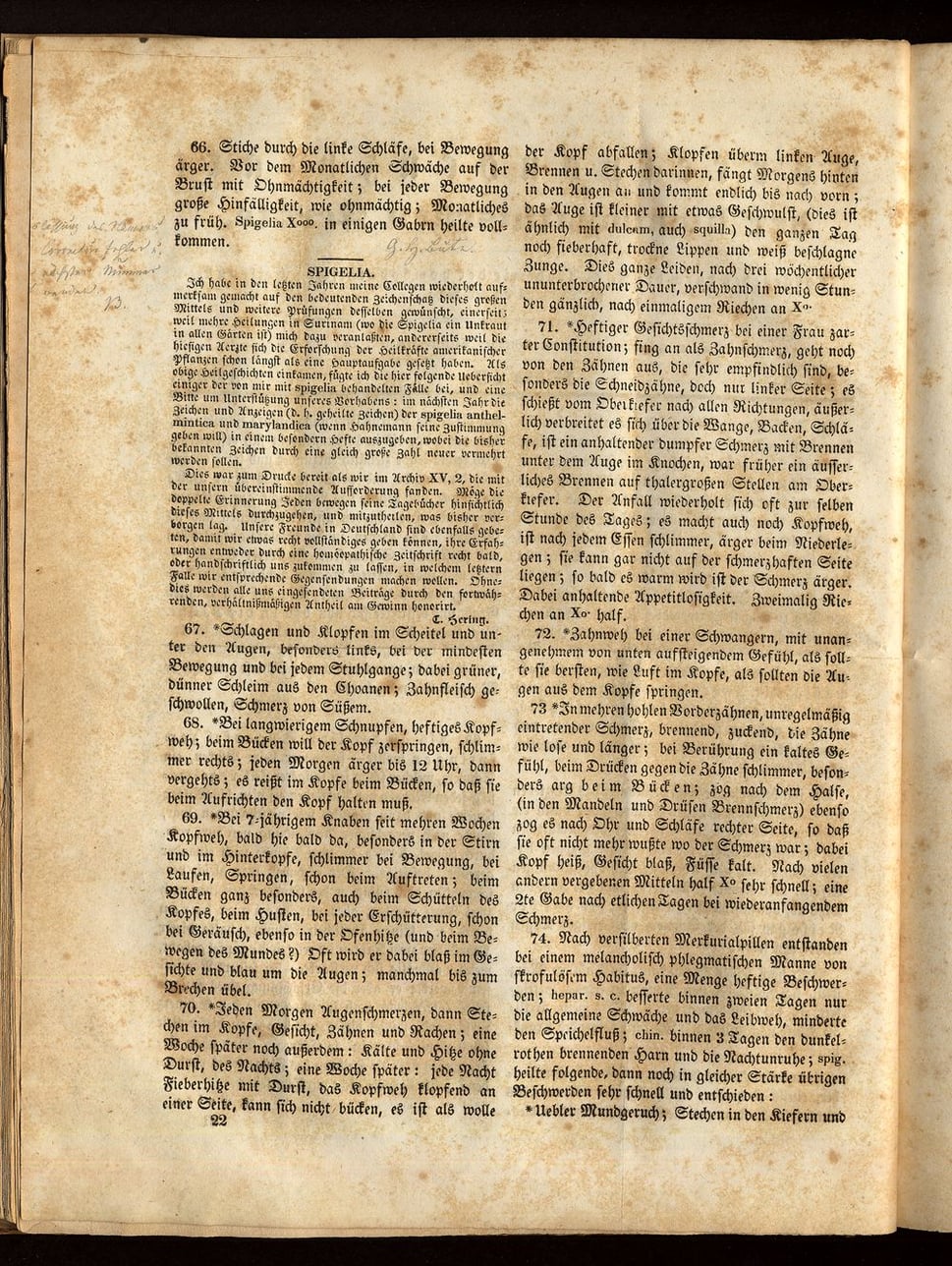
66. Stiche durch die linke Schlafse, bei Bewegung ärger. Vor dem Monatlichen Schwäche auf der Brust mit Ohnmachtigkeit; bei jeder Bewegung große Hinsfälligkeit, wie ohnmächtig; Monatliches zu früh. Spigelia Xoo. in einigen Gaben heilte vollkommen. SPIGELIA. Ich habe in den letzten Jahren meine Collegen wiederholt aufmerksam gemacht auf den bedeutenden Heilwerth dieses großen Mittels und weitere Prüfungen desselben gewünscht, einerseits weil mehrere Heilungen in Surinam (wo die Spigelia ein Unkraut in allen Gärten ist) mich dazu veranlassten, andererseits weil die hiesigen Ärzte sich die Erforschung der Heilkraft amerikanischer Pflanzen schon längst als eine Hauptaufgabe gesetzt haben. Als obige Beifüglichen einnehme, fügte ich die hier folgende Uebersicht an, die von mir mit spiegelhaften behandelt habe, und eine Mittel zur Heilung unseres Weibesbens: im nächsten Jahr die Zeichen und Angaben (d. h. geheilte Zeichen) der spigelia anthelmintica und marylandica (wenn Zahlmengen seine Zustimmung geben will) in einem besonderen Hefte auszugeben, worin die bisher bekannten Zeichen durch eine gleich große Zahl neuer vermehrt werden sollen. Dies war zum Dritte bereit als wir im Archiv XV. 2. die mit der unsern übereinstimmende Ausforderung fanden. Wege die doppelte Erinnerung jeden bewogen seine Tagebücher hinsichtlich dieses Mittels durchzugehen, und mitzuheissen, was bisher verborgen lag. Unsere Freunde in Deutschland sind ebenfalls gebeten, damit wir etwas recht vollständiges geben können, ihrer Erfahrung nach anderer durch eine heimwehreiche Zeitbrieft recht bald, oder handchriftlich uns zukommen zu lassen, in welchem letzten Falle wir entsprechende Gegenbemerkungen machen wollen. Ohne dies werden alle uns eingefundenen Beiträge durch den fortwährenden, verschlimmernscheinenden Anteil am Gewinn hineinziehen. 67. *Schlagen und Klopfen im Scheitel und unter den Augen, besonders links, bei der mindesten Bewegung und bei jedem Stuhlgange; dabei grünlicher, dünner Schleim aus den Choanen; Zahnfleisch geschwollen, Schmerz von Süssem. 68. *Bei langwierigem Schnupfen, heftiges Kopfschweh; beim Bücken will der Kopf zerspringen, schlummer rechts; jeden Morgen ärger bis 12 Uhr, dann vergeht's; es reist im Kopfe beim Bücken, so daß sie beim Aufrichten den Kopf halten muß. 69. *Bei 7-jährigem Knaben seit mehreren Wochen Kopfschweh, bald hier bald da, besonders in der Stirn und im Hinterkopfe, schlimmer bei Bewegung, bei Laufen, Springen, schon beim Auftreten; beim Bücken ganz besonders, auch beim Schütteln des Kopfes, beim Husten, bei jeder Erschütterung, schon bei Geräusch, ebenso in der Öffnisse (und beim Bewegen des Mundes?) Oft wird er dabei bläf im Gesichte und blau um die Augen; manchmal bis zum Brechen äbel. 70. *Jeden Morgen Augenschmerzen, dann Stechen im Kopfe, Gesicht, Zähnen und Nachen; eine Woche später noch ausserdem: Kälte und Hisse ohne Durst, des Nachts; eine Woche später: jede Nacht Fieberhöhe mit Durst, das Kopfschweh klopfend an einer Seite, kann sich nicht bücken, es ist als wolle der Kopf abfallen; Klopfen überm linken Auge, Bremmen u. Stechen darinnen, fängt Morgens hinten in den Augen an und kommt endlich bis nach vorn; das Auge ist kleiner mit etwas Geschwulst, (dies ist ähnlich mit dalem, auch squilla) den ganzen Tag noch sieberhaft, trockne Lippen und weiss beschlagne Zunge. Dies ganze Leiden, nach drei wöchentlicher ununterbrochener Dauer, verschwand in wenig Stunden ganzlich, nach einmaligem Riechen an Xo. 71. *Heftiger Gesichtsschmerz bei einer Frau zar- ter Constitution; fing an als Zahnschmerz, geht noch von den Zähnen aus, die sehr empfindlich sind, besonders die Schneidezähne, doch nur linker Seite; es schließt vom Oberkiefer nach allen Richtungen, äußerlich verbreitet es sich über die Wangen, Backen, Schlafse, ist ein anhaltender dumpfer Schmerz mit Brennen unter dem Auge im Knochen, war früher ein äußerliches Brennen auf thalergrossen Stellen am Oberkiefer. Der Anfall wiederholt sich oft zur selben Stunde des Tages; es macht auch noch Kopfschweh, ist nach jedem Essen schlummer, ärger beim Niederlegen; sie kann gar nicht auf der schmerzhaften Seite liegen; so bald es warm wird ist der Schmerz ärger. Dabei anhaltende Appetitlosigkeit. Zweimalig Riechen an Xo half. 72. *Zahnweh bei einer Schwangeren, mit unangenehmem von unten aufsteigendem Gefühl, als sollte sie bersten, wie Luft im Kopfe, als sollten die Augen aus dem Kopfe springen. 73.*In mehreren hohlen Borderzähnen, unregelmäßig eintretender Schmerz, brennend, zuckend, die Zähne wie lose und länger; bei Berührung ein kaltes Gefühl, beim Drühen gegen die Zähne schlummer, besonders arg beim Bücken; zog nach dem Halse, (in den Mandeln und Drüsen Brennschmerz) ebenso zog es nach Ohr und Schlafse rechter Seite, so daß sie oft nicht mehr wusste wo der Schmerz war; dabei Kopf heiß, Gesicht blau, Füße kalt. Nach vielen andern vergebener Mitteln half Xo sehr schnell; eine Rte Gabe nach etlichen Tagen bei wiederansangendem Schmerz. 74. Nach versilberten Merkurialpilzen entstanden bei einem melancholisch phlegmatischen Manne von krofulössem Habitus, eine Menge heftige Beschwerden; hep. s. c. besterte binnen zweien Tagen nur die allgemeine Schwäche und das Leibweh, minderte den Speichelfluss; chin. binnen 3 Tagen den dunkelrothen brennenden Harn und die Nachtunruhe; spig. heilte folgende, dann noch in gleicher Stärke übrigen Beschwerden sehr schnell und entschieden: *Uebler Mundgeruch; Stechen in den Kiefern und
OCR Text
Backen, doch noch mehr Schmerzen im Zahnfleische; kann die Kiefer nicht weiter öffnen als einen Zoll, wegen Geschwulst links im Munde besonders der Speichelgangöffnung (die Mündung des Speichelganges konnte man einige Tage vorher wie Lappen sehen in den Mund hängen, nun liß sich der Mund nicht mehr so weit öffnen); es spannt links und er kann nicht kauen, man fühlt außen, daß es elastisch geschwollen ist; später wird es weich und ist wie eine lange Rath quer über den Backen zu fühlen; der ganze Mund ist wund, das Zahnfleisch beim Essen schmerzhaft; im Halse drückender Schmerz beim Schlucken der Speisen oder Getränke, besonders beim Rachen und Aufbringen des Schleims, was kaum möglich ist. Dabei noch Schmerz im Scheitel wie ein Geschwür bei Bewegung, und noch immer dünner oftter Stuhl. 75. *Seit 18 Jahren Schleimauflösse aus dem After und große Knoten daran die im Gehen hindern; stößt der Schleimfluß dann schmerzt es als stecke was im After und brennt, dabei fühlt er auch im Ganzen sehr unwohl. Zu diesem chronischen Leiden kam nun ein früher auch schon einmal dagegenwesener Anfall: Schlechter Appetit, kann viele Speisen nicht vertragen, fühlt sich schlecht nachher, es liegt schwer im Magen, darf kein Wasser trinken; es läuft viel Wasser im Munde zusammen und er muß viel ausspießt sauer, bitter Aufstoßes besonders Nachmittags; der Schlaf seit etlichen Nächten sehr schlecht. Nach der ersten Gabe Xo vergingen die leichten- wahren Zeichen alle sehr bald; nach 2, 3 Wochen wiederholte Gaben befestigten das ältere Leiden sehr bedeutend. Wegen Ortsveränderung unterblieb die fernere Behandlung. 76. Bei einem Mädchen, bei welchem der Regel- durchbruch schwierig und erst nach homöopathischen Arzneien erfolgt war, blieb nach sp. die Regel wieder weg; bei einer Frau wo dieselbe nach Abortus war weggelassen kam sie sogleich nach sp. 77. Eine-Kranke mit often Anfällen nächtlichen Asthma's, was besonders durch, selbst auf der Straße, eingetauchtem Rauch wieder aufgeregt wurde, die außerdem zuweilen Flattern des Herzens hatte, wurde sehr viel gehebelt. 78. *Beim Gehen und nachher: Herzklöpser was er im ganzen Leibe fühlt. 79. *Herzklöpser nach jeder Körperbewegung, besonders nach Treppensteigen, nachm Essen; das Herz schien mit großer zu sein beim Anschlagen; bei dem Herzklöpser schlägt es schneller und kräftiger; am mehrsten klopft es etwas über der Brustwarze nach innen zu; nach vieltem Atmenholen ein Spannen über die Brust weg—bei einem jungen Mädchen seit vielen Jahren. Lach. und Sulph. waren auch wohlthätig, aurum aber verschlimmerte. 80. Biele andre Fälle, Herzleiden, Hämorrhoidal- beschwerden, Fieber, Kopfs- Augen- Gesichts- und Zahnschmerzen, die ganz oder theilweise geheilt wurden, folgen ein andermal. Obige Fälle wurden meistens vor Erscheinen des „Jahr" geheilt. Hier nur noch einiges Allgemeine zur Bestätigung oder Ergänzung des Jahr'schen Auszuges, der im Ganzen sehr sorgfältig gemacht ist und das Studium des Mittels sehr erleichtert. Man findet noch sehr viele Zeichen die den Merku- rialbeschwerden entsprechen, sowol sogleich entstehen- de als später folgende. Charakteristisch ist das Typische der Schmerzan- fälle, nicht nur der Kopf- und Gesicht-, sondern eben- falls der Augen- und Zahnschmerzen. Diese Anfälle scheinen öfters des Morgens und Vormittags bis 12 Uhr zu kommen (dagegen viele andere, besonders Unterleibsbeschwerden Nachmittags verschlimmern) wel- ches nicht in den Zeichen sondern durch die Heilungen angegeben wird, vergl. 64, 65, 68, 70. Charakteristisch ist die Erhöhung der Kopf-, Au- gen- und Zahnschmerzen bei Bewegung, besonders bei im B ü c k e n. Unter den Zeichen findet sich beim Buben schlimmer: „Druck und Herauspressen im Kopfe," „Gefühl als wolle das Gehirn vorn heraus." Letzteres ist noch bei 15 bis 20 andern Mitteln, erstes bei noch vielen, und bei mehreren hervorstechend charakteristisch (ign., puls., coloc., bryon., bell. u. a.) Unter obigen wenigen Heilungen findet sich dieselbe Bedingung bei verschiedenartigen Kopf- schmerzen (64, 68, 69, 70), bei Augenschmerz 65, bei Zahnschmerz 73. Bei keinem Mittel findet sich die- ser verschiedene Schmerz durch dieselbe Bedingung vermehrt, daher sie hier einen besonderen Werth be- kommt. Bei Zahnschmerz ist sie nur an sepia. und Magnet erwähnt, bei Augenschmerzen in senega, phosph. ipec. dros. vorn welchen allen die Diagnose sehr leicht ist. Je mehr unsere Kenntnis der Mittel in die Breite wächst (an Mitteln überhaupt oder nur an Zeichen des einen oder andern) desto nötiger wird es die Beding- ungen z. B. „schlimmer bei Bewegung" schärfer, vollständiger, tiefer aufzufassen, weil sie sonst in ihrer Flachheit nutzlos werden. Es fragt sich nicht mehr welche Mittel haben „bei Bewegung schlimmer,"
Version History (3 versions)
- ✓ v3 (current) · 12/16/2025, 3:32:07 AM
"OCR: Updated 2 refs" - v2 · 12/16/2025, 3:28:10 AM · View this version
"Added to parent 01KCJK6ZB2Q6SB5TW1WTJN7KE4" - v1 · 12/16/2025, 3:28:09 AM · View this version
"Initial discovery snapshot"
Additional Components
book_05.txt
BOOK V


CALYPSO—ULYSSES REACHES SCHERIA ON A RAFT.


And now, as Dawn rose from her couch beside Tithonus—harbinger of light
alike to mortals and immortals—the gods met in council and with them,
Jove the lord of thunder, who is their king. Thereon Minerva began to
tell them of the many sufferings of Ulysses, for she pitied him away
there in the house of the nymph Calypso.

“Father Jove,” said she, “and all you other gods that live in
everlasting bliss, I hope there may never be such a thing as a kind and
well-disposed ruler any more, nor one who will govern equitably. I hope
they will be all henceforth cruel and unjust, for there is not one of
his subjects but has forgotten Ulysses, who ruled them as though he
were their father. There he is, lying in great pain in an island where
dwells the nymph Calypso, who will not let him go; and he cannot get
back to his own country, for he can find neither ships nor sailors to
take him over the sea. Furthermore, wicked people are now trying to
murder his only son Telemachus, who is coming home from Pylos and
Lacedaemon, where he has been to see if he can get news of his father.”

“What, my dear, are you talking about?” replied her father, “did you
not send him there yourself, because you thought it would help Ulysses
to get home and punish the suitors? Besides, you are perfectly able to
protect Telemachus, and to see him safely home again, while the suitors
have to come hurry-skurrying back without having killed him.”

When he had thus spoken, he said to his son Mercury, “Mercury, you are
our messenger, go therefore and tell Calypso we have decreed that poor
Ulysses is to return home. He is to be convoyed neither by gods nor
men, but after a perilous voyage of twenty days upon a raft he is to
reach fertile Scheria,50 the land of the Phaeacians, who are near of
kin to the gods, and will honour him as though he were one of
ourselves. They will send him in a ship to his own country, and will
give him more bronze and gold and raiment than he would have brought
back from Troy, if he had had all his prize money and had got home
without disaster. This is how we have settled that he shall return to
his country and his friends.”

Thus he spoke, and Mercury, guide and guardian, slayer of Argus, did as
he was told. Forthwith he bound on his glittering golden sandals with
which he could fly like the wind over land and sea. He took the wand
with which he seals men’s eyes in sleep or wakes them just as he
pleases, and flew holding it in his hand over Pieria; then he swooped
down through the firmament till he reached the level of the sea, whose
waves he skimmed like a cormorant that flies fishing every hole and
corner of the ocean, and drenching its thick plumage in the spray. He
flew and flew over many a weary wave, but when at last he got to the
island which was his journey’s end, he left the sea and went on by land
till he came to the cave where the nymph Calypso lived.

He found her at home. There was a large fire burning on the hearth, and
one could smell from far the fragrant reek of burning cedar and sandal
wood. As for herself, she was busy at her loom, shooting her golden
shuttle through the warp and singing beautifully. Round her cave there
was a thick wood of alder, poplar, and sweet smelling cypress trees,
wherein all kinds of great birds had built their nests—owls, hawks, and
chattering sea-crows that occupy their business in the waters. A vine
loaded with grapes was trained and grew luxuriantly about the mouth of
the cave; there were also four running rills of water in channels cut
pretty close together, and turned hither and thither so as to irrigate
the beds of violets and luscious herbage over which they flowed. 51
Even a god could not help being charmed with such a lovely spot, so
Mercury stood still and looked at it; but when he had admired it
sufficiently he went inside the cave.

Calypso knew him at once—for the gods all know each other, no matter
how far they live from one another—but Ulysses was not within; he was
on the sea-shore as usual, looking out upon the barren ocean with tears
in his eyes, groaning and breaking his heart for sorrow. Calypso gave
Mercury a seat and said: “Why have you come to see me,
Mercury—honoured, and ever welcome—for you do not visit me often? Say
what you want; I will do it for you at once if I can, and if it can be
done at all; but come inside, and let me set refreshment before you.”

As she spoke she drew a table loaded with ambrosia beside him and mixed
him some red nectar, so Mercury ate and drank till he had had enough,
and then said:

“We are speaking god and goddess to one another, and you ask me why I
have come here, and I will tell you truly as you would have me do. Jove
sent me; it was no doing of mine; who could possibly want to come all
this way over the sea where there are no cities full of people to offer
me sacrifices or choice hecatombs? Nevertheless I had to come, for none
of us other gods can cross Jove, nor transgress his orders. He says
that you have here the most ill-starred of all those who fought nine
years before the city of King Priam and sailed home in the tenth year
after having sacked it. On their way home they sinned against
Minerva,52 who raised both wind and waves against them, so that all his
brave companions perished, and he alone was carried hither by wind and
tide. Jove says that you are to let this man go at once, for it is
decreed that he shall not perish here, far from his own people, but
shall return to his house and country and see his friends again.”

Calypso trembled with rage when she heard this, “You gods,” she
exclaimed, “ought to be ashamed of yourselves. You are always jealous
and hate seeing a goddess take a fancy to a mortal man, and live with
him in open matrimony. So when rosy-fingered Dawn made love to Orion,
you precious gods were all of you furious till Diana went and killed
him in Ortygia. So again when Ceres fell in love with Iasion, and
yielded to him in a thrice-ploughed fallow field, Jove came to hear of
it before so very long and killed Iasion with his thunderbolts. And now
you are angry with me too because I have a man here. I found the poor
creature sitting all alone astride of a keel, for Jove had struck his
ship with lightning and sunk it in mid ocean, so that all his crew were
drowned, while he himself was driven by wind and waves on to my island.
I got fond of him and cherished him, and had set my heart on making him
immortal, so that he should never grow old all his days; still I cannot
cross Jove, nor bring his counsels to nothing; therefore, if he insists
upon it, let the man go beyond the seas again; but I cannot send him
anywhere myself for I have neither ships nor men who can take him.
Nevertheless I will readily give him such advice, in all good faith, as
will be likely to bring him safely to his own country.”

“Then send him away,” said Mercury, “or Jove will be angry with you and
punish you”.

On this he took his leave, and Calypso went out to look for Ulysses,
for she had heard Jove’s message. She found him sitting upon the beach
with his eyes ever filled with tears, and dying of sheer home sickness;
for he had got tired of Calypso, and though he was forced to sleep with
her in the cave by night, it was she, not he, that would have it so. As
for the day time, he spent it on the rocks and on the sea shore,
weeping, crying aloud for his despair, and always looking out upon the
sea. Calypso then went close up to him said:

“My poor fellow, you shall not stay here grieving and fretting your
life out any longer. I am going to send you away of my own free will;
so go, cut some beams of wood, and make yourself a large raft with an
upper deck that it may carry you safely over the sea. I will put bread,
wine, and water on board to save you from starving. I will also give
you clothes, and will send you a fair wind to take you home, if the
gods in heaven so will it—for they know more about these things, and
can settle them better than I can.”

Ulysses shuddered as he heard her. “Now goddess,” he answered, “there
is something behind all this; you cannot be really meaning to help me
home when you bid me do such a dreadful thing as put to sea on a raft.
Not even a well found ship with a fair wind could venture on such a
distant voyage: nothing that you can say or do shall make me go on
board a raft unless you first solemnly swear that you mean me no
mischief.”

Calypso smiled at this and caressed him with her hand: “You know a
great deal,” said she, “but you are quite wrong here. May heaven above
and earth below be my witnesses, with the waters of the river Styx—and
this is the most solemn oath which a blessed god can take—that I mean
you no sort of harm, and am only advising you to do exactly what I
should do myself in your place. I am dealing with you quite
straightforwardly; my heart is not made of iron, and I am very sorry
for you.”

When she had thus spoken she led the way rapidly before him, and
Ulysses followed in her steps; so the pair, goddess and man, went on
and on till they came to Calypso’s cave, where Ulysses took the seat
that Mercury had just left. Calypso set meat and drink before him of
the food that mortals eat; but her maids brought ambrosia and nectar
for herself, and they laid their hands on the good things that were
before them. When they had satisfied themselves with meat and drink,
Calypso spoke, saying:

“Ulysses, noble son of Laertes, so you would start home to your own
land at once? Good luck go with you, but if you could only know how
much suffering is in store for you before you get back to your own
country, you would stay where you are, keep house along with me, and
let me make you immortal, no matter how anxious you may be to see this
wife of yours, of whom you are thinking all the time day after day; yet
I flatter myself that I am no whit less tall or well-looking than she
is, for it is not to be expected that a mortal woman should compare in
beauty with an immortal.”

“Goddess,” replied Ulysses, “do not be angry with me about this. I am
quite aware that my wife Penelope is nothing like so tall or so
beautiful as yourself. She is only a woman, whereas you are an
immortal. Nevertheless, I want to get home, and can think of nothing
else. If some god wrecks me when I am on the sea, I will bear it and
make the best of it. I have had infinite trouble both by land and sea
already, so let this go with the rest.”

Presently the sun set and it became dark, whereon the pair retired into
the inner part of the cave and went to bed.

When the child of morning rosy-fingered Dawn appeared, Ulysses put on
his shirt and cloak, while the goddess wore a dress of a light gossamer
fabric, very fine and graceful, with a beautiful golden girdle about
her waist and a veil to cover her head. She at once set herself to
think how she could speed Ulysses on his way. So she gave him a great
bronze axe that suited his hands; it was sharpened on both sides, and
had a beautiful olive-wood handle fitted firmly on to it. She also gave
him a sharp adze, and then led the way to the far end of the island
where the largest trees grew—alder, poplar and pine, that reached the
sky—very dry and well seasoned, so as to sail light for him in the
water.53 Then, when she had shown him where the best trees grew,
Calypso went home, leaving him to cut them, which he soon finished
doing. He cut down twenty trees in all and adzed them smooth, squaring
them by rule in good workmanlike fashion. Meanwhile Calypso came back
with some augers, so he bored holes with them and fitted the timbers
together with bolts and rivets. He made the raft as broad as a skilled
shipwright makes the beam of a large vessel, and he fixed a deck on top
of the ribs, and ran a gunwale all round it. He also made a mast with a
yard arm, and a rudder to steer with. He fenced the raft all round with
wicker hurdles as a protection against the waves, and then he threw on
a quantity of wood. By and by Calypso brought him some linen to make
the sails, and he made these too, excellently, making them fast with
braces and sheets. Last of all, with the help of levers, he drew the
raft down into the water.

In four days he had completed the whole work, and on the fifth Calypso
sent him from the island after washing him and giving him some clean
clothes. She gave him a goat skin full of black wine, and another
larger one of water; she also gave him a wallet full of provisions, and
found him in much good meat. Moreover, she made the wind fair and warm
for him, and gladly did Ulysses spread his sail before it, while he sat
and guided the raft skilfully by means of the rudder. He never closed
his eyes, but kept them fixed on the Pleiads, on late-setting Bootes,
and on the Bear—which men also call the wain, and which turns round and
round where it is, facing Orion, and alone never dipping into the
stream of Oceanus—for Calypso had told him to keep this to his left.
Days seven and ten did he sail over the sea, and on the eighteenth the
dim outlines of the mountains on the nearest part of the Phaeacian
coast appeared, rising like a shield on the horizon.

But King Neptune, who was returning from the Ethiopians, caught sight
of Ulysses a long way off, from the mountains of the Solymi. He could
see him sailing upon the sea, and it made him very angry, so he wagged
his head and muttered to himself, saying, “Good heavens, so the gods
have been changing their minds about Ulysses while I was away in
Ethiopia, and now he is close to the land of the Phaeacians, where it
is decreed that he shall escape from the calamities that have befallen
him. Still, he shall have plenty of hardship yet before he has done
with it.”

Thereon he gathered his clouds together, grasped his trident, stirred
it round in the sea, and roused the rage of every wind that blows till
earth, sea, and sky were hidden in cloud, and night sprang forth out of
the heavens. Winds from East, South, North, and West fell upon him all
at the same time, and a tremendous sea got up, so that Ulysses’ heart
began to fail him. “Alas,” he said to himself in his dismay, “what ever
will become of me? I am afraid Calypso was right when she said I should
have trouble by sea before I got back home. It is all coming true. How
black is Jove making heaven with his clouds, and what a sea the winds
are raising from every quarter at once. I am now safe to perish. Blest
and thrice blest were those Danaans who fell before Troy in the cause
of the sons of Atreus. Would that I had been killed on the day when the
Trojans were pressing me so sorely about the dead body of Achilles, for
then I should have had due burial and the Achaeans would have honoured
my name; but now it seems that I shall come to a most pitiable end.”

As he spoke a sea broke over him with such terrific fury that the raft
reeled again, and he was carried overboard a long way off. He let go
the helm, and the force of the hurricane was so great that it broke the
mast half way up, and both sail and yard went over into the sea. For a
long time Ulysses was under water, and it was all he could do to rise
to the surface again, for the clothes Calypso had given him weighed him
down; but at last he got his head above water and spat out the bitter
brine that was running down his face in streams. In spite of all this,
however, he did not lose sight of his raft, but swam as fast as he
could towards it, got hold of it, and climbed on board again so as to
escape drowning. The sea took the raft and tossed it about as Autumn
winds whirl thistledown round and round upon a road. It was as though
the South, North, East, and West winds were all playing battledore and
shuttlecock with it at once.

When he was in this plight, Ino daughter of Cadmus, also called
Leucothea, saw him. She had formerly been a mere mortal, but had been
since raised to the rank of a marine goddess. Seeing in what great
distress Ulysses now was, she had compassion upon him, and, rising like
a sea-gull from the waves, took her seat upon the raft.

“My poor good man,” said she, “why is Neptune so furiously angry with
you? He is giving you a great deal of trouble, but for all his bluster
he will not kill you. You seem to be a sensible person, do then as I
bid you; strip, leave your raft to drive before the wind, and swim to
the Phaeacian coast where better luck awaits you. And here, take my
veil and put it round your chest; it is enchanted, and you can come to
no harm so long as you wear it. As soon as you touch land take it off,
throw it back as far as you can into the sea, and then go away again.”
With these words she took off her veil and gave it him. Then she dived
down again like a sea-gull and vanished beneath the dark blue waters.

But Ulysses did not know what to think. “Alas,” he said to himself in
his dismay, “this is only some one or other of the gods who is luring
me to ruin by advising me to quit my raft. At any rate I will not do so
at present, for the land where she said I should be quit of all
troubles seemed to be still a good way off. I know what I will do—I am
sure it will be best—no matter what happens I will stick to the raft as
long as her timbers hold together, but when the sea breaks her up I
will swim for it; I do not see how I can do any better than this.”

While he was thus in two minds, Neptune sent a terrible great wave that
seemed to rear itself above his head till it broke right over the raft,
which then went to pieces as though it were a heap of dry chaff tossed
about by a whirlwind. Ulysses got astride of one plank and rode upon it
as if he were on horseback; he then took off the clothes Calypso had
given him, bound Ino’s veil under his arms, and plunged into the
sea—meaning to swim on shore. King Neptune watched him as he did so,
and wagged his head, muttering to himself and saying, “There now, swim
up and down as you best can till you fall in with well-to-do people. I
do not think you will be able to say that I have let you off too
lightly.” On this he lashed his horses and drove to Aegae where his
palace is.

But Minerva resolved to help Ulysses, so she bound the ways of all the
winds except one, and made them lie quite still; but she roused a good
stiff breeze from the North that should lay the waters till Ulysses
reached the land of the Phaeacians where he would be safe.

Thereon he floated about for two nights and two days in the water, with
a heavy swell on the sea and death staring him in the face; but when
the third day broke, the wind fell and there was a dead calm without so
much as a breath of air stirring. As he rose on the swell he looked
eagerly ahead, and could see land quite near. Then, as children rejoice
when their dear father begins to get better after having for a long
time borne sore affliction sent him by some angry spirit, but the gods
deliver him from evil, so was Ulysses thankful when he again saw land
and trees, and swam on with all his strength that he might once more
set foot upon dry ground. When, however, he got within earshot, he
began to hear the surf thundering up against the rocks, for the swell
still broke against them with a terrific roar. Everything was enveloped
in spray; there were no harbours where a ship might ride, nor shelter
of any kind, but only headlands, low-lying rocks, and mountain tops.

Ulysses’ heart now began to fail him, and he said despairingly to
himself, “Alas, Jove has let me see land after swimming so far that I
had given up all hope, but I can find no landing place, for the coast
is rocky and surf-beaten, the rocks are smooth and rise sheer from the
sea, with deep water close under them so that I cannot climb out for
want of foot hold. I am afraid some great wave will lift me off my legs
and dash me against the rocks as I leave the water—which would give me
a sorry landing. If, on the other hand, I swim further in search of
some shelving beach or harbour, a hurricane may carry me out to sea
again sorely against my will, or heaven may send some great monster of
the deep to attack me; for Amphitrite breeds many such, and I know that
Neptune is very angry with me.”

While he was thus in two minds a wave caught him and took him with such
force against the rocks that he would have been smashed and torn to
pieces if Minerva had not shown him what to do. He caught hold of the
rock with both hands and clung to it groaning with pain till the wave
retired, so he was saved that time; but presently the wave came on
again and carried him back with it far into the sea—tearing his hands
as the suckers of a polypus are torn when some one plucks it from its
bed, and the stones come up along with it—even so did the rocks tear
the skin from his strong hands, and then the wave drew him deep down
under the water.

Here poor Ulysses would have certainly perished even in spite of his
own destiny, if Minerva had not helped him to keep his wits about him.
He swam seaward again, beyond reach of the surf that was beating
against the land, and at the same time he kept looking towards the
shore to see if he could find some haven, or a spit that should take
the waves aslant. By and by, as he swam on, he came to the mouth of a
river, and here he thought would be the best place, for there were no
rocks, and it afforded shelter from the wind. He felt that there was a
current, so he prayed inwardly and said:

“Hear me, O King, whoever you may be, and save me from the anger of the
sea-god Neptune, for I approach you prayerfully. Any one who has lost
his way has at all times a claim even upon the gods, wherefore in my
distress I draw near to your stream, and cling to the knees of your
riverhood. Have mercy upon me, O king, for I declare myself your
suppliant.”

Then the god staid his stream and stilled the waves, making all calm
before him, and bringing him safely into the mouth of the river. Here
at last Ulysses’ knees and strong hands failed him, for the sea had
completely broken him. His body was all swollen, and his mouth and
nostrils ran down like a river with sea-water, so that he could neither
breathe nor speak, and lay swooning from sheer exhaustion; presently,
when he had got his breath and came to himself again, he took off the
scarf that Ino had given him and threw it back into the salt54 stream
of the river, whereon Ino received it into her hands from the wave that
bore it towards her. Then he left the river, laid himself down among
the rushes, and kissed the bounteous earth.

“Alas,” he cried to himself in his dismay, “what ever will become of
me, and how is it all to end? If I stay here upon the river bed through
the long watches of the night, I am so exhausted that the bitter cold
and damp may make an end of me—for towards sunrise there will be a keen
wind blowing from off the river. If, on the other hand, I climb the
hill side, find shelter in the woods, and sleep in some thicket, I may
escape the cold and have a good night’s rest, but some savage beast may
take advantage of me and devour me.”

In the end he deemed it best to take to the woods, and he found one
upon some high ground not far from the water. There he crept beneath
two shoots of olive that grew from a single stock—the one an ungrafted
sucker, while the other had been grafted. No wind, however squally,
could break through the cover they afforded, nor could the sun’s rays
pierce them, nor the rain get through them, so closely did they grow
into one another. Ulysses crept under these and began to make himself a
bed to lie on, for there was a great litter of dead leaves lying
about—enough to make a covering for two or three men even in hard
winter weather. He was glad enough to see this, so he laid himself down
and heaped the leaves all round him. Then, as one who lives alone in
the country, far from any neighbor, hides a brand as fire-seed in the
ashes to save himself from having to get a light elsewhere, even so did
Ulysses cover himself up with leaves; and Minerva shed a sweet sleep
upon his eyes, closed his eyelids, and made him lose all memories of
his sorrows.
book_06.txt
BOOK VI


THE MEETING BETWEEN NAUSICAA AND ULYSSES.


So here Ulysses slept, overcome by sleep and toil; but Minerva went off
to the country and city of the Phaeacians—a people who used to live in
the fair town of Hypereia, near the lawless Cyclopes. Now the Cyclopes
were stronger than they and plundered them, so their king Nausithous
moved them thence and settled them in Scheria, far from all other
people. He surrounded the city with a wall, built houses and temples,
and divided the lands among his people; but he was dead and gone to the
house of Hades, and King Alcinous, whose counsels were inspired of
heaven, was now reigning. To his house, then, did Minerva hie in
furtherance of the return of Ulysses.

She went straight to the beautifully decorated bedroom in which there
slept a girl who was as lovely as a goddess, Nausicaa, daughter to King
Alcinous. Two maid servants were sleeping near her, both very pretty,
one on either side of the doorway, which was closed with well made
folding doors. Minerva took the form of the famous sea captain Dymas’s
daughter, who was a bosom friend of Nausicaa and just her own age;
then, coming up to the girl’s bedside like a breath of wind, she
hovered over her head and said:

“Nausicaa, what can your mother have been about, to have such a lazy
daughter? Here are your clothes all lying in disorder, yet you are
going to be married almost immediately, and should not only be well
dressed yourself, but should find good clothes for those who attend
you. This is the way to get yourself a good name, and to make your
father and mother proud of you. Suppose, then, that we make tomorrow a
washing day, and start at daybreak. I will come and help you so that
you may have everything ready as soon as possible, for all the best
young men among your own people are courting you, and you are not going
to remain a maid much longer. Ask your father, therefore, to have a
waggon and mules ready for us at daybreak, to take the rugs, robes, and
girdles, and you can ride, too, which will be much pleasanter for you
than walking, for the washing-cisterns are some way from the town.”

When she had said this Minerva went away to Olympus, which they say is
the everlasting home of the gods. Here no wind beats roughly, and
neither rain nor snow can fall; but it abides in everlasting sunshine
and in a great peacefulness of light, wherein the blessed gods are
illumined for ever and ever. This was the place to which the goddess
went when she had given instructions to the girl.

By and by morning came and woke Nausicaa, who began wondering about her
dream; she therefore went to the other end of the house to tell her
father and mother all about it, and found them in their own room. Her
mother was sitting by the fireside spinning her purple yarn with her
maids around her, and she happened to catch her father just as he was
going out to attend a meeting of the town council, which the Phaeacian
aldermen had convened. She stopped him and said:

“Papa dear, could you manage to let me have a good big waggon? I want
to take all our dirty clothes to the river and wash them. You are the
chief man here, so it is only right that you should have a clean shirt
when you attend meetings of the council. Moreover, you have five sons
at home, two of them married, while the other three are good looking
bachelors; you know they always like to have clean linen when they go
to a dance, and I have been thinking about all this.”

She did not say a word about her own wedding, for she did not like to,
but her father knew and said, “You shall have the mules, my love, and
whatever else you have a mind for. Be off with you, and the men shall
get you a good strong waggon with a body to it that will hold all your
clothes.”

On this he gave his orders to the servants, who got the waggon out,
harnessed the mules, and put them to, while the girl brought the
clothes down from the linen room and placed them on the waggon. Her
mother prepared her a basket of provisions with all sorts of good
things, and a goat skin full of wine; the girl now got into the waggon,
and her mother gave her also a golden cruse of oil, that she and her
women might anoint themselves. Then she took the whip and reins and
lashed the mules on, whereon they set off, and their hoofs clattered on
the road. They pulled without flagging, and carried not only Nausicaa
and her wash of clothes, but the maids also who were with her.

When they reached the water side they went to the washing cisterns,
through which there ran at all times enough pure water to wash any
quantity of linen, no matter how dirty. Here they unharnessed the mules
and turned them out to feed on the sweet juicy herbage that grew by the
water side. They took the clothes out of the waggon, put them in the
water, and vied with one another in treading them in the pits to get
the dirt out. After they had washed them and got them quite clean, they
laid them out by the sea side, where the waves had raised a high beach
of shingle, and set about washing themselves and anointing themselves
with olive oil. Then they got their dinner by the side of the stream,
and waited for the sun to finish drying the clothes. When they had done
dinner they threw off the veils that covered their heads and began to
play at ball, while Nausicaa sang for them. As the huntress Diana goes
forth upon the mountains of Taygetus or Erymanthus to hunt wild boars
or deer, and the wood nymphs, daughters of Aegis-bearing Jove, take
their sport along with her (then is Leto proud at seeing her daughter
stand a full head taller than the others, and eclipse the loveliest
amid a whole bevy of beauties), even so did the girl outshine her
handmaids.

When it was time for them to start home, and they were folding the
clothes and putting them into the waggon, Minerva began to consider how
Ulysses should wake up and see the handsome girl who was to conduct him
to the city of the Phaeacians. The girl, therefore, threw a ball at one
of the maids, which missed her and fell into deep water. On this they
all shouted, and the noise they made woke Ulysses, who sat up in his
bed of leaves and began to wonder what it might all be.

“Alas,” said he to himself, “what kind of people have I come amongst?
Are they cruel, savage, and uncivilised, or hospitable and humane? I
seem to hear the voices of young women, and they sound like those of
the nymphs that haunt mountain tops, or springs of rivers and meadows
of green grass. At any rate I am among a race of men and women. Let me
try if I cannot manage to get a look at them.”

As he said this he crept from under his bush, and broke off a bough
covered with thick leaves to hide his nakedness. He looked like some
lion of the wilderness that stalks about exulting in his strength and
defying both wind and rain; his eyes glare as he prowls in quest of
oxen, sheep, or deer, for he is famished, and will dare break even into
a well fenced homestead, trying to get at the sheep—even such did
Ulysses seem to the young women, as he drew near to them all naked as
he was, for he was in great want. On seeing one so unkempt and so
begrimed with salt water, the others scampered off along the spits that
jutted out into the sea, but the daughter of Alcinous stood firm, for
Minerva put courage into her heart and took away all fear from her. She
stood right in front of Ulysses, and he doubted whether he should go up
to her, throw himself at her feet, and embrace her knees as a
suppliant, or stay where he was and entreat her to give him some
clothes and show him the way to the town. In the end he deemed it best
to entreat her from a distance in case the girl should take offence at
his coming near enough to clasp her knees, so he addressed her in
honeyed and persuasive language.

“O queen,” he said, “I implore your aid—but tell me, are you a goddess
or are you a mortal woman? If you are a goddess and dwell in heaven, I
can only conjecture that you are Jove’s daughter Diana, for your face
and figure resemble none but hers; if on the other hand you are a
mortal and live on earth, thrice happy are your father and
mother—thrice happy, too, are your brothers and sisters; how proud and
delighted they must feel when they see so fair a scion as yourself
going out to a dance; most happy, however, of all will he be whose
wedding gifts have been the richest, and who takes you to his own home.
I never yet saw any one so beautiful, neither man nor woman, and am
lost in admiration as I behold you. I can only compare you to a young
palm tree which I saw when I was at Delos growing near the altar of
Apollo—for I was there, too, with much people after me, when I was on
that journey which has been the source of all my troubles. Never yet
did such a young plant shoot out of the ground as that was, and I
admired and wondered at it exactly as I now admire and wonder at
yourself. I dare not clasp your knees, but I am in great distress;
yesterday made the twentieth day that I had been tossing about upon the
sea. The winds and waves have taken me all the way from the Ogygian
island,55 and now fate has flung me upon this coast that I may endure
still further suffering; for I do not think that I have yet come to the
end of it, but rather that heaven has still much evil in store for me.

“And now, O queen, have pity upon me, for you are the first person I
have met, and I know no one else in this country. Show me the way to
your town, and let me have anything that you may have brought hither to
wrap your clothes in. May heaven grant you in all things your heart’s
desire—husband, house, and a happy, peaceful home; for there is nothing
better in this world than that man and wife should be of one mind in a
house. It discomfits their enemies, makes the hearts of their friends
glad, and they themselves know more about it than any one.”

To this Nausicaa answered, “Stranger, you appear to be a sensible,
well-disposed person. There is no accounting for luck; Jove gives
prosperity to rich and poor just as he chooses, so you must take what
he has seen fit to send you, and make the best of it. Now, however,
that you have come to this our country, you shall not want for clothes
nor for anything else that a foreigner in distress may reasonably look
for. I will show you the way to the town, and will tell you the name of
our people; we are called Phaeacians, and I am daughter to Alcinous, in
whom the whole power of the state is vested.”

Then she called her maids and said, “Stay where you are, you girls. Can
you not see a man without running away from him? Do you take him for a
robber or a murderer? Neither he nor any one else can come here to do
us Phaeacians any harm, for we are dear to the gods, and live apart on
a land’s end that juts into the sounding sea, and have nothing to do
with any other people. This is only some poor man who has lost his way,
and we must be kind to him, for strangers and foreigners in distress
are under Jove’s protection, and will take what they can get and be
thankful; so, girls, give the poor fellow something to eat and drink,
and wash him in the stream at some place that is sheltered from the
wind.”

On this the maids left off running away and began calling one another
back. They made Ulysses sit down in the shelter as Nausicaa had told
them, and brought him a shirt and cloak. They also brought him the
little golden cruse of oil, and told him to go and wash in the stream.
But Ulysses said, “Young women, please to stand a little on one side
that I may wash the brine from my shoulders and anoint myself with oil,
for it is long enough since my skin has had a drop of oil upon it. I
cannot wash as long as you all keep standing there. I am ashamed to
strip56 before a number of good looking young women.”

Then they stood on one side and went to tell the girl, while Ulysses
washed himself in the stream and scrubbed the brine from his back and
from his broad shoulders. When he had thoroughly washed himself, and
had got the brine out of his hair, he anointed himself with oil, and
put on the clothes which the girl had given him; Minerva then made him
look taller and stronger than before, she also made the hair grow thick
on the top of his head, and flow down in curls like hyacinth blossoms;
she glorified him about the head and shoulders as a skilful workman who
has studied art of all kinds under Vulcan and Minerva enriches a piece
of silver plate by gilding it—and his work is full of beauty. Then he
went and sat down a little way off upon the beach, looking quite young
and handsome, and the girl gazed on him with admiration; then she said
to her maids:

“Hush, my dears, for I want to say something. I believe the gods who
live in heaven have sent this man to the Phaeacians. When I first saw
him I thought him plain, but now his appearance is like that of the
gods who dwell in heaven. I should like my future husband to be just
such another as he is, if he would only stay here and not want to go
away. However, give him something to eat and drink.”

They did as they were told, and set food before Ulysses, who ate and
drank ravenously, for it was long since he had had food of any kind.
Meanwhile, Nausicaa bethought her of another matter. She got the linen
folded and placed in the waggon, she then yoked the mules, and, as she
took her seat, she called Ulysses:

“Stranger,” said she, “rise and let us be going back to the town; I
will introduce you at the house of my excellent father, where I can
tell you that you will meet all the best people among the Phaeacians.
But be sure and do as I bid you, for you seem to be a sensible person.
As long as we are going past the fields and farm lands, follow briskly
behind the waggon along with the maids and I will lead the way myself.
Presently, however, we shall come to the town, where you will find a
high wall running all round it, and a good harbour on either side with
a narrow entrance into the city, and the ships will be drawn up by the
road side, for every one has a place where his own ship can lie. You
will see the market place with a temple of Neptune in the middle of it,
and paved with large stones bedded in the earth. Here people deal in
ship’s gear of all kinds, such as cables and sails, and here, too, are
the places where oars are made, for the Phaeacians are not a nation of
archers; they know nothing about bows and arrows, but are a sea-faring
folk, and pride themselves on their masts, oars, and ships, with which
they travel far over the sea.

“I am afraid of the gossip and scandal that may be set on foot against
me later on; for the people here are very ill-natured, and some low
fellow, if he met us, might say, ‘Who is this fine-looking stranger
that is going about with Nausicaa? Where did she find him? I suppose
she is going to marry him. Perhaps he is a vagabond sailor whom she has
taken from some foreign vessel, for we have no neighbours; or some god
has at last come down from heaven in answer to her prayers, and she is
going to live with him all the rest of her life. It would be a good
thing if she would take herself off and find a husband somewhere else,
for she will not look at one of the many excellent young Phaeacians who
are in love with her.’ This is the kind of disparaging remark that
would be made about me, and I could not complain, for I should myself
be scandalised at seeing any other girl do the like, and go about with
men in spite of everybody, while her father and mother were still
alive, and without having been married in the face of all the world.

“If, therefore, you want my father to give you an escort and to help
you home, do as I bid you; you will see a beautiful grove of poplars by
the road side dedicated to Minerva; it has a well in it and a meadow
all round it. Here my father has a field of rich garden ground, about
as far from the town as a man’s voice will carry. Sit down there and
wait for a while till the rest of us can get into the town and reach my
father’s house. Then, when you think we must have done this, come into
the town and ask the way to the house of my father Alcinous. You will
have no difficulty in finding it; any child will point it out to you,
for no one else in the whole town has anything like such a fine house
as he has. When you have got past the gates and through the outer
court, go right across the inner court till you come to my mother. You
will find her sitting by the fire and spinning her purple wool by
firelight. It is a fine sight to see her as she leans back against one
of the bearing-posts with her maids all ranged behind her. Close to her
seat stands that of my father, on which he sits and topes like an
immortal god. Never mind him, but go up to my mother, and lay your
hands upon her knees if you would get home quickly. If you can gain her
over, you may hope to see your own country again, no matter how distant
it may be.”

So saying she lashed the mules with her whip and they left the river.
The mules drew well, and their hoofs went up and down upon the road.
She was careful not to go too fast for Ulysses and the maids who were
following on foot along with the waggon, so she plied her whip with
judgement. As the sun was going down they came to the sacred grove of
Minerva, and there Ulysses sat down and prayed to the mighty daughter
of Jove.

“Hear me,” he cried, “daughter of Aegis-bearing Jove, unweariable, hear
me now, for you gave no heed to my prayers when Neptune was wrecking
me. Now, therefore, have pity upon me and grant that I may find friends
and be hospitably received by the Phaeacians.”

Thus did he pray, and Minerva heard his prayer, but she would not show
herself to him openly, for she was afraid of her uncle Neptune, who was
still furious in his endeavors to prevent Ulysses from getting home.
book_07.txt
BOOK VII


RECEPTION OF ULYSSES AT THE PALACE OF KING ALCINOUS.


Thus, then, did Ulysses wait and pray; but the girl drove on to the
town. When she reached her father’s house she drew up at the gateway,
and her brothers—comely as the gods—gathered round her, took the mules
out of the waggon, and carried the clothes into the house, while she
went to her own room, where an old servant, Eurymedusa of Apeira, lit
the fire for her. This old woman had been brought by sea from Apeira,
and had been chosen as a prize for Alcinous because he was king over
the Phaeacians, and the people obeyed him as though he were a god.57
She had been nurse to Nausicaa, and had now lit the fire for her, and
brought her supper for her into her own room.

Presently Ulysses got up to go towards the town; and Minerva shed a
thick mist all round him to hide him in case any of the proud
Phaeacians who met him should be rude to him, or ask him who he was.
Then, as he was just entering the town, she came towards him in the
likeness of a little girl carrying a pitcher. She stood right in front
of him, and Ulysses said:

“My dear, will you be so kind as to show me the house of king Alcinous?
I am an unfortunate foreigner in distress, and do not know one in your
town and country.”

Then Minerva said, “Yes, father stranger, I will show you the house you
want, for Alcinous lives quite close to my own father. I will go before
you and show the way, but say not a word as you go, and do not look at
any man, nor ask him questions; for the people here cannot abide
strangers, and do not like men who come from some other place. They are
a sea-faring folk, and sail the seas by the grace of Neptune in ships
that glide along like thought, or as a bird in the air.”

On this she led the way, and Ulysses followed in her steps; but not one
of the Phaeacians could see him as he passed through the city in the
midst of them; for the great goddess Minerva in her good will towards
him had hidden him in a thick cloud of darkness. He admired their
harbours, ships, places of assembly, and the lofty walls of the city,
which, with the palisade on top of them, were very striking, and when
they reached the king’s house Minerva said:

“This is the house, father stranger, which you would have me show you.
You will find a number of great people sitting at table, but do not be
afraid; go straight in, for the bolder a man is the more likely he is
to carry his point, even though he is a stranger. First find the queen.
Her name is Arete, and she comes of the same family as her husband
Alcinous. They both descend originally from Neptune, who was father to
Nausithous by Periboea, a woman of great beauty. Periboea was the
youngest daughter of Eurymedon, who at one time reigned over the
giants, but he ruined his ill-fated people and lost his own life to
boot.

“Neptune, however, lay with his daughter, and she had a son by him, the
great Nausithous, who reigned over the Phaeacians. Nausithous had two
sons Rhexenor and Alcinous;58 Apollo killed the first of them while he
was still a bridegroom and without male issue; but he left a daughter
Arete, whom Alcinous married, and honours as no other woman is honoured
of all those that keep house along with their husbands.

“Thus she both was, and still is, respected beyond measure by her
children, by Alcinous himself, and by the whole people, who look upon
her as a goddess, and greet her whenever she goes about the city, for
she is a thoroughly good woman both in head and heart, and when any
women are friends of hers, she will help their husbands also to settle
their disputes. If you can gain her good will, you may have every hope
of seeing your friends again, and getting safely back to your home and
country.”

Then Minerva left Scheria and went away over the sea. She went to
Marathon59 and to the spacious streets of Athens, where she entered the
abode of Erechtheus; but Ulysses went on to the house of Alcinous, and
he pondered much as he paused a while before reaching the threshold of
bronze, for the splendour of the palace was like that of the sun or
moon. The walls on either side were of bronze from end to end, and the
cornice was of blue enamel. The doors were gold, and hung on pillars of
silver that rose from a floor of bronze, while the lintel was silver
and the hook of the door was of gold.

On either side there stood gold and silver mastiffs which Vulcan, with
his consummate skill, had fashioned expressly to keep watch over the
palace of king Alcinous; so they were immortal and could never grow
old. Seats were ranged all along the wall, here and there from one end
to the other, with coverings of fine woven work which the women of the
house had made. Here the chief persons of the Phaeacians used to sit
and eat and drink, for there was abundance at all seasons; and there
were golden figures of young men with lighted torches in their hands,
raised on pedestals, to give light by night to those who were at table.
There are60 fifty maid servants in the house, some of whom are always
grinding rich yellow grain at the mill, while others work at the loom,
or sit and spin, and their shuttles go backwards and forwards like the
fluttering of aspen leaves, while the linen is so closely woven that it
will turn oil. As the Phaeacians are the best sailors in the world, so
their women excel all others in weaving, for Minerva has taught them
all manner of useful arts, and they are very intelligent.

Outside the gate of the outer court there is a large garden of about
four acres with a wall all round it. It is full of beautiful
trees—pears, pomegranates, and the most delicious apples. There are
luscious figs also, and olives in full growth. The fruits never rot nor
fail all the year round, neither winter nor summer, for the air is so
soft that a new crop ripens before the old has dropped. Pear grows on
pear, apple on apple, and fig on fig, and so also with the grapes, for
there is an excellent vineyard: on the level ground of a part of this,
the grapes are being made into raisins; in another part they are being
gathered; some are being trodden in the wine tubs, others further on
have shed their blossom and are beginning to show fruit, others again
are just changing colour. In the furthest part of the ground there are
beautifully arranged beds of flowers that are in bloom all the year
round. Two streams go through it, the one turned in ducts throughout
the whole garden, while the other is carried under the ground of the
outer court to the house itself, and the town’s people draw water from
it. Such, then, were the splendours with which the gods had endowed the
house of king Alcinous.

So here Ulysses stood for a while and looked about him, but when he had
looked long enough he crossed the threshold and went within the
precincts of the house. There he found all the chief people among the
Phaeacians making their drink offerings to Mercury, which they always
did the last thing before going away for the night.61 He went straight
through the court, still hidden by the cloak of darkness in which
Minerva had enveloped him, till he reached Arete and King Alcinous;
then he laid his hands upon the knees of the queen, and at that moment
the miraculous darkness fell away from him and he became visible. Every
one was speechless with surprise at seeing a man there, but Ulysses
began at once with his petition.

“Queen Arete,” he exclaimed, “daughter of great Rhexenor, in my
distress I humbly pray you, as also your husband and these your guests
(whom may heaven prosper with long life and happiness, and may they
leave their possessions to their children, and all the honours
conferred upon them by the state) to help me home to my own country as
soon as possible; for I have been long in trouble and away from my
friends.”

Then he sat down on the hearth among the ashes and they all held their
peace, till presently the old hero Echeneus, who was an excellent
speaker and an elder among the Phaeacians, plainly and in all honesty
addressed them thus:

“Alcinous,” said he, “it is not creditable to you that a stranger
should be seen sitting among the ashes of your hearth; every one is
waiting to hear what you are about to say; tell him, then, to rise and
take a seat on a stool inlaid with silver, and bid your servants mix
some wine and water that we may make a drink offering to Jove the lord
of thunder, who takes all well disposed suppliants under his
protection; and let the housekeeper give him some supper, of whatever
there may be in the house.”

When Alcinous heard this he took Ulysses by the hand, raised him from
the hearth, and bade him take the seat of Laodamas, who had been
sitting beside him, and was his favourite son. A maid servant then
brought him water in a beautiful golden ewer and poured it into a
silver basin for him to wash his hands, and she drew a clean table
beside him; an upper servant brought him bread and offered him many
good things of what there was in the house, and Ulysses ate and drank.
Then Alcinous said to one of the servants, “Pontonous, mix a cup of
wine and hand it round that we may make drink-offerings to Jove the
lord of thunder, who is the protector of all well-disposed suppliants.”

Pontonous then mixed wine and water, and handed it round after giving
every man his drink-offering. When they had made their offerings, and
had drunk each as much as he was minded, Alcinous said:

“Aldermen and town councillors of the Phaeacians, hear my words. You
have had your supper, so now go home to bed. To-morrow morning I shall
invite a still larger number of aldermen, and will give a sacrificial
banquet in honour of our guest; we can then discuss the question of his
escort, and consider how we may at once send him back rejoicing to his
own country without trouble or inconvenience to himself, no matter how
distant it may be. We must see that he comes to no harm while on his
homeward journey, but when he is once at home he will have to take the
luck he was born with for better or worse like other people. It is
possible, however, that the stranger is one of the immortals who has
come down from heaven to visit us; but in this case the gods are
departing from their usual practice, for hitherto they have made
themselves perfectly clear to us when we have been offering them
hecatombs. They come and sit at our feasts just like one of our selves,
and if any solitary wayfarer happens to stumble upon some one or other
of them, they affect no concealment, for we are as near of kin to the
gods as the Cyclopes and the savage giants are.”62

Then Ulysses said: “Pray, Alcinous, do not take any such notion into
your head. I have nothing of the immortal about me, neither in body nor
mind, and most resemble those among you who are the most afflicted.
Indeed, were I to tell you all that heaven has seen fit to lay upon me,
you would say that I was still worse off than they are. Nevertheless,
let me sup in spite of sorrow, for an empty stomach is a very
importunate thing, and thrusts itself on a man’s notice no matter how
dire is his distress. I am in great trouble, yet it insists that I
shall eat and drink, bids me lay aside all memory of my sorrows and
dwell only on the due replenishing of itself. As for yourselves, do as
you propose, and at break of day set about helping me to get home. I
shall be content to die if I may first once more behold my property, my
bondsmen, and all the greatness of my house.”63

Thus did he speak. Every one approved his saying, and agreed that he
should have his escort inasmuch as he had spoken reasonably. Then when
they had made their drink offerings, and had drunk each as much as he
was minded they went home to bed every man in his own abode, leaving
Ulysses in the cloister with Arete and Alcinous while the servants were
taking the things away after supper. Arete was the first to speak, for
she recognised the shirt, cloak, and good clothes that Ulysses was
wearing, as the work of herself and of her maids; so she said,
“Stranger, before we go any further, there is a question I should like
to ask you. Who, and whence are you, and who gave you those clothes?
Did you not say you had come here from beyond the sea?”

And Ulysses answered, “It would be a long story Madam, were I to relate
in full the tale of my misfortunes, for the hand of heaven has been
laid heavy upon me; but as regards your question, there is an island
far away in the sea which is called ‘the Ogygian.’ Here dwells the
cunning and powerful goddess Calypso, daughter of Atlas. She lives by
herself far from all neighbours human or divine. Fortune, however,
brought me to her hearth all desolate and alone, for Jove struck my
ship with his thunderbolts, and broke it up in mid-ocean. My brave
comrades were drowned every man of them, but I stuck to the keel and
was carried hither and thither for the space of nine days, till at last
during the darkness of the tenth night the gods brought me to the
Ogygian island where the great goddess Calypso lives. She took me in
and treated me with the utmost kindness; indeed she wanted to make me
immortal that I might never grow old, but she could not persuade me to
let her do so.

“I stayed with Calypso seven years straight on end, and watered the
good clothes she gave me with my tears during the whole time; but at
last when the eighth year came round she bade me depart of her own free
will, either because Jove had told her she must, or because she had
changed her mind. She sent me from her island on a raft, which she
provisioned with abundance of bread and wine. Moreover she gave me good
stout clothing, and sent me a wind that blew both warm and fair. Days
seven and ten did I sail over the sea, and on the eighteenth I caught
sight of the first outlines of the mountains upon your coast—and glad
indeed was I to set eyes upon them. Nevertheless there was still much
trouble in store for me, for at this point Neptune would let me go no
further, and raised a great storm against me; the sea was so terribly
high that I could no longer keep to my raft, which went to pieces under
the fury of the gale, and I had to swim for it, till wind and current
brought me to your shores.

“There I tried to land, but could not, for it was a bad place and the
waves dashed me against the rocks, so I again took to the sea and swam
on till I came to a river that seemed the most likely landing place,
for there were no rocks and it was sheltered from the wind. Here, then,
I got out of the water and gathered my senses together again. Night was
coming on, so I left the river, and went into a thicket, where I
covered myself all over with leaves, and presently heaven sent me off
into a very deep sleep. Sick and sorry as I was I slept among the
leaves all night, and through the next day till afternoon, when I woke
as the sun was westering, and saw your daughter’s maid servants playing
upon the beach, and your daughter among them looking like a goddess. I
besought her aid, and she proved to be of an excellent disposition,
much more so than could be expected from so young a person—for young
people are apt to be thoughtless. She gave me plenty of bread and wine,
and when she had had me washed in the river she also gave me the
clothes in which you see me. Now, therefore, though it has pained me to
do so, I have told you the whole truth.”

Then Alcinous said, “Stranger, it was very wrong of my daughter not to
bring you on at once to my house along with the maids, seeing that she
was the first person whose aid you asked.”

“Pray do not scold her,” replied Ulysses; “she is not to blame. She did
tell me to follow along with the maids, but I was ashamed and afraid,
for I thought you might perhaps be displeased if you saw me. Every
human being is sometimes a little suspicious and irritable.”

“Stranger,” replied Alcinous, “I am not the kind of man to get angry
about nothing; it is always better to be reasonable; but by Father
Jove, Minerva, and Apollo, now that I see what kind of person you are,
and how much you think as I do, I wish you would stay here, marry my
daughter, and become my son-in-law. If you will stay I will give you a
house and an estate, but no one (heaven forbid) shall keep you here
against your own wish, and that you may be sure of this I will attend
tomorrow to the matter of your escort. You can sleep64 during the whole
voyage if you like, and the men shall sail you over smooth waters
either to your own home, or wherever you please, even though it be a
long way further off than Euboea, which those of my people who saw it
when they took yellow-haired Rhadamanthus to see Tityus the son of
Gaia, tell me is the furthest of any place—and yet they did the whole
voyage in a single day without distressing themselves, and came back
again afterwards. You will thus see how much my ships excel all others,
and what magnificent oarsmen my sailors are.”

Then was Ulysses glad and prayed aloud saying, “Father Jove, grant that
Alcinous may do all as he has said, for so he will win an imperishable
name among mankind, and at the same time I shall return to my country.”

Thus did they converse. Then Arete told her maids to set a bed in the
room that was in the gatehouse, and make it with good red rugs, and to
spread coverlets on the top of them with woollen cloaks for Ulysses to
wear. The maids thereon went out with torches in their hands, and when
they had made the bed they came up to Ulysses and said, “Rise, sir
stranger, and come with us for your bed is ready,” and glad indeed was
he to go to his rest.

So Ulysses slept in a bed placed in a room over the echoing gateway;
but Alcinous lay in the inner part of the house, with the queen his
wife by his side.
Parent
No children (leaf entity)